AutoShorts.ai
AutoShorts.ai makes and posts faceless videos: short vertical videos in which no person appears on camera. The customer chooses a topic once, called a series. For every video the service writes a script with a language model, reads it with text to speech, which is software that turns text into a human-sounding voice, generates the pictures with an image model, renders the video, and posts it to the customer's TikTok or YouTube account. The plans differ only in how often it posts: 3 times a week for US$19 a month, once a day for US$39, twice a day for US$69.
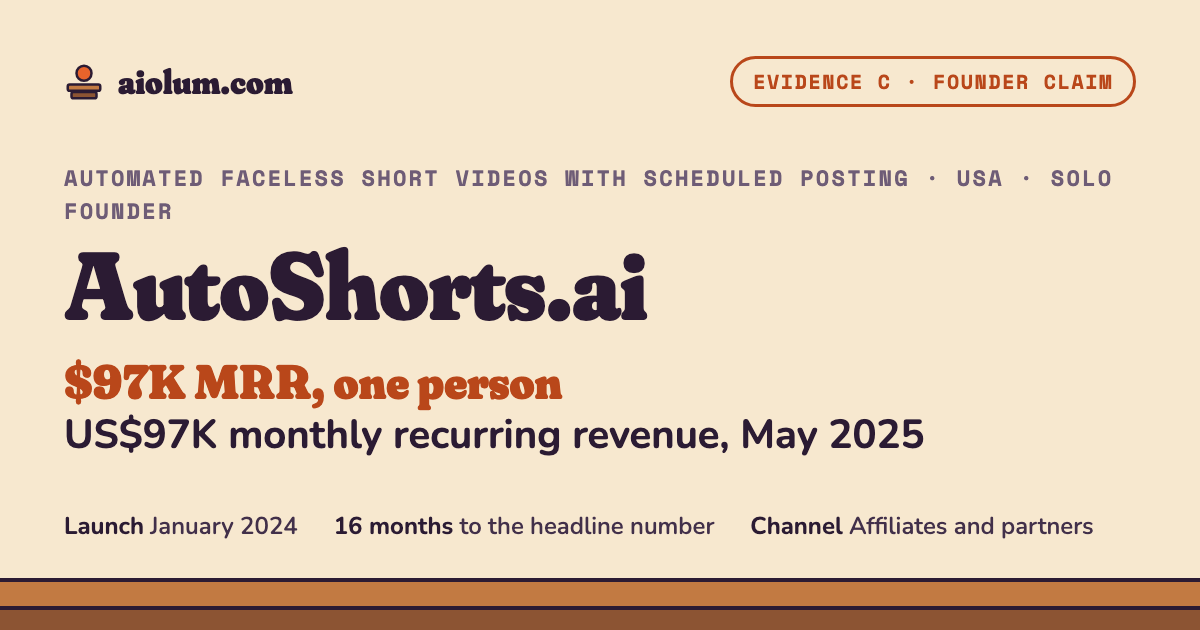
Eric Smith, a former Instagram software engineer in Florida who builds products alone, wrote that the idea came on 20 December 2023 and the first subscriber on 1 February 2024. He then posted his MRR on X at each step. MRR is monthly recurring revenue: the value of all active subscriptions for one month, where a yearly plan counts as one twelfth. It was US$1,000 on 28 February 2024, US$40,000 on 13 May and US$83,300 on 31 July 2024, which is US$1 million of ARR, annual recurring revenue, MRR times 12. After that the growth almost stopped: US$93,822 in September 2024 and US$97,452 in June 2025. Money collected in one month was higher, US$113,400 in November 2024 and US$138,000 in May 2025, because yearly plans are paid at once. He says he has no employees and no investors.
Every number on this page is a statement by the founder on X, several with images of his own Stripe dashboard: grade C. No payment processor, buyer or journalist has confirmed them. The article that led to this story reports "over $113,000 MRR"; the founder's post gives US$113,400 as the revenue of November 2024, not as MRR. The page also shows the rules of YouTube and TikTok that such videos must pass, and what happened to earlier companies that sold video without effort.
The numbers, graded
Each row shows the evidence grade and the source numbers from the list at the end of this page. The grades are explained in How Aiolum verifies.
| Fact | Value | Grade | How we know | Sources |
|---|---|---|---|---|
| Monthly recurring revenue, May 2025 | US$97,452 | C | Founder's post of 11 June 2025 on the results of May gives US$97,000, rounded. The Stripe dashboard image attached to the post, updated 11 June 2025, shows US$97,452.18. He took and posted the image himself. | [1] |
| Annual run rate from that MRR | about US$1.17 million a year | calc | Calculated: US$97,452.18 times 12 = US$1,169,426. This is the headline figure on this page. | [1] |
| Revenue collected in May 2025 | US$138,000 | C | Same post. The gross volume chart in the image peaks at US$138,300. It is higher than MRR because a yearly plan is paid at once, and he had made the yearly plan easier to see in May. The founder writes: "remember MRR != Revenue". | [1, 8] |
| Revenue collected in November 2024 | US$113,400 | C | Founder's post of 2 December 2024, which calls it a slight decline. A listicle of September 2025 reports this as over US$113,000 MRR and names no source. It is one month of revenue, not MRR. | [2, 13] |
| One month of revenue, costs and profit, posted 5 September 2024 | gross revenue US$112,928, MRR US$93,822, expenses US$44,069.59, profit US$68,858 | C | A table in an image posted by the founder. The post does not say which month the table covers. | [3] |
| Check of that cost table | the seven cost lines add up to US$50,969.59, not US$44,069.59 | calc | Calculated: 16,439.81 + 10,893 + 9,173.44 + 7,900 + 4,242.27 + 2,158.83 + 162.24. The difference is exactly US$6,900. With the sum of the lines, profit is US$61,958, which is 54.9% of revenue and not 61.0%. | [3] |
| Paid to AI model providers in that table | US$24,309 in the month, 21.5% of gross revenue | calc | Calculated: ElevenLabs text to speech US$10,893 + image generation US$9,173.44 + OpenAI US$4,242.27. | [3] |
| Marketing in that table | Facebook ads US$16,439.81 and affiliates US$7,900 | C | The founder calls marketing the biggest expense. The company's partner page offers affiliates a 30% recurring commission. | [3, 14] |
| MRR on 31 July 2024 | US$83,300, equal to US$1 million of ARR | C | Founder's post of 1 August 2024, with the words "completely solo and with no funding". | [4] |
| Time from the first subscriber to US$1 million of ARR | 181 days | calc | Calculated: 1 February 2024 to 31 July 2024. | [4] |
| MRR steps in 2024 | US$1,000 on 28 February, US$2,000 on 16 March, US$5,000 on 2 April, US$12,000 on 19 April, US$20,000 on 27 April, US$30,000 on 5 May, US$40,000 on 13 May, US$70,000 on 27 June, US$75,000 on 19 July | C | Founder's posts, most with a dashboard image. Indie Hackers and the eBiz Insider newsletter repeated these figures and did not measure them. | [4, 5, 11, 12] |
| MRR growth from September 2024 to June 2025 | 3.9% in nine months | calc | Calculated: from US$93,822 to US$97,452.18. | [1, 3] |
| Costs at US$40,000 MRR, May 2024 | about US$10,000 a month | C | Founder's reply of 17 May 2024: servers, AI models and Facebook ads. | [6] |
| Ad cost for one new customer, and the value of a customer | April 2024: about US$14 and about US$184. July 2024: US$20 and about 6 times that | C | Founder's posts of 21 April and 20 July 2024 about his Facebook ads. | [7] |
| Churn, July 2024 | about 23% | C | Founder's reply of 19 July 2024: "Churn is pretty bad, around 23%". He does not name the period. For monthly subscriptions the usual period is one month. | [7] |
| Cost of free users, September 2024 | about US$13,000 a month | C | Founder's post of 16 September 2024. In a test three days later, removing the free plan almost doubled conversions. | [7] |
| Volume | 600 videos a day in early April 2024; more than 2.5 million AI images in June 2024 | C | Founder's posts of 4 April and 14 July 2024. | [5, 7] |
| Team | 1 person | C | "Solo" in his posts through 11 June 2025, with 3 to 4 hours of work a day. On 1 April 2025 he wrote that he sometimes thinks about hiring. His X profile on 13 October 2026 still says "Solo indiehacker". | [1, 8, 9] |
| Outside funding | none | C | "No funding" on 1 August 2024 and "Bootstrapped" on 11 June 2025. | [1, 4] |
| MRR in the founder's X profile, read 13 October 2026 | US$117,000 | C | Profile text without a date. No post with this figure was found, so it is not the headline. | [9] |
| The founder's other products, November 2024 | NicheScraper US$24,400 and CopyGenius US$9,500 in the month | C | Same post as the AutoShorts figure. Both were larger earlier: NicheScraper came close to US$70,000 of MRR before March 2024, and CopyGenius lost US$30,000 of MRR. | [2, 7, 8] |
| Time from launch to the May 2025 figure | 16 months | calc | Calculated: January 2024 to May 2025. | [1, 12] |
How to read this table: a grade C value is a statement by the founder in a post on X, sometimes with an image of his own dashboard, or a statement by a site that repeats him. A "calc" value was computed on this page from the rows above it. No value is grade A or B.
| Plan | Per month, billed yearly (US$) | Per month, billed monthly (US$) | Limit |
|---|---|---|---|
| Free | 0 | 0 | videos carry a watermark; 1 video to try, per the founder and a reviewer |
| Starter | 15.83 | 19 | posts 3 times a week, 1 series |
| Daily | 32.50 | 39 | posts once a day, 1 series |
| Hardcore | 57.50 | 69 | posts twice a day, 1 series |
Each plan covers one series, which is one topic with its own posting schedule. A yearly plan costs 10 times the monthly price: US$190, US$390 or US$690 a year. Starter Story recorded the same three monthly prices in May 2024, so they did not change in 29 months. The plan records carry the creation dates 2 January 2024 for the monthly plans and 26 June 2024 for the yearly plans.
The timeline
From an idea in December 2023 to US$83,300 a month in recurring revenue by July 2024, then a plateau. Each entry carries its grade.
- January and February 2023CCopyGenius, his AI copywriting tool, goes from US$11,000 to US$14,000 of MRR in 11 days. A post of 13 February reports US$20,000 and credits Facebook ads without audience targeting. [9]
- 20 December 2023CThe idea is formed. He builds a first version for his own use. [5, 6]
- 2 January 2024CThe three monthly price plans are created in the site's database, at US$19, US$39 and US$69. [14]
- Late January to 1 February 2024CLaunch in the last week of January, according to Indie Hackers. His Stripe chart starts on 31 January. First subscriber on 1 February. [1, 5, 12]
- 25 March 2024CUS$3,000 MRR. A connection to YouTube, requested by customers, multiplies the conversion rate by 4 to 6. [7, 9]
- April 2024C600 videos a day force a rebuild of the rendering system. Facebook blocks his ads by mistake, so he asks affiliates to promote the product: MRR goes from US$6,000 on 14 April to US$12,000 on 19 April and US$20,000 on 27 April. [5, 9]
- 13 May 2024CUS$40,000 MRR, with costs of about US$10,000 a month. Customers who are YouTubers publish videos about the product without being asked. [5, 6]
- 27 June 2024CUS$70,000 MRR. He reports many copies of the product. Yearly plans are added on 26 June. [5, 14]
- 31 July 2024CUS$83,300 MRR, which is US$1 million of ARR, six months after the first subscriber, alone and without investors. [4]
- 5 September 2024CHe posts one month of accounts: gross revenue US$112,928, MRR US$93,822, profit US$68,858. Free users cost about US$13,000 a month. [3, 7]
- 2 December 2024CNovember revenue: US$113,400, a slight decline. He has reduced marketing and works on the code and on search traffic. [2]
- April and May 2025CHe considers hiring and stays alone. Making the yearly plan easier to see raises monthly revenue from US$100,000 to about US$135,000. [8]
- 11 June 2025CResults of May: US$138,000 of revenue, US$97,452 of MRR, 3 to 4 hours of work a day. This is the last dated figure found. [1]
- 15 July 2025CYouTube renames its rule on repetitious content to inauthentic content and states that it covers mass-produced videos, which cannot earn ad money. [17]
- 1 October 2025CHe writes that he has worked for some months on a new release for AutoShorts. This is the latest post about the product that could be read. The site's terms are updated on 15 October 2025. [8, 9, 14]
- 13 October 2026CThe site is online with the same prices. The founder's profile reads US$117,000 MRR, without a date. [9, 14, 15]
Why it worked
Four causes, in the order they mattered. Each one is a reusable lesson.
Customers who are also the sales channel
The buyers are people who publish videos, so they already have an audience. The founder pays them a 30% recurring commission and wrote that reaching US$1 million a year was largely because of affiliates. When Facebook blocked his ads by mistake in April 2024, he put more work into affiliates, and MRR doubled in five days. He also found that each announced feature made earlier affiliates publish a new video.
Paid ads with a measured return
He bought Facebook ads in the first two months and published the result: about US$14 to win a customer worth about US$184 in April 2024, and US$20 against about six times that in July 2024. He increased spending only while the return stayed positive. In the cost table of September 2024, ads are the largest line.
A trend, a tedious task, automation
His stated formula: find a trend, find a tedious task that people do by hand because of the trend, and automate it. In early 2024 a faceless video took one to two hours across ChatGPT, a stock footage site, ElevenLabs and a video editor. He says this was the third product he built this way, and that being early gave time to improve a first version that was not very good.
The product shows itself
He ran test channels made with AutoShorts and put the link in the video descriptions. Viewers who wanted the same kind of channel became customers. He also found that customers stay when one of their videos gets many views, and that the first week of posting decides whether a customer cancels.
Small changes with large effects
The YouTube connection multiplied conversions by 4 to 6. A test without the free plan almost doubled conversions and cut costs and support requests. Showing the yearly plan more clearly took about one hour and raised monthly revenue by about 35%, although that change moves future payments forward and does not raise MRR by the same amount.
How it was built
These details come from the founder's posts on X and from the code of the company's site. They are grade C. [3, 5, 6, 7, 8, 14]
- A Next.js web application. In May 2024 the founder named OpenAI and Replicate as the AI services. The cost table of September 2024 lists ElevenLabs for the voice, a provider for image generation, and OpenAI.
- He rents the image models from a provider and does not host them himself. He wrote that he would rather pay than carry that work.
- The first version took about six weeks: idea on 20 December 2023, first paying subscriber on 1 February 2024.
- At 600 videos a day in April 2024 the rendering system had to be rebuilt.
- In April 2025 he wrote that the application runs on one DigitalOcean server for US$96 a month with no load balancer. The September 2024 table shows US$2,158.83 for rendering and hosting servers together.
- Payments go through Stripe, as his dashboard images show.
- He answers support email and writes the code himself. Sales come from Facebook ads, affiliates, his own test channels and, since late 2024, search traffic.
Tools named in the sources
Each one opens its page in the Tools tab, with every story that uses it.
The dead that came before
Five companies in the Loot Drop database promised video or social media publishing without skill or staff. The values below are from that database and are not independently verified.
HighlightCam
The promiseAn algorithm that finds the best moments in raw footage and edits the video for you.
Why it diedPhones and consumer editing programs offered easier alternatives. Buyers adopted automatic editing slowly, and the company found no business model that could grow.
Fuzzwich
The promiseAnimated videos by drag and drop, with ready-made characters and scenes, for people without animation skill.
Why it diedIt did not grow beyond its early users and stayed on the desktop while viewers moved to phones and social media.
ReelSurfer
The promiseCut a short clip from any online video and share it, with no editing skill.
Why it diedYouTube and Facebook added clipping and sharing themselves, and mobile apps replaced the desktop tool.
ClearMix
The promiseProfessional marketing videos for companies, fast and at low cost, through a network of freelance videographers and editors.
Why it diedCanva and Adobe added video, and AI editing tools automated the manual work that ClearMix sold.
Argyle Social
The promiseOne tool for marketers to publish on social networks and connect the results to sales leads.
Why it diedLarger competitors with bigger marketing budgets took the market, and the product depended on the social platforms' APIs.
What changed
Each of the five sold easier video or easier publishing, and each lost when a larger company added the same function or when the manual work behind the service could be automated. ClearMix is the clearest case: the database says AI editing tools made its freelance process obsolete. AutoShorts stands on the other side of that change. It is one of the AI tools that removed the manual work.
What differs in 2024 is that every part can be rented per use. A language model writes the script, a speech model reads it, an image model draws the pictures, and one engineer joined them in about six weeks. The cost per video is low enough to sell about 60 videos a month for US$69. What does not differ is the dependence. The predecessors depended on platforms that could add their feature. AutoShorts depends on TikTok and YouTube to accept automated posts, and on three model providers for every video.
Can one person copy it now?
The method, yes. The same product, with care.
The method is repeatable and the founder says he used it three times: a trend, a manual task, automation, then ads and affiliates. The same product is harder now. The founder reports many copies since June 2024, and Faceless.video, already on this site, reported US$1 million of ARR for about August 2024 with a similar product built without code. His own recurring revenue was nearly flat from September 2024 to June 2025.
Where it is still open: Tasks that creators or small businesses still do by hand around a rising format, in a field where the buyers publish online themselves and can act as affiliates.
- 1Find a trend and a task that people repeat by hand because of it. Build the tool first for your own use.
- 2Charge from the first week. Test Facebook ads early, and raise the budget only while a customer is worth several times the ad cost.
- 3Pay customers a recurring commission, and ask first those who already publish to an audience.
- 4Run public accounts made with your own product and link the product in every description.
- 5Show the yearly plan clearly, and test whether the free plan helps or costs.
What to watch
The risks are the mirror image of the causes above.
Self-reported, and misquoted by others
All figures are the founder's posts and his own dashboard images. The listicle that led here turned one month of revenue, US$113,400, into MRR. His cost table of September 2024 does not add up: the lines sum to US$6,900 more than the stated total. TrustMRR, which verifies revenue through payment processors, answered "Not found" for three versions of the name on 13 October 2026; its profile AutoAIShorts is another product. Starter Story marks its page as estimated from public sources.
Recurring revenue stopped growing in late 2024
MRR was US$93,822 in September 2024 and US$97,452 in June 2025, a rise of 3.9% in nine months. The jump in revenue in May 2025 came from yearly plans paid at once. The last dated figure is from June 2025. The US$117,000 in his profile in October 2026 has no date and no post behind it.
YouTube does not pay for mass-produced videos
YouTube's monetization policy page, read 13 October 2026, says that since 15 July 2025 the rule once named "repetitious content" is named "inauthentic content" and covers content that is "repetitive or mass-produced". Its list of what cannot earn money includes AI-generated content made with generic templates that gives the impression of mass production, and image slideshows with little narrative. A second page requires creators to disclose realistic AI-generated content. A customer who buys AutoShorts to earn ad money from an automated channel is the case this rule describes.
TikTok limits automated posting
TikTok's Community Guidelines, effective 24 September 2026, require a label on AI-generated content that shows realistic scenes or people, list "Using automation to run many accounts or send repetitive content" as spam, and keep unoriginal or low-quality content out of the For You feed. Its developer rules allow about 15 posts a day per account through the posting API, keep posts from unaudited apps private, and say an app must not add its logo or watermark. An app can post publicly only after it passes TikTok's audit.
Every video is bought from three model providers
In the September 2024 table, ElevenLabs, an image generation provider and OpenAI together cost US$24,309, which is 21.5% of gross revenue. A price rise goes straight to the margin, and free users alone cost about US$13,000 a month. The same providers also sell products of their own: on 3 October 2024 the founder wrote that OpenAI had released a feature that did what the editor of his CopyGenius did, and did it better. In April 2025 he wrote that CopyGenius lost US$30,000 of MRR after ChatGPT appeared.
High churn, many copies, one person
The founder reported churn of about 23% in July 2024 and said the first week of posting decides whether a customer stays, which depends on platform algorithms that he does not control. An A/B test in September 2025 doubled churn instead of reducing it. Copies of the product have used his published tactics since mid-2024. Support, code and marketing all depend on one person who also runs other products.
Sources
The grade next to each source is the best grade that the source can support. "Read in full" means that the text of the page was downloaded and the numbers were checked in it.
- C X post by Eric Smith, 11 June 2025: the results of May 2025, revenue and MRRRead in full through the fxtwitter API, and viewed the attached Stripe dashboard image. Source for the headline MRR, the May revenue, the team and the funding.
- C X post by Eric Smith, 2 December 2024: how the businesses did in November 2024Read in full through the fxtwitter API. This is the origin of the figure in the listicle: US$113,400 of revenue for AutoShorts in November 2024, written as $113.4k.
- C X posts by Eric Smith, 4 and 5 September 2024: MRR back at US$93,000, and the monthly cost breakdownRead both posts in full through the fxtwitter API and viewed the cost table image. The sum of the cost lines was recalculated on this page.
- C X post by Eric Smith, 1 August 2024: US$83,300 of MRR alone, US$1 million of ARR on 31 JulyRead in full through the fxtwitter API.
- C X posts by Eric Smith, 18 March to 1 July 2024: MRR updates from US$2,000 to US$70,000Read seven posts in full through the fxtwitter API: 18 March, 4 April, 20 April, 28 April, 8 May, 16 May and 1 July 2024. Each repeats the dates of the earlier steps.
- C X replies by Eric Smith, 16 and 17 May 2024: growth channels, costs and technologyRead five replies in full through the fxtwitter API. Source for the US$10,000 of monthly costs, Next.js, OpenAI and Replicate, and the first version built for his own use.
- C X posts by Eric Smith, February to October 2024: the manual method, YouTube connection, ad returns, AI images, affiliates, churn, test channels, the free plan and OpenAIRead in full through the fxtwitter API: posts of 6 February, 22 and 25 March, 21 April, 14, 17, 19, 20 and 25 July, 12, 16 and 19 September, and 3 October 2024.
- C X posts by Eric Smith, 2025: his formula, hiring, CopyGenius, the single server, the yearly plan and a coming releaseRead in full through the fxtwitter API: posts of 1 January, 1, 16 and 21 April, 21 May and 1 October 2025.
- C X profile of Eric Smith, @ericsmith1302, and its embedded timeline, read 13 October 2026Read the profile through the fxtwitter API: 17,274 followers, location Florida, profile text that gives US$117,000 of MRR for AutoShorts. Read the public embedded timeline, which listed 100 posts from January 2023 to October 2025; no later post was visible. Source for the 2023 CopyGenius posts, the US$3,000 step and the September 2025 churn test.
- C Starter Story, 24 May 2024, changed 18 August 2026: How Eric Smith Grew AutoShorts.ai To $92K MRRRead the free part. The page is marked as estimated from public sources and embeds the founder's posts. Source for the May 2024 prices, one founder, and his earlier work at Instagram.
- C eBiz Insider newsletter by Niall Doherty, issue 383, May 2024: Zero to $40K/Month in Less Than 6 MonthsRead in full. It quotes the founder's posts and links them. The same issue carries a paid advertisement for AutoShorts.
- C Indie Hackers, 21 May 2024: Faceless short maker tool makes $30k MRR, by Rushab JainRead in full with the reader comments. A community summary of the founder's posts. Source for the launch in the last week of January 2024.
- C Sidetool, 26 September 2025: One-Person SaaS Success Stories: Real Revenue Numbers in 2025Read in full. The first source for this story. It reports over US$113,000 MRR without a source or a date, and adds product details, such as paid priority processing, that were not found in the founder's posts read for this page. No fact on this page relies on it.
- C AutoShorts.ai home page, partner page and terms, read 13 October 2026Read the home page and the plan data inside it. The other pages load by script, so their text was read from the script files. Source for the prices, the plan dates, the 30% commission, the Next.js framework and the terms dated 15 October 2025.
- C Internet Archive, list of captures of autoshorts.ai, January 2024 to August 2026Read the capture index only: a first capture on 4 January 2024 that redirects, then at least one capture in every month from May 2024 to August 2026, most of them working pages.
- C Argil, 6 April 2026, changed 2 October 2026: AutoShorts AI Review 2026: Features, Pricing, and Better AlternativesRead in full. Written by a competitor that sells an alternative. It confirms the US$19 plan, one series per plan and the free video in 2026.
- C YouTube Help: YouTube channel monetization policies, read 13 October 2026Read the sections on the 15 July 2025 update, on generic or repetitive content and on what is allowed to earn money. The platform's own rule page.
- C YouTube Help: Disclosing use of GenAI content, read 13 October 2026Read in full. The platform's own rule page.
- C TikTok Community Guidelines, Integrity and Authenticity, effective 24 September 2026The page loads by script; read the encoded text inside the page code. Sections on AI-generated content, spam and For You feed eligibility.
- C TikTok for Developers: Content Sharing Guidelines, read 13 October 2026Read in full. Source for the audit requirement, the private posts of unaudited apps, the posting cap and the watermark rule.
- C TrustMRR, searched 13 October 2026: no profile for AutoShorts.aiThe addresses for the slugs autoshorts, autoshorts-ai and autoshortsai answered "Not found". Read the markdown profile AutoAIShorts: it belongs to another site, autoaishorts.com. Listed only to prevent confusion.
- C Loot Drop database export, 1,749 failed startupsLocal export. AI-written summaries, not independently verified. Source for the failed predecessors.