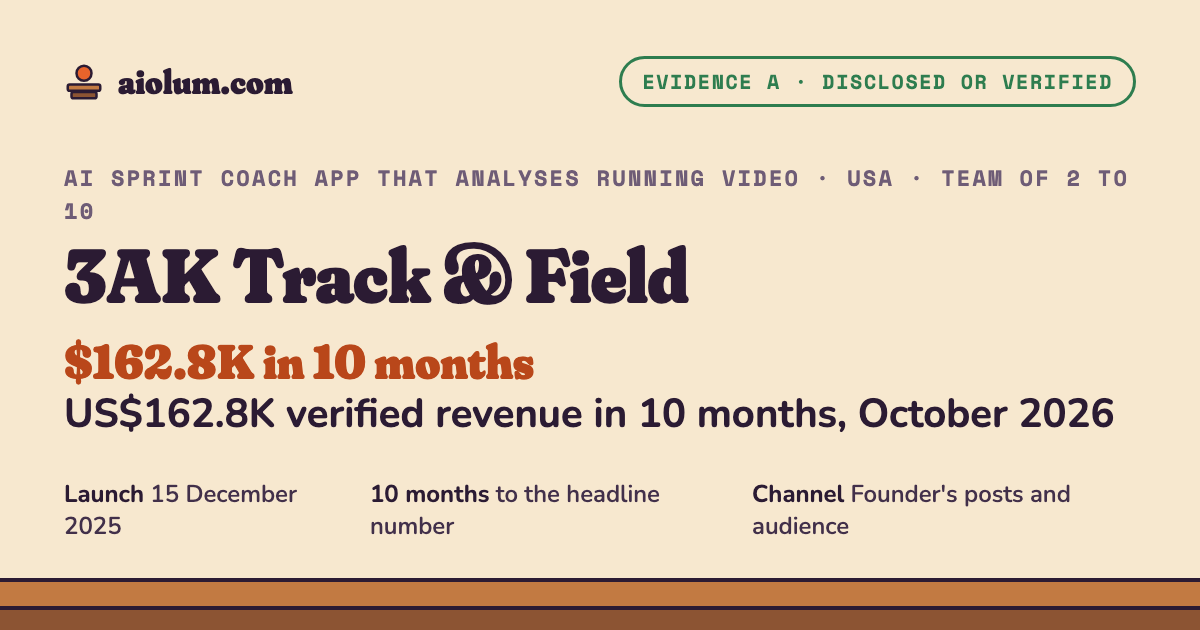
3AK Track & Field
3AK is an iPhone app that coaches sprinting. The user films a sprint and uploads the clip, and the app's stride analysis, a step-by-step reading of body position and timing from video, splits the run into phases (reaction, drive, acceleration, top-end, speed and finish) and says what to work on. It also has an AI coach to chat with, adaptive sprint plans, strength workouts and photo calorie logging, in which the user photographs a meal and the app estimates its calories and macros, the grams of protein, fat and carbohydrate. Every feature needs an App Store subscription. The app was made in Rork, a no-code AI app builder: a service that writes and publishes an app from instructions in plain language, so the makers write no code.
Braylin Byrd and Christian Rac, high-school teammates in Texas who now run track for Texas Tech and Texas Southern, had about 150,000 Instagram followers from their training videos, and daily messages asking for their training plan. The app reached the App Store on 15 December 2025, and they announced it to their followers in January 2026. By 12 October 2026 it had US$162,777 of verified sales, US$30,898 of them in the last 30 days, and monthly recurring revenue (MRR), the subscription income that repeats every month, of US$14,367 from 4,283 active subscriptions. Monthly revenue peaked at US$22,145 in March 2026, fell to US$11,330 in July and returned to US$21,652 in September.
The revenue figures are grade A. TrustMRR, a site that shows startups' revenue read directly from their payment accounts, and a second site, whatsthe.app, both read them from RevenueCat, a service that records App Store subscription payments for app makers. The founders' own figures, such as US$10,000 in the first month and the effect of a price cut, are grade C. The founders listed the app for sale in June 2026 at US$350,000. By 16 October 2026 the TrustMRR profile no longer loaded, and no source says that the app was sold, so this page treats it as running. The page also shows earlier companies that sold coaching or form feedback to athletes and lost to larger rivals.
The numbers, graded
Each row shows the evidence grade and the source numbers from the list at the end of this page. The grades are explained in How Aiolum verifies.
| Fact | Value | Grade | How we know | Sources |
|---|---|---|---|---|
| Verified revenue to 12 October 2026, all time | US$162,777 | A | TrustMRR, read from the app's RevenueCat account through an API key, synced 12 October 2026. The monthly table starts in December 2025, so the 12-month figure is the same. The profile does not say whether Apple's commission is already taken off. | [1] |
| Verified revenue, last 30 days to 12 October 2026 | US$30,898 | A | TrustMRR. Last 7 days: US$8,047. Last 3 months: US$55,992. Last 6 months: US$104,492. The profile gives growth of 109.8% over the 30 days before; calculated, those earlier 30 days brought about US$14,727. | [1] |
| Monthly recurring revenue (MRR), 12 October 2026 | US$14,367 from 4,283 active subscriptions | A | TrustMRR snapshot, up 27.0% in 30 days. Calculated: US$3.35 per subscription per month, and US$172,404 a year at that rate. | [1] |
| Revenue by month | US$2,555 in December 2025, US$22,145 in March 2026, US$11,330 in July 2026, US$21,652 in September 2026 | A | TrustMRR monthly table. Calculated: July was 49% below March; September was 1.91 times July and 1.71 times August (US$12,676). July to September brought US$45,658, 12% less than April to June (US$52,006). The first 12 days of October brought US$15,992. | [1] |
| Second tracker, 28 days to 30 September 2026 | US$21,344 of revenue, MRR of US$13,324, 3,817 active subscriptions | A | whatsthe.app, which says "All data is verified through RevenueCat". MRR growth over 28 days: 9.8%. Calculated: US$3.49 of MRR per subscription, close to TrustMRR's US$3.35. | [2] |
| First month, and the figure reported in March 2026 | US$10,000 in the first month, US$17,460 in the last 28 days | C | Rork's case study, 9 March 2026. It says the 28-day figure is "verified by RevenueCat" but shows no RevenueCat data, and its headline says US$19K a month. Rork sells the app builder. TrustMRR records US$11,887 for January and US$22,145 for March 2026. | [4, 1] |
| Fall reported for August 2026 | about US$9,500 to US$10,200 a month | C | AI Dev Cases, update of 25 September 2026, quoting TrustMRR (US$9,534 in the 30 days to 17 August) and whatsthe.app (MRR of US$10,218 in mid-August). It called the cause unconfirmed. Calculated: 45% and 42% below the US$17,460 that Rork reported in March. | [6] |
| Prices on the US App Store, 16 October 2026 | US$29.99, US$39.99 or US$49.99 a year; US$9.99 a month; US$6.99 or US$9.99 a week | B | In-app purchase list on the App Store page. The founders say they launched at US$59.99 a year and US$9.99 a month, cut the yearly price to US$29.99, and that conversions tripled. | [3, 4, 5] |
| What the subscription includes | AI stride and form analysis, AI coaching, workout programs, nutrition tracking, daily challenges, performance analytics | B | App Store description: "3AK requires a subscription to access all features". The meal photo returns calories and macros. AI Dev Cases writes that the AI form analysis and the AI coach carry the product value. | [3, 6] |
| App Store rating, 16 October 2026 | 4.8 from about 2,200 ratings in the US, number 118 in Sports | B | Shown as "2.2K Ratings". whatsthe.app counts about 2,300 ratings across all countries. Age rating 9+, marked as containing health or wellness topics. The description, written by the developer, says 50,000+ people train with it. | [3, 2] |
| Release on the App Store | 15 December 2025 | C | whatsthe.app gives this worldwide release date. TrustMRR's founded date is 16 December 2025, and its first month of sales is December 2025 (US$2,555). The founders, Rork and MRR Story say they launched in January 2026. | [2, 1, 4, 5] |
| Founders | Braylin Byrd and Christian Rac, Division I college track athletes at Texas Tech and Texas Southern | C | Rork, MRR Story and AI Dev Cases. They were teammates in high school and say they are 19 and 20 years old. The website shows Byrd as founder of 3AK; TrustMRR lists Rac as the founder and the seller. | [4, 5, 7, 1] |
| Team at the October 2026 figure | 2 co-founders and a third partner for 3AK Football; no employees reported | C | MRR Story, May 2026: a third co-founder, a football player at West Virginia, joined to lead 3AK Football. Its profile card shows 2 founders and 0 employees. No source mentions staff. | [5] |
| Company and App Store account | 3AKings LLC, Houston, Texas | B | The App Store names 3AKings LLC as the seller; the website footer gives Houston, TX. The developer account is in the name of an individual whose first name is Christian, and it also publishes 3AK Football and two other apps. The TrustMRR seller message is signed "Christian J". No source says whether the account name is Christian Rac's legal name. | [3, 7, 1] |
| Funding | none reported | C | No source mentions investors. MRR Story lists the costs as Rork subscriptions, Apple's developer fee of US$99 a year and Shopify at US$39 a month. | [5] |
| Audience before launch | 112,000 Instagram followers on Byrd's account and 42,500 on Rac's | C | Rork, 9 March 2026, repeated by AI Dev Cases in July 2026. Rork also shows Instagram growth from 20,000 to 110,000 followers in one year, without naming the account. Byrd's relay reel of 14 February 2026, with "3AK Method in App Store to get this fast" on screen, had about 118,300 likes. | [4, 6] |
| Paid advertising | Meta ads at US$50 to US$100 a day | C | Seller message on TrustMRR: "Only paid channel is Meta at $50–100/day". Calculated: US$1,500 to US$3,000 a month. MRR Story says no money went to ads at launch. The profile's profit margin of 80.0% is not among the metrics that it says are verified. | [1, 5] |
| Sale listing | US$350,000 asked, listed 19 June 2026 | C | TrustMRR copy of 12 October 2026: 16 offers received. whatsthe.app shows the price cut from US$500,000. Calculated: 0.94 times the last 30 days of revenue times 12, or 2.15 times all revenue so far. | [1, 2] |
| Shopify store of training programs | US$100 to US$200 a day | C | Rork and MRR Story. Separate from the app revenue above; no tracker shows it. Calculated: US$3,000 to US$6,000 a month. | [4, 5] |
| Time from store release to the October 2026 figure | 10 months | calc | Calculated: December 2025 to October 2026. | [2, 1] |
How to read this table: a grade A value was read from the app's RevenueCat account by TrustMRR or by whatsthe.app. A grade B value is a record that Apple shows on the App Store. A grade C value is a statement by the founders, by Rork, which sells the app builder, or by a site that compiles them. A "calc" value was computed on this page from the rows above it.
| Plan | Per month, billed yearly (US$) | Per month, billed monthly (US$) | Limit |
|---|---|---|---|
| Yearly, lowest listed | 2.50 | US$29.99 a year; all features | |
| Yearly | 3.33 | US$39.99 a year | |
| Yearly, highest listed | 4.17 | US$49.99 a year | |
| Monthly | 9.99 | all features | |
| Weekly | US$6.99 a week | ||
| Weekly Pro | US$9.99 a week |
The App Store lists ten in-app purchase entries, with three different yearly prices, and does not say which buyer sees which. AI Dev Cases reads this as A/B testing: showing different prices to different users to compare how many buy. Calculated: the weekly plans cost about US$30.29 and US$43.29 a month (the price times 52, divided by 12). The founders launched at US$59.99 a year and US$9.99 a month. A separate 3AK Shopify store sells training programs.
The timeline
From a training post in May 2025 to a for-sale listing in June 2026 and a recovery in the autumn. Each entry carries its grade.
- 14 May 2025CA training post called "Literal Cheat Code" on the 3AK Instagram account gets about 3,300 likes. Commenters ask to see the method. [4]
- Before December 2025CThe two founders find Rork and spend 8 to 10 hours a day learning it, with ChatGPT to help them debug. Neither can code. [4, 5]
- 15 December 2025CWorldwide release on the App Store. [2]
- December 2025AFirst verified sales: US$2,555. [1]
- January 2026ALaunch to their followers, with no paid ads by their account. TrustMRR records US$11,887 for the month; Rork reports US$10,000 in the first month. [1, 4, 5]
- 14 February 2026CByrd's relay reel with the app's name on screen gets about 118,300 likes and 549 comments. [4]
- March 2026AThe best month so far: US$22,145. On 9 March Rork publishes its case study with US$17,460 in 28 days. By then the yearly price has been cut from US$59.99 to US$29.99. [1, 4]
- 14 May 2026BVersion 4.1.0 adds live run tracking and an activity tab. In May, MRR Story reports a third co-founder and a second app, 3AK Football. [3, 5]
- 19 June 2026CListed for sale on TrustMRR at US$350,000. The seller writes that he is out of time and working on too many projects. [1]
- July 2026ARevenue falls to US$11,330, the lowest month since January. [1]
- 1 August 2026BVersion 5.8 adds a "General Health and Fitness path with sprint plans built for everyday athletes". By October the app is called 3AK Sprinting. [3, 1]
- September 2026ARevenue returns to US$21,652. On 25 September AI Dev Cases reports the August fall. [1, 6]
- 12 October 2026ALast TrustMRR sync: US$30,898 in 30 days, MRR of US$14,367, 4,283 active subscriptions. [1]
- 16 October 2026BThe live TrustMRR profile no longer loads. The App Store still shows the same seller and developer account, with version 6.7 released the day before. [3, 1]
Why it worked
Four causes, in the order they mattered. Each one is a reusable lesson.
Audience first
Byrd and Rac posted their own training and race results for years; Byrd cut his 100-metre time from 11.4 to 10.2 seconds in one year. By launch they had about 150,000 followers and daily messages asking for their training plan. The app answered those messages, so buyers were waiting on the first day, and the founders say the first paying customer came from a reply to a direct message.
Promotion inside normal posts
The launch reels were race footage with one line of text: "3AK Method in App Store to get this fast". One had about 118,300 likes. The seller writes that Meta ads at US$50 to US$100 a day are the only paid channel, and that influencers, videos by other creators, App Store search optimization and marketing outside the US were never tried.
Priced for teenagers
The founders say their buyers are high-school and college athletes aged about 15 to 22. They cut the yearly price from US$59.99 to US$29.99, about US$2.50 a month, and say conversions tripled. Calculated from TrustMRR, the average subscription now brings US$3.35 a month.
A niche the large apps leave open
The founders describe Strava and Nike Run Club as apps that track miles. 3AK reads a sprint start, the drive phase and top speed from a phone video, the questions that sprinters ask. In August 2026 it widened to everyday people who want to get fit by sprinting, and September revenue was 1.91 times July's.
How it was built
These details come from the founders, Rork, the TrustMRR profile and the App Store page. Only the App Store records are checked by Apple; the rest is grade C. [4, 5, 1, 3]
- Built entirely in Rork by two founders with no coding experience. The app's bundle ID, its internal name on the App Store, starts with app.rork.
- ChatGPT helped them debug when they were stuck.
- TrustMRR's tech stack, entered by the founder, lists SwiftUI, Apple's interface framework, for the app, Supabase for the backend database and RevenueCat for subscriptions.
- The AI features: stride analysis of an uploaded video in six phases, an AI coach in a chat, and meal photos turned into calories and macros. No source names the AI models behind them.
- The App Store page lists 25 versions between 4 April and 15 October 2026, most of them bug fixes. Reviews in February and March reported failed video uploads and unreadable coach messages.
- A Shopify store sells training programs as PDF files that promote the app, and the app promotes the store.
- Costs named by the founders: Rork subscriptions, Apple's US$99 a year and Shopify's US$39 a month, plus the Meta ads that the seller describes.
Tools named in the sources
Each one opens its page in the Tools tab, with every story that uses it.
The dead that came before
Four companies in the Loot Drop database sold coaching, form feedback or fitness tracking to active people and failed, all of them against larger competitors. The values below are from that database and are not independently verified.
Charge Running
The promiseLive running classes with a coach speaking in your headphones, as in a group class.
Why it diedThe database summary says AI fitness apps gave the same personal attention without fixed class times.
Enflux
The promiseClothing with sensors that tracked movement in 3D and gave real-time feedback on exercise form.
Why it diedHardware with high manufacturing costs, in a wearables market led by Fitbit and Apple.
Jawbone
The promiseUP fitness wristbands that turned daily activity data into health advice.
Why it diedLost to Fitbit and Apple after US$930 million of funding, product recalls and lawsuits.
Fitmob
The promiseLow-cost group workouts in many venues, with a community around them.
Why it diedClassPass won the studio partnerships while Fitmob spent about US$10 million organizing pop-up classes.
What changed
All four predecessors needed expensive things to deliver coaching or feedback: sensor clothing (Enflux), wristbands (Jawbone), live instructors on a schedule (Charge Running) or class venues (Fitmob). Each raised venture money, and each lost to a larger competitor. 3AK needs no hardware and no instructors: the analysis works on a video from the user's own phone, and the costs that the founders name are software subscriptions, Apple's fee and Meta ads of US$50 to US$100 a day.
The second difference is how customers arrived. The predecessors had to find their users; 3AK started with two athletes' Instagram audiences, which the founders built over years from their own training posts. The cause that ended all four, a larger competitor, is still present: Strava, which says it has more than 150 million registered users, agreed in April 2025 to buy Runna and its AI-powered training plans.
Can one person copy it now?
The method, yes, if you already have the audience.
The founders built the app without code, so the software is not the hard part. The hard part took years: about 150,000 followers who trusted two athletes because of their own race results, and who asked for the product before it existed. Without such an audience, the same app would have to buy its users with ads.
Where it is still open: Sports in which a phone camera can see the technique and young athletes follow athlete-creators: jumps, throws, swimming and pitching. 3AK Football and Wrestle AI already cover two other sports.
- 1Choose a sport you compete in, and post your own training and race results until people ask for your plan.
- 2Treat the questions people send you as the feature list.
- 3Build the app with a no-code builder, put the analysis and the coach behind a subscription, and show the app inside your normal posts.
- 4Price for the buyers you have: these founders halved the yearly price for high-school athletes.
What to watch
The risks are the mirror image of the causes above.
A summer fall, then a recovery
Revenue fell from US$22,145 in March to US$11,330 in July, and AI Dev Cases reported MRR near US$10,000 in August. September brought US$21,652, and the 30 days to 12 October brought US$30,898. The rise came after the 1 August update that opened the app to everyday fitness users; no source says that the update caused it.
For sale, and the TrustMRR profile is gone
The app has been listed since 19 June 2026 at US$350,000, cut from US$500,000 on whatsthe.app. By 16 October 2026 the live TrustMRR profile no longer loaded, and the Wayback Machine has no copy. No source says that the app was sold, and the App Store still shows the same seller and developer account. A buyer would not get the two Instagram accounts that bring most customers.
Strava and Runna
Strava announced on 17 April 2025 that it would buy Runna, a running-plan app that Tom's Guide calls an AI run coaching app. Strava's own AI feature, Athlete Intelligence, entered a beta test for subscribers in May 2024. Runna's plans target races such as 5K runs and marathons. Neither source mentions sprint video analysis, which either company could add.
Rork and unnamed AI models
The founders do not write code, so every update depends on Rork, its prices and its terms. The stride analysis and the coach use AI models that no source names, so this page cannot say what they cost or who could change them.
Another Rork coach on this site
Wrestle AI, a wrestling coach also built in Rork and promoted through a creator's audience, reported US$131,863 in total revenue by February 2026 in Rork's figures (grade C), while 3AK's figures come from RevenueCat through two trackers (grade A).
Statements that do not agree
MRR Story says no money went to ads at launch and that the founders tested videos by other creators; the seller message says Meta ads are the only paid channel and that such videos were never run. The founders say January 2026, while sales started in December 2025. The website says sprinting gives "More testosterone and growth hormone, naturally"; this page did not check that claim. Apple rates the app 9+, and the founders say most buyers are 15 to 22 years old.
Sources
The grade next to each source is the best grade that the source can support. "Read in full" means that the text of the page was downloaded and the numbers were checked in it.
- A TrustMRR profile of 3AK Track & Field, as read on 12 October 2026Read the markdown profile in full, from the copy that this site's pipeline saved; revenue synced 12 October 2026 from RevenueCat through an API key. The live profile no longer loaded on 16 October 2026, and the Wayback Machine has no copy. Revenue, MRR and subscription counts are grade A; the seller message, the asking price, the tech stack and the profit margin are written by the founder, grade C.
- A whatsthe.app listing of 3AKRead in full on 16 October 2026. Metrics "verified through RevenueCat", last updated 30 September 2026. Source for the second revenue reading, the release date and the price cut of the listing.
- B Apple App Store: 3AK SprintingRead in full on 16 October 2026. Source for the features, the subscription list, the age rating, the ratings, the seller, the developer account and the version history.
- C Rork blog, 9 March 2026: Two college athletes are making $19K/mo with an app they built in RorkRead in full. Written by Rork, which sells the app builder. Source for the founders, the first-month revenue, the 28-day figure, the Instagram audiences, the reels and the price cut.
- C MRR Story, May 2026: This No-Code Sports App Hit $45K in 2 MonthsRead in full. Written in the founders' voice; the page does not say whether they were interviewed. Source for the tools, the costs, the ages, the third co-founder and 3AK Football.
- C AI Dev Cases, 13 July 2026, updated 25 September 2026: How 3AK was built in RorkRead in full. A compiled case study. Source for the August 2026 fall that it read from two trackers and for the reading of the price list as A/B testing.
- C 3AK websiteRead in full on 16 October 2026. Source for the company name and city, the general-fitness message and Byrd's role as founder.
- A Strava press release, 17 April 2025: Strava to Acquire Runna, A Leading Running Training AppRead in full. The acquirer's own announcement; the user count is Strava's own figure. Source for the date and the 150+ million registered users.
- C Tom's Guide: Strava just bought the AI run coaching app RunnaRead the article. A reviewer's description of Runna's AI-powered training plans.
- C Strava press release, 16 May 2024, on Fitt Insider: Strava unveils new chapter of accelerated product developmentRead the press release. Source for Athlete Intelligence, Strava's AI feature in beta for subscribers.
- C Aiolum story: Wrestle AIRead the story file on this site for the one-sentence comparison. Its revenue figures come from Rork, grade C.
- C Loot Drop database export, failed startupsLocal export. AI-written summaries, not independently verified. Source for the failed predecessors.