CopyGenius
CopyGenius is an AI copywriting tool: a web app that writes marketing text, such as ads, product descriptions, blog outlines and emails, from a few details that the customer types in. Its terms page says that the text comes from GPT-3, a large language model from OpenAI, which is a program trained on a very large amount of text to predict the words that come next. The customer chooses one of more than 40 templates, fixed forms that turn the customer's details into an instruction for the model, and gets a draft in seconds. A second tool, the Genius Editor, analyzes the author's writing style and tone of voice and writes the next sentence or paragraph. Plans sell a number of words per month: 40,000 words for US$19, 120,000 words for US$39, and an Unlimited plan for US$79.
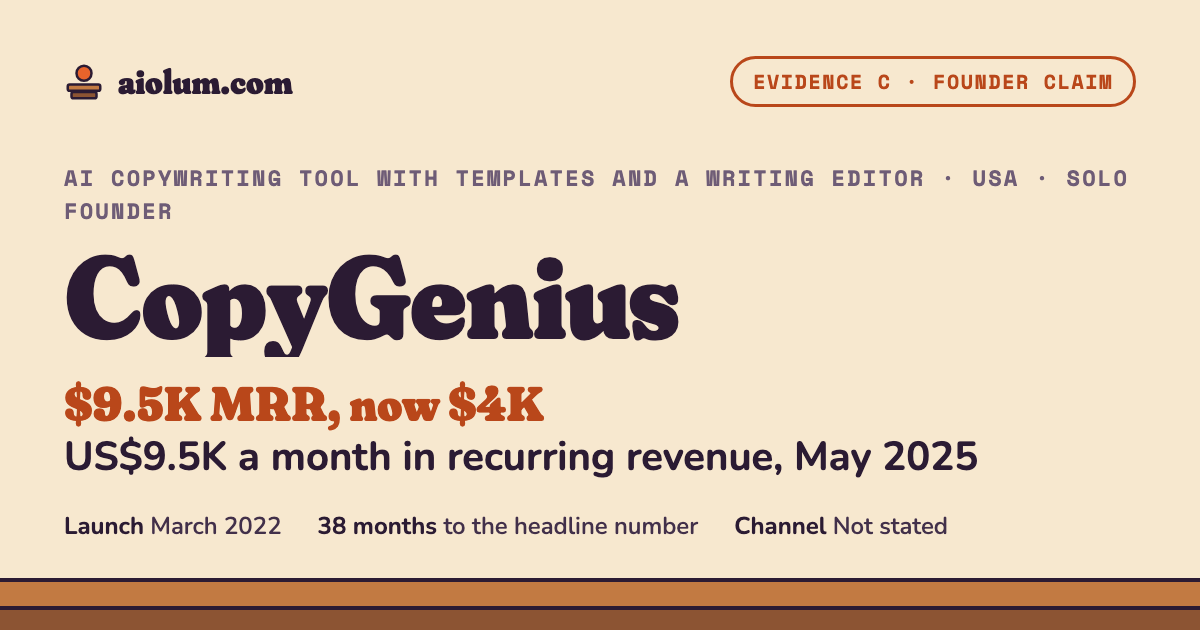
Eric Smith, a former Instagram software engineer in Florida who calls himself a solo indie hacker, started CopyGenius in March 2022; the oldest plan record in the site's data was created on 27 March 2022. A report by Gaps, last changed on 2 May 2025, gives US$9,500 of MRR, monthly recurring revenue: the value of all active subscriptions for one month. The same report says that MRR had earlier reached US$14,000, and gives no date for it. In September 2026 his profile on X, as the directory Arrfounder shows it, listed CopyGenius at US$4,000 of MRR, 71.4% below that best figure. The same founder later built AutoShorts.ai, which has its own story on this site.
Every number on this page is the founder's own profile text or a figure from a third-party site that does not name its source: grade C. No payment processor, buyer or journalist has confirmed them. The Gaps page is excluded from the Wayback Machine, so its older versions cannot be read to date the figures more exactly. The page also shows what happened to earlier writing tools when a larger company offered the same help inside a product that people already used.
The numbers, graded
Each row shows the evidence grade and the source numbers from the list at the end of this page. The grades are explained in How Aiolum verifies.
| Fact | Value | Grade | How we know | Sources |
|---|---|---|---|---|
| Monthly recurring revenue, by May 2025 | US$9,500 | C | Gaps, in a page first published on 6 May 2024 and last changed on 2 May 2025, writes that the business "is now achieving $9,500 in monthly recurring revenue". Other entries in the same version describe events up to about October 2024, so the figure dates from between about October 2024 and May 2025. Gaps does not name its source. This is the headline figure on this page. | [1] |
| Annual run rate from that MRR | US$114,000 a year | calc | Calculated: US$9,500 times 12 = US$114,000. | [1] |
| Highest monthly recurring revenue reported | US$14,000 | C | Same Gaps page: the figure "has previously reached $14,000 MRR". No date is given. | [1] |
| Fall from the highest figure to May 2025 | 32.1% | calc | Calculated: (US$14,000 minus US$9,500) divided by US$14,000. | [1] |
| Monthly recurring revenue, September 2026 | US$4,000 | C | The founder's profile text on X, as Arrfounder shows it in a record updated on 20 September 2026: "CopyGenius.io: $4K MRR". Arrfounder's product page gives the same US$4,000 a month and US$48,000 a year, collected with AI on 20 September 2026; Arrfounder does not mark the founder as verified. | [2, 3] |
| Fall from the highest figure to September 2026 | 71.4% | calc | Calculated: (US$14,000 minus US$4,000) divided by US$14,000. Against the May 2025 figure of US$9,500 the fall is 57.9%. | [1, 3] |
| Launch | March 2022 | C | Gaps: "founded in March 2022 by Eric Smith". The oldest plan record in the site's data, the Free plan, was created on 27 March 2022. The terms page gives 18 January 2022 as its last update. | [1, 4, 6] |
| Time from launch to the headline figure | 38 months | calc | Calculated: March 2022 to May 2025, the last change of the page that reports the figure. | [1] |
| Prices | US$19, US$39 and US$79 a month, or 10 times that a year | C | Plan data in the home page, read 16 October 2026, and the same records in a Wayback Machine copy of 25 February 2023. Gaps describes the same three paid tiers, from 40,000 words to unlimited. | [4, 5, 1] |
| AI model | GPT-3, from OpenAI | C | Terms page: "the A.I. model powering CopyGenius (GPT-3) is designed to write creatively, not necessarily factually". No source says whether it later moved to a newer model. | [6] |
| Usage limits | a hard monthly word cap and 3 requests every 10 seconds | C | FAQ: the word limit resets each month and unused words do not roll over; refill credits can be bought; "All plans have a rate limit of 3 queries every 10 seconds". | [4] |
| Payment providers in the site code | Stripe, PayPal and Shopify | C | The site's script lists these three as subscription providers. The plan records carry PayPal plan identifiers. | [4] |
| Affiliate commission | 30% of every payment, recurring, with no cap | C | Partners page, read 16 October 2026. It invites affiliates with the words "Ready to start making passive income?" | [4] |
| Shopify app, October 2026 | not available in the Shopify App Store | C | The App Store page for CopyGenius says: "This app is not currently available on the Shopify App Store." The site still has a Shopify login page. | [7, 4] |
| Team | 1 founder | C | Gaps names one founder. His profile text on X, as Arrfounder shows it, begins "Solo indiehacker (Ex-Instagram Eng)". No source mentions an employee. | [1, 3] |
| Outside funding | none reported | C | No source mentions an investor. The terms page names no company, only the product. | [1, 6] |
| The founder's products, September 2026 | AutoShorts.ai US$117,000, NicheScraper US$11,000 and CopyGenius US$4,000 of MRR | C | His profile text as Arrfounder shows it. It also lists a project named ProjectX at US$20,000 a month, which this page could not identify. | [3] |
How to read this table: a grade C value is the founder's own profile text, a figure from a third-party site that does not name its source, or a reading of the company's own pages. A "calc" value was computed on this page from the rows above it. No value is grade A or B.
| Plan | Per month, billed yearly (US$) | Per month, billed monthly (US$) | Limit |
|---|---|---|---|
| Free | 0 | 0 | 500 words once, to try |
| Starter | 15.83 | 19 | 40,000 words a month |
| Premium | 32.50 | 39 | 120,000 words a month |
| Unlimited | 65.83 | 79 | sold as unlimited; the plan record sets 8,000,000 words a month |
The address copygenius.io/pricing returns an error page; the plans are in the data of the home page. A yearly plan costs 10 times the monthly price: US$190, US$390 or US$790 a year, which is 16.7% less than 12 monthly payments. Words that are not used do not carry over to the next month, and a customer can buy one-time refill credits. A Wayback Machine copy of the home page from 25 February 2023 holds the same nine plan records with the same prices, so the prices did not change between February 2023 and October 2026. The data also holds an older Starter plan at US$5 a month or US$50 a year for 5,000 words, created in April and August 2022; its monthly record allows use through Shopify and not on the web.
The timeline
From a template tool on GPT-3, eight months before ChatGPT, to a product that its founder listed at US$4,000 a month in 2026. Each entry carries its grade.
- 18 January 2022CThe CopyGenius terms page gives this date as its last update, two months before the first plan record. [6]
- 27 March 2022CThe Free plan record, 500 words to try, is created. Gaps gives March 2022 as the founding month. [4, 1]
- 21 April to 24 August 2022CPaid plans are added: a Starter plan at US$5 a month in April, Unlimited at US$79 in May, and the present Starter at US$19 and Premium at US$39 on 24 August. [4]
- 30 November 2022COpenAI releases ChatGPT. It gains one million users in five days and 100 million in two months. [8]
- 1 February 2023COpenAI announces ChatGPT Plus at US$20 a month and says it will keep free access to ChatGPT. [9]
- 25 February 2023CA Wayback Machine copy of the CopyGenius home page shows the same nine plan records and prices as in 2026. [5]
- Not dated, before May 2025CMonthly recurring revenue reaches its highest reported level, US$14,000. [1]
- 6 May 2024 to 2 May 2025CGaps publishes a report on AI content startups. The version last changed on 2 May 2025 lists CopyGenius sixth, at US$9,500 of MRR. [1]
- 20 September 2026CArrfounder's latest update shows the founder's profile listing CopyGenius at US$4,000 of MRR. [2, 3]
- 16 October 2026CThe site still sells the same plans. Its Shopify app is no longer available in the Shopify App Store. [4, 7]
Why it worked
Four causes, in the order they mattered. Each one is a reusable lesson.
Templates instead of instructions
The customer does not write an instruction for the model. For an ad or a product description, a template asks for a few details and builds the request itself, and the draft arrives in seconds in more than 100 languages. Until 30 November 2022 there was no ChatGPT, so this was the easy way to get text from GPT-3.
Words sold as a monthly allowance
Each plan is a hard cap of words per month that resets at renewal, with refill credits for more. The FAQ promises that the customer is never billed above the plan price, and the cap also puts an upper limit on the model cost of each customer.
An editor that continues the author's text
The Genius Editor is a text editor with the model built in. The site says it analyzes the author's writing style and tone of voice to write the next sentence or paragraph. It is the part of the product that is closest to what a general chatbot does.
Several small sales channels
The checkout code reports each purchase to a Google Ads account as a conversion, so the business measured paid search ads. Affiliates earn 30% of every payment for as long as the customer stays. A Shopify app sold the tool to shop owners until it left the App Store. No source says which channel brought most customers.
How it was built
These details come from the company's own pages and the code that they send to the browser. They are grade C. [4, 6]
- A Next.js web app: the pages load from /_next/ paths and carry their plan data as JSON inside the page.
- Text from OpenAI's GPT-3, per the terms page. The FAQ says that the model was trained on roughly 10% of the published internet and that names, citations and emails in its output are generally filler made up by the model.
- Payments through Stripe and PayPal, and through Shopify for the Shopify app; the code lists all three as subscription providers.
- The route list of the site includes an affiliate dashboard and admin pages for affiliates, events and user costs.
- The route list also includes a Chrome sign-in page and a Shopify login page; this page found no Chrome Web Store listing.
- A Google Ads conversion tag in the checkout code.
Tools named in the sources
Each one opens its page in the Tools tab, with every story that uses it.
The dead that came before
Three companies in the Loot Drop database sold a better tool for writers and lost to a larger company that offered the same help inside a bigger product. The values below are from that database and are not independently verified.
Draft
The promiseA simple cloud editor for writers, with version control and collaborative editing.
Why it diedGoogle Docs made it redundant. Its narrow focus and free tier could not compete with Google's full set of office tools.
WriteWith
The promiseGroup writing in the browser, with several authors on one document.
Why it diedGoogle Docs offered the same core function with better integration, and WriteWith had too little money to keep going.
Taleship
The promiseA shared writing space for novelists, with real-time co-authoring.
Why it diedIt spread its work over too many features and could not stand out among the free tools that writers already had.
What changed
The three predecessors sold a better place to write, and each lost to a large company that offered the same help inside a product that people already used, at no extra price. CopyGenius sold the next step, a tool that writes the text itself, and the same thing happened to it faster: ChatGPT appeared eight months after CopyGenius launched and gained 100 million users in two months.
What differs is the cost. The predecessors needed years and, in two cases, outside money. CopyGenius needed one engineer, a web app and an account with a model provider, and its founder still listed it at US$4,000 a month in 2026. A template product on top of a model costs little to build and run, so it can stay profitable at a small size, but nothing in it stops the model maker from offering the same function to everyone.
Can one person copy it now?
The product, no. Being early on a new model, yes, for a short time.
A general template tool for marketing text is now a free feature of the large chatbots, and the figures on this page show the fall. What can still be copied is the timing and the pricing: a paid tool for one job on a new model, sold in the months before the model maker offers the same thing to everyone, with usage sold as a capped monthly allowance.
Where it is still open: Jobs that a general chatbot does badly because they need the customer's own data or a direct connection to a platform, for example text that is published straight into a shop, an ad account or a store listing.
- 1When a new model becomes available through an API, ship a narrow tool for one job in its first months, and charge from the first day.
- 2Sell usage as a capped allowance, so the model cost of each customer has an upper limit.
- 3Add a channel inside a platform where the buyers already are, such as an app store for shop owners.
- 4Expect the model maker to release the same function, and build the next product before revenue falls.
What to watch
The risks are the mirror image of the causes above.
General chatbots write the same texts
OpenAI released ChatGPT on 30 November 2022 and runs it on a freemium model, which means basic use is free and a paid plan adds more. It gained 100 million users in two months and had 900 million weekly active users in February 2026, per Wikipedia. OpenAI announced ChatGPT Plus on 1 February 2023 at a flat US$20 a month, about the price of the CopyGenius Starter plan, which is capped at 40,000 words.
Many tools at the same price
In the same Gaps report, Magai sells access to ChatGPT, Gemini and other AI services in one subscription from US$19 a month for up to 50,000 words, against 40,000 words for US$19 at CopyGenius. OpenAI priced gpt-3.5-turbo, the model of ChatGPT, at US$0.002 per 1,000 tokens, the pieces of words that models count, 10 times cheaper than its earlier GPT-3.5 models; that lowered the cost of text for every rival at once. CopyGenius kept the prices it had in February 2023.
Two earlier copywriting stories on this site
Headlime was sold for seven figures in March 2021 and Rytr was sold in October 2022 after a run rate of US$1 million a year, both before ChatGPT was released, while CopyGenius launched in March 2022 and stayed with its founder as its revenue fell.
One model provider that is also a competitor
The terms page names GPT-3 as the model behind the product, and no source says whether it moved to a newer model or to another provider. OpenAI sets the price and the rules of the model, and it also sells ChatGPT to the same customers.
Self-reported and partly undated
Gaps gives no date for the US$14,000 figure and no source for either of its figures, and its page is excluded from the Wayback Machine. The 2026 figure is the founder's profile text as Arrfounder collects it with AI, and Arrfounder does not mark him as verified.
A Shopify channel that ended
The Shopify App Store no longer lists the CopyGenius app, and an old plan in the site's data was for Shopify use only. No source says when or why the app left the store.
Sources
The grade next to each source is the best grade that the source can support. "Read in full" means that the text of the page was downloaded and the numbers were checked in it.
- C Gaps, 6 May 2024, changed 2 May 2025: 17 AI Content Startups (With 2025 Revenue Numbers)Read in full. Entry #6 is CopyGenius. Source for the founder, the founding month, the templates, the three paid tiers and the US$9,500 and US$14,000 figures, and for Magai's price. The page is excluded from the Wayback Machine, so earlier versions could not be read.
- C Arrfounder product page: CopyGenius, record updated 20 September 2026Read in full, with the record data inside the page: MRR 4,000, ARR 48,000, source "ai", collected 20 September 2026, founder not verified.
- C Arrfounder founder page: Eric Smith (@ericsmith1302), record updated 20 September 2026Read in full. It shows the founder's X profile text, his location in Florida and four products. Source for the 2026 figure, the solo founder, and the link between CopyGenius and AutoShorts.ai.
- C CopyGenius home page with its FAQ, partners and editor sections, read 16 October 2026The pages build their text with scripts. Read the plan data inside the home page and the text in the site's script files for the home, FAQ and partners pages and its route list. The /pricing address returned an error page.
- C Wayback Machine copy of the CopyGenius home page, 25 February 2023Read the plan data inside the page: the same nine plan records and prices as in October 2026.
- C CopyGenius Terms & Conditions, last updated 18 January 2022The page builds its text with a script; read the text in that script file. Source for GPT-3 as the model. It names no company.
- C Shopify App Store page for CopyGenius, read 16 October 2026Read in full. It says that the app is not currently available on the Shopify App Store.
- C Wikipedia: ChatGPT, read 16 October 2026Read the sections on release and users: released 30 November 2022, run on a freemium model, one million users in five days, 100 million in two months, 900 million weekly active users in February 2026.
- C OpenAI, 1 February 2023: Introducing ChatGPT PlusRead in full. Source for the US$20 monthly price and the promise to keep free access.
- C OpenAI: Introducing ChatGPT and Whisper APIsRead in full. The downloaded copy shows no date. Source for the price of gpt-3.5-turbo.
- C Starter Story: How Eric Smith Grew AutoShorts.ai To $92K MRRRead the free part. It does not mention CopyGenius. Source that Eric Smith founded AutoShorts.ai and worked as a software engineer at Instagram, which matches the profile text in source 3.
- C Loot Drop database export, 1,749 failed startupsLocal export. AI-written summaries, not independently verified. Source for the failed predecessors.