traxy
traxy is a lead generation tool, software that finds people who may buy and gets their contact details, for B2B sales teams. It works on LinkedIn only. A customer adds LinkedIn profiles to a watchlist, a list of accounts to follow: their own, their competitors', well-known voices in their market. When someone likes, comments on or reposts a post from those profiles, traxy scores that person from 1% to 100% against the customer's ICP, the ideal customer profile, a description of the buyer by job title, seniority, company size and industry. People above a threshold become leads. For extra credits, prepaid units that each action costs, it adds the lead's email and phone number. An AI "Outbound Agent" can research each lead and write the first message. Plans start at US$149 a month.
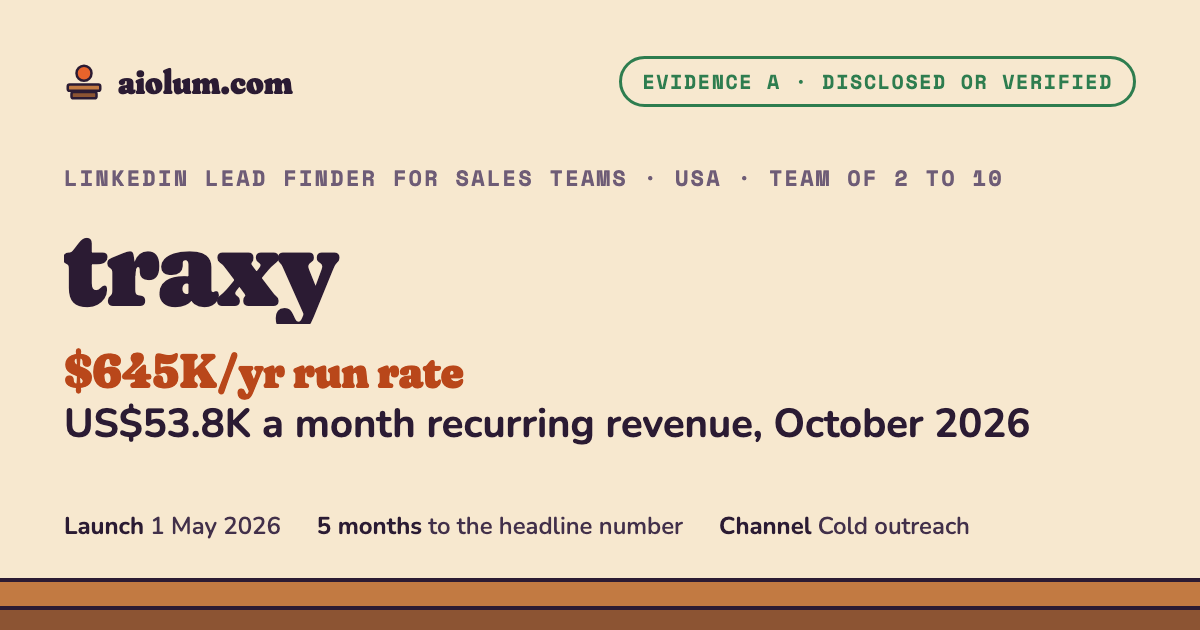
Ben Buaron, a founder in New York who also runs Windmill Growth, a LinkedIn ghostwriting agency, launched traxy on 1 May 2026, after the first Stripe payments in March. By his posts, MRR, monthly recurring revenue, the subscription money that comes in every month, reached US$10,000 on 17 July, US$20,000 on 28 August and US$30,000 on 11 September 2026. On 23 September he connected Stripe to TrustMRR, a site that reads revenue directly from a company's payment processor, and it showed US$40,000. On 15 October 2026 it shows US$53,752 of MRR from 243 active subscriptions and US$58,301 of revenue in the last 30 days: a run rate of about US$645,000 a year, five months after launch. By the founder's account, most customers came from outreach to leads that traxy itself found, and many trials from his posts on X.
The revenue, MRR and subscription figures are grade A, because TrustMRR reads them from Stripe. Everything else, including the team size and how the product collects its data, comes from the founder's posts and the company's own pages, grade C. The largest risk is the data source. LinkedIn's User Agreement forbids software that scrapes, which means collects automatically by a program, profiles and other data from LinkedIn. traxy says it needs no LinkedIn login and does not say how it collects the engagement; its home page quotes customers who call it scraping. The page also shows what happened to earlier companies that sold sales data or depended on another company's platform.
The numbers, graded
Each row shows the evidence grade and the source numbers from the list at the end of this page. The grades are explained in How Aiolum verifies.
| Fact | Value | Grade | How we know | Sources |
|---|---|---|---|---|
| Monthly recurring revenue (MRR), 15 October 2026 | US$53,752 | A | TrustMRR, read from Stripe through an API key; revenue last synced on 15 October 2026. MRR growth in the last 30 days: +42.7%. | [1] |
| Run rate from that MRR | about US$645,000 a year | calc | Calculated: US$53,752 times 12 is US$645,024. The founder rounds it down to "$500k arr" in his post of 5 October 2026. | [1, 3] |
| Revenue in the last 30 days, to 15 October 2026 | US$58,301 | A | TrustMRR. 77.6% more than in the 30 days before. | [1] |
| Revenue by calendar month, 2026 | March US$545, April US$3,436, May US$5,761, June US$10,182, July US$11,955, August US$21,415, September US$45,007 | A | TrustMRR monthly table. October up to the 14th: US$32,392. | [1] |
| September revenue compared with August | 2.1 times | calc | Calculated: US$45,007 divided by US$21,415. | [1] |
| All-time revenue to 15 October 2026 | US$130,693 | A | TrustMRR. The same as the last twelve months: all of it is from 2026. | [1] |
| Active subscriptions, 15 October 2026 | 243 | A | TrustMRR. There were 177 on 23 September 2026. | [1, 2] |
| Average MRR per active subscription | about US$221 a month | calc | Calculated: US$53,752 divided by 243. The cheapest plan costs US$149 a month, so many customers pay for larger plans or the done-for-you service. | [1, 22] |
| MRR on 23 September 2026 | US$40,000 a month | A | TrustMRR's post on X when the profile was connected: US$41,000 of revenue in 30 days, US$88,000 in total, 177 active subscriptions. | [2] |
| MRR steps reported by the founder | US$10,000 on 17 July, US$20,000 on 28 August, US$30,000 on 11 September 2026 | C | Founder's post of 11 September 2026: 77, 42 and 14 days for the three steps, counted from 1 May. | [4] |
| MRR on 3 August and 31 August 2026 | US$13,500 and US$20,600 | C | Founder's posts. On 31 August he also listed 78 active trials and 68 booked demos. | [6, 7] |
| Paying users | 80 on 12 August, 100 on 21 August 2026 | C | Founder's posts. The home page says "1,000+" teams use traxy, which counts sign-ups; Stripe shows 243 active subscriptions in October. | [5, 19, 23, 1] |
| traxy's share of the founder's income | US$22,000 of US$142,210 in August, US$47,000 of US$166,342 in September 2026 | C | Founder's monthly income posts. The rest, US$120,000 and US$119,000, came from Windmill Growth, his ghostwriting agency, which manages more than 150 LinkedIn profiles. TrustMRR shows US$21,415 and US$45,007 for traxy in those months. | [9, 8, 1, 40, 41] |
| Team | 2 to 5 people | C | The founder's entry on TrustMRR. His posts mention a head of go-to-market (3 August 2026), a first customer-support hire (13 August) and "our lean team" (14 October). His agency, a separate company, has 4 full-time writers. | [1, 6, 14, 15, 3] |
| Outside funding | about 7 angel investors by 13 September 2026, amounts not stated | C | Founder's posts. On 23 September he mentioned a "mini pre-seed round". He wrote that from then on only clients may invest. The TrustMRR entry says bootstrapped. | [12, 13, 11, 1] |
| Legal entity | traxy, inc., 54 Spring St, New York | C | Privacy policy and terms of service. New York law governs the terms. | [25, 24] |
| Founded and launched | founded 30 January 2026, launched 1 May 2026 | C | Founded date from the TrustMRR entry, launch date from the founder. Stripe shows US$545 of revenue in March 2026, before the public launch. | [1, 5] |
| Time from launch to the October 2026 figure | 5 months | calc | Calculated: May 2026 to October 2026. | [1, 5] |
How to read this table: a grade A value is read from Stripe by TrustMRR. A grade C value is a founder post on X or a statement on the company's own pages. A "calc" value was computed on this page from the rows above it.
| Plan | Per month, billed yearly (US$) | Per month, billed monthly (US$) | Limit |
|---|---|---|---|
| Pro | 119 | 149 | 5,000 credits a month |
| Scale, smallest size | 239 | 299 | 15,000 credits a month, automated sending |
| Scale, largest size | 879 | 1,099 | 100,000 credits a month |
| DFY Outbound (done for you) | 1,099 | 3-month minimum; traxy's team runs the outbound | |
| Enterprise and Agencies | custom | custom | custom volume; agencies get 30% off each client account |
Prices follow the monthly credit volume. One credit qualifies one engagement against the ICP; an email costs 3 credits and a phone number 5, charged only when found. Credits reset every month with no rollover. 15,000 credits and more add automated sending; 30,000 and more add the Outbound Agent and its onboarding. The 30,000, 50,000 and 75,000-credit sizes load their prices by script and could not be read. A Design Partner pays 50% of a Pro or Scale plan in return for two posts a month about traxy on LinkedIn or X. Every plan starts with a 7-day free trial.
The timeline
From a placeholder domain to US$53,752 of monthly recurring revenue, five months after launch. Each entry carries its grade.
- 28 January 2026Ctraxy.ai shows a placeholder page: "AI Solutions for Tomorrow" and a contact form. [26]
- 30 January 2026CFounded date in the TrustMRR entry. [1]
- March to April 2026AFirst Stripe revenue before the public launch: US$545 in March and US$3,436 in April. [1]
- 1 May 2026CPublic launch, by the founder's account. [5]
- 19 May 2026CThe archived home page sells "LinkedIn Engagement into Qualified Pipeline" with three plans, Lite, Pro and Scale, at US$63, US$119 and US$239 a month for 2, 5 and 15 monitored profiles. [27]
- 17 July 2026CUS$10,000 of MRR, 77 days after launch. [4]
- 3 August 2026CUS$13,500 of MRR. The founder promises his head of go-to-market a Rolex watch for US$100,000 of MRR by the end of September. [6]
- 12 August 2026C80 paying users and 5 to 7 trials a day. He asks his followers how to scale a self-serve product. [5]
- 13 August 2026CFirst customer-support hire. [14]
- 21 August 2026C100 paying users. [19]
- 26 to 29 August 2026CA done-for-you outbound service is offered at US$499 a month for up to 3 senders. One post on X brings 20 times the usual daily sign-ups, and the app crashes. [20, 10]
- 31 August 2026CUS$20,600 of MRR, 78 active trials and 68 booked demos. traxy made US$22,000 of the founder's US$142,210 income in August. [7, 9]
- 11 September 2026CUS$30,000 of MRR, 14 days after US$20,000. [4]
- 13 September 2026CAbout 7 angel investors so far, all found through X. From now on only clients may invest. [12]
- 23 September 2026AStripe connected to TrustMRR: US$40,000 of MRR, 177 active subscriptions, US$88,000 of total revenue. [2]
- 1 October 2026CSeptember income: US$47,000 from traxy and US$119,000 from Windmill Growth. [8]
- 5 October 2026C"5 months after launching traxy hit $500k arr." Goal: US$1 million by 31 December. He also writes about bugs and churn. [3]
- 15 October 2026AUS$53,752 of MRR, 243 active subscriptions and US$58,301 of revenue in the last 30 days, all verified from Stripe. The done-for-you service now costs US$1,099 a month. [1, 22]
Why it worked
Four causes, in the order they mattered. Each one is a reusable lesson.
Engagement is the signal
A like or comment on a relevant post shows that a person is active on LinkedIn and interested in the topic now. traxy re-checks the engagement on each watched post every 2 hours, scores each person who engaged with "a model weighing 30+ variables", and keeps only the ones who fit the customer's ICP. The FAQ advises watching competitors, investors, employees and well-known voices in the market, because their audience overlaps with the buyer.
The product finds its own customers
The founder sells traxy with traxy. On 10 September 2026 he wrote that the stack of traxy for leads, Claude for research, HeyReach for LinkedIn messages and Smartlead or Instantly for email "took us to $25k MRR in 4 months". His posts on X add to it: on 30 August he wrote that two months of posting had brought 3 angel investors, 95 trials and around US$8,000 of MRR.
Credits instead of seats
Each engagement that traxy checks costs 1 credit, an email 3 credits and a phone number 5. So a customer who watches busy profiles pays more, and larger sizes add automated sending and the Outbound Agent. The average active subscription pays about US$221 a month, well above the US$149 entry price.
An agency as the first user and a sales channel
The founder runs Windmill Growth, a ghostwriting agency with 4 full-time writers, and uses traxy for his own companies. On 22 August 2026 he wrote that he uses only traxy to find leads for two companies, had canceled Sales Navigator, Apollo and ZoomInfo, US$1,700 a month, for traxy at US$499 a month, and had booked 79 meetings from traxy alone. Other agencies resell it: they get 30% off each client account, and traxy's own team runs outbound for customers who pay for the done-for-you service.
How it was built
These details come from the company's FAQ, terms and pricing pages and from the founder's posts. They are grade C. [21, 24, 22, 16, 38, 39, 1]
- LinkedIn is the only data source. The FAQ says setup takes 60 seconds: paste a LinkedIn profile URL, and "No account authentication on LinkedIn is required". Engagement on watched posts is re-checked every 2 hours. The site does not say how the engagement is collected.
- The terms describe the service as software that analyzes LinkedIn engagement, builds a LinkedIn feed for the customer's ICP and runs "automated and semi-automated LinkedIn outreach", partly with technology licensed from third parties that act as subprocessors.
- Each person who engages gets an ICP fit score from "a model weighing 30+ variables": job title, seniority, company size, industry, growth stage and behavior. No source names the AI model or the model provider inside the product.
- An MCP server lets customers ask their own AI assistant, such as Claude, Codex or Cursor, for their leads after a one-time OAuth login. MCP, the Model Context Protocol, is a standard way for an AI assistant to call an outside service.
- Integrations: Slack, Zapier, Clay, HeyReach, Meta Ads, webhooks and CSV export. Payments run through Stripe.
- The founder writes code with OpenAI's Codex agent, for example asking it for a QA plan with 50 edge cases for the team's tester. A post of 20 August 2026 shows that the database runs on Supabase.
- traxy's own outbound, by the founder's post of 10 September 2026: traxy finds the leads, Claude does the research, HeyReach sends the LinkedIn messages, and Smartlead or Instantly sends the email.
Tools named in the sources
Each one opens its page in the Tools tab, with every story that uses it.
The dead that came before
Five companies in the Loot Drop database sold sales data, depended on another company's platform, or sold web scraping. The values below are from that database and are not independently verified.
BranchOut
The promiseA professional network built on top of Facebook.
Why it diedFacebook changed its API rules, and the growth that came through Facebook ended. LinkedIn kept the market.
Elucify
The promiseFresh business contact data for sales teams, collected from its users.
Why it diedZoomInfo and Clearbit had larger and more reliable databases. Crowdsourced data was hard to keep accurate, and users would not pay for data that was often out of date.
Slik
The promiseSales intelligence that finds and ranks leads for sales teams.
Why it diedLinkedIn Sales Navigator and ZoomInfo offered the same with more data. Slik could not keep its data fresh, and customers left.
Argyle Social
The promiseSocial media marketing with lead generation, connected to Pardot and Marketo.
Why it diedLarger marketing suites with bigger budgets won the buyers. It depended on the social platforms' APIs and their data-access rules.
Dashblock
The promiseTurn any web page into an API without code: web scraping for non-programmers.
Why it diedWebsites kept changing, and keeping the scrapers working took constant engineering work.
What changed
Elucify and Slik sold sales data and lost to ZoomInfo and LinkedIn Sales Navigator, which had more data and kept it fresher. BranchOut and Argyle Social grew on other companies' platforms and lost when the rules changed or the larger players moved in. Dashblock sold scraping and spent its engineering on websites that kept changing. traxy carries all of these risks at once: it sells data about LinkedIn members, it depends on access to LinkedIn, and it competes with LinkedIn's own Sales Navigator.
Two things are different. First, the data is not a static database that goes out of date: it is who engaged with a relevant post in the last hours, so freshness is the product, and a model scores each person while an agent drafts a message for each one. Second, the founder had customers before the product: his own agency, and other agencies that run LinkedIn accounts for clients and resell traxy to them. It also gave traxy a sales channel that does not depend on ads, and Stripe shows revenue even before the public launch: US$545 in March 2026.
Can one person copy it now?
The method, yes. The data source is the hard part.
Turning engagement on relevant posts into ranked leads is a method that anyone with a sales audience can copy, and the founder's posts show the steps. The difficult part is getting the data in a way that the platform allows and that data-protection law accepts. A copy that depends on scraping LinkedIn carries the same legal risk as traxy.
Where it is still open: The same idea on sources with official or licensed data access: a company's own website visitors, its own social accounts through the platforms' official APIs, GitHub activity, and community forums that sell API access.
- 1Start from a service business that you already run, and build the tool that this business needs.
- 2Choose a signal that shows interest now, such as engagement on a competitor's post, instead of a static contact list.
- 3Price by usage, with credits, so that the heaviest users pay the most.
- 4Use the product to find its own customers, and post the revenue and named customer results often.
What to watch
The risks are the mirror image of the causes above.
LinkedIn forbids this kind of data collection
traxy's main product is data about LinkedIn members: who engaged with which post, their job and company, and for extra credits their email and phone number. LinkedIn's User Agreement, effective 3 November 2025, says that members must not "Develop, support or use software, devices, scripts, robots or any other means or processes (such as crawlers, browser plugins and add-ons or any other technology) to scrape or copy the Services, including profiles and other data from the Services". traxy says that it "doesn't authenticate with LinkedIn" and watches "public engagement", but not how it collects it. Its home page quotes a customer: "Now I’m scraping engagement on my posts and a few competitor posts with traxy." Its privacy policy says it works with LinkedIn "exclusively through user-authorized connections", which the no-login setup in the FAQ does not match. If LinkedIn blocks the collection or sues, the product stops.
Courts: public data is not a free pass
In hiQ Labs v. LinkedIn, the US Ninth Circuit appeals court ruled for hiQ, a company that collected public LinkedIn profiles, and affirmed that decision again in April 2022. But in November 2022 a district court in California ruled that hiQ had breached LinkedIn's User Agreement, and the case ended in a settlement. In January 2025 LinkedIn sued Proxycurl, a data company with about US$10 million of revenue. Proxycurl shut down on 4 July 2025 to comply with its settlement with LinkedIn, and its founder wrote that "there is no winning in fighting this".
European data-protection law covers the people in the lists
Under the EU General Data Protection Regulation (GDPR), a company that uses a person's data for marketing without consent must rely on Article 6(1)(f), its legitimate interests, which do not apply "where such interests are overridden by the interests or fundamental rights and freedoms of the data subject". When the data was not collected from the person, Article 14 requires the company to say "from which source the personal data originate", "at the latest at the time of the first communication to that data subject". Under Article 21 the person can object "at any time" to direct marketing, including profiling. traxy's privacy policy makes each customer the data controller and traxy a processor, so these duties fall on the customer who contacts a lead in Europe.
US cold-email rules
Under the CAN-SPAM Act (15 U.S.C. 7704), every commercial email must clearly identify itself as an advertisement or solicitation unless the recipient agreed in advance, must offer a way to opt out, and must carry "a valid physical postal address of the sender". Sending to a person more than 10 business days after an opt-out request is unlawful. The sender is responsible, and traxy's Outbound Agent writes the messages and can send them automatically.
Platform access can be priced or closed
Reddit shows what a platform can do with its data. In 2023 it started to charge for its API: the developer of the Apollo app was quoted US$12,000 for 50 million requests, about US$20 million a year, and Apollo and other apps shut down when the change took effect on 30 June 2023. In February 2024 Reddit licensed its content to Google for about US$60 million a year, and later made a deal with OpenAI. traxy's own news page reported on 5 October 2026 that Reddit is closing its public API and RSS feeds (not verified here). traxy reads only LinkedIn, and its terms say that it "cannot guarantee that LinkedIn will remain interoperable with the Services".
Larger competitors, and LinkedIn itself
The founder names the tools that his customers replace with traxy: LinkedIn Sales Navigator, Apollo and ZoomInfo. On 24 September 2026 he congratulated the team of Trigify, a competitor, and offered its users a free first month. LinkedIn owns the data and sells Sales Navigator; if it adds the same feature, traxy has no data that LinkedIn lacks.
One founder, two companies, some related revenue
The founder also runs Windmill Growth, his LinkedIn ghostwriting agency, which made US$119,000 in September 2026 against traxy's US$47,000. The founder is also a customer: on 22 August he wrote that he pays US$499 a month for traxy and uses only traxy to find leads for two companies. The team of 2 to 5 people is his own entry on TrustMRR, and no source shows which people work for which company. About 7 angel investors have joined, while the TrustMRR entry says bootstrapped.
Very young, with churn that the founder admits
The figures cover five months since launch. On 5 October 2026 the founder wrote about "bugs and churn" and a feature that took 30 days to code. The home page's "1,000+" teams count sign-ups, not the 243 paying subscriptions. One day, 13 October 2026, brought US$9,490 of revenue, and the profile does not say what was sold.
Sources
The grade next to each source is the best grade that the source can support. "Read in full" means that the text of the page was downloaded and the numbers were checked in it.
- A TrustMRR: traxy.ai, data as of 15 October 2026Read the markdown profile (https://trustmrr.com/startup/traxy-ai.md), revenue synced on 15 October 2026. The revenue, MRR, growth and subscription figures in its Verification Sources section are read from Stripe through an API key, grade A. The description, founded date, team size, funding and pricing fields are written by the founder, grade C.
- A TrustMRR on X, 23 September 2026: traxy.ai joins TrustMRRRead in full through api.fxtwitter.com. TrustMRR's automatic post with the Stripe-verified figures on the day the profile was connected.
- C Ben Buaron on X, 5 October 2026: 5 months after launching traxy hit $500k arrRead in full through api.fxtwitter.com (the founder's timeline, read on 15 October 2026). Source for the ARR claim, the year-end goal, the bugs and churn, and the agency's 4 full-time writers.
- C Ben Buaron on X, 11 September 2026: how long each $10k MRR tookRead in full through api.fxtwitter.com. Source for the dates of the first three US$10,000 steps of MRR.
- C Ben Buaron on X, 12 August 2026: i launched traxy on May 1stRead in full through api.fxtwitter.com. Source for the launch date, the 80 paying users and the trial rate.
- C Ben Buaron on X, 3 August 2026: the MRR goal for the head of go-to-marketRead in full through api.fxtwitter.com. Source for the US$13,500 of MRR on 3 August and the head of go-to-market.
- C Ben Buaron on X, 31 August 2026: the biggest week at traxyRead in full through api.fxtwitter.com. Source for the US$20,600 of MRR, 78 active trials, 68 booked demos and the waitlist for the done-for-you service.
- C Ben Buaron on X, 1 October 2026: income in September 2026Read in full through api.fxtwitter.com. Source for the split of the founder's income between Windmill Growth and traxy.
- C Ben Buaron on X, 31 August 2026: income in August 2026Read in full through api.fxtwitter.com. Source for the August split between Windmill Growth and traxy.
- C Ben Buaron on X, 29 August 2026: 20 times the daily sign-ups from one postRead in full through api.fxtwitter.com. Source for the sign-up spike and the crash.
- C Ben Buaron on X, 30 August 2026: what two months of posting broughtRead in full through api.fxtwitter.com. Source for the 3 new angel investors, 95 trials and around US$8,000 of MRR attributed to posting on X.
- C Ben Buaron on X, 13 September 2026: about 7 angel investors from XRead in full through api.fxtwitter.com. Source for the angel investors and the rule that only clients may invest.
- C Ben Buaron on X, 23 September 2026: the mini pre-seed roundRead in full through api.fxtwitter.com. A one-line post; no amount or investor is named.
- C Ben Buaron on X, 13 August 2026: the first customer-support hireRead in full through api.fxtwitter.com. Source for the first CS hire.
- C Ben Buaron on X, 14 October 2026: managed services and a lean teamRead in full through api.fxtwitter.com. Source for the customer-support work and the words "our lean team".
- C Ben Buaron on X, 10 September 2026: the traxy outbound stackRead in full through api.fxtwitter.com. Source for the tools used to find traxy's own customers and the US$25,000 of MRR in 4 months.
- C Ben Buaron on X, 22 August 2026: tools canceled for traxyRead in full through api.fxtwitter.com. Source for the canceled Sales Navigator, Apollo and ZoomInfo, the US$499 a month paid for traxy and the 79 meetings.
- C Ben Buaron on X, 24 September 2026: message to Trigify usersRead in full through api.fxtwitter.com. Source for Trigify as a competitor.
- C Ben Buaron on X, 21 August 2026: 100 paying usersRead in full through api.fxtwitter.com.
- C Ben Buaron on X, 26 August 2026: the US$499 done-for-you offerRead in full through api.fxtwitter.com. Source for the first price of the done-for-you service.
- C traxy FAQ, read 15 October 2026Read in full. Source for the no-login setup, the 2-hour refresh, the fit-score model, the credit prices, Stripe, the integrations and the MCP server.
- C traxy pricing page, read 15 October 2026Read in full. The page shows the Pro price and the plan features; the middle Scale sizes load their prices by script and could not be read.
- C traxy home page, Markdown version, read 15 October 2026Read in full. Source for the product description, the 1,000+ claim and the customer quotes about scraping.
- C traxy Terms of Service, last updated 1 August 2026Read the sections on the services, third-party technology, acceptable use, LinkedIn and governing law.
- C traxy Privacy Policy, read 15 October 2026Read in full. Source for the legal entity, the address, the controller and processor roles and the LinkedIn access statement.
- C Wayback Machine: traxy.ai on 28 January 2026Read in full. A placeholder page.
- C Wayback Machine: traxy.ai on 19 May 2026Read in full. Source for the product and the plans soon after launch.
- A LinkedIn User Agreement, effective 3 November 2025Read the list of things members agree not to do. LinkedIn's own text.
- C Wikipedia: hiQ Labs v. LinkedInRead in full. Source for the appeals-court rulings, the November 2022 breach ruling and the settlement.
- C Proxycurl blog, 4 July 2025: Proxycurl Shuts Down. Thank you.Read in full. The founder's own account of LinkedIn's lawsuit and the shutdown.
- C Wikipedia: Reddit API controversyRead the sections on the pricing and the impact on third-party apps.
- C Wikipedia: RedditRead the section on AI integration. Source for the Google and OpenAI licensing deals.
- C traxy news page, read 15 October 2026Read the list of stories. Source for traxy's own report on Reddit's API and RSS feeds, not verified independently.
- B GDPR Article 6, Lawfulness of processing (gdpr-info.eu)Read in full. The text of the regulation, reproduced by an independent publisher.
- B GDPR Article 14, Information to be provided where personal data have not been obtained from the data subject (gdpr-info.eu)Read in full. The text of the regulation, reproduced by an independent publisher.
- B GDPR Article 21, Right to object (gdpr-info.eu)Read in full. The text of the regulation, reproduced by an independent publisher.
- B 15 U.S. Code 7704, Other protections for users of commercial electronic mail (Cornell LII)Read the sections on required content and opt-out requests. The FTC's own guide could not be downloaded.
- C Ben Buaron on X, 26 September 2026: a QA plan from CodexRead in full through api.fxtwitter.com. Source for the use of Codex.
- C Ben Buaron on X, 20 August 2026: the database in SupabaseRead in full through api.fxtwitter.com. Source for Supabase.
- C Ben Buaron on X, 14 September 2026: warm outbound on LinkedIn for a ghostwriting agencyRead in full through api.fxtwitter.com. Source for Windmill Growth as the founder's ghostwriting agency.
- C Ben Buaron on X, 8 September 2026: managing more than 150 LinkedIn profilesRead in full through api.fxtwitter.com. Source for the size of the agency's LinkedIn work.
- C Loot Drop database export, 1,749 failed startupsLocal export. AI-written summaries, not independently verified. Source for the failed predecessors.