Rank Prompt
Rank Prompt sells software for answer engine optimization (AEO), the work of making a brand appear in the answers of AI assistants, the way search engine optimization (SEO) makes a page appear in Google's list of links. The same work is also called generative engine optimization (GEO) or AI SEO. The product sends a customer's chosen questions, called prompts (the text that a person types into an AI assistant), to six AI engines: ChatGPT, Perplexity, Google AI Mode with AI Overviews, Claude, Gemini and Grok. It reads each answer, records whether it names the customer's brand and which pages it cites, and computes a visibility score: the share of answers that named the brand. For example, 9 questions on 3 engines give 27 answers; if 9 of them name the brand, the score is 33%. Then it suggests fixes and writes articles meant to be cited.
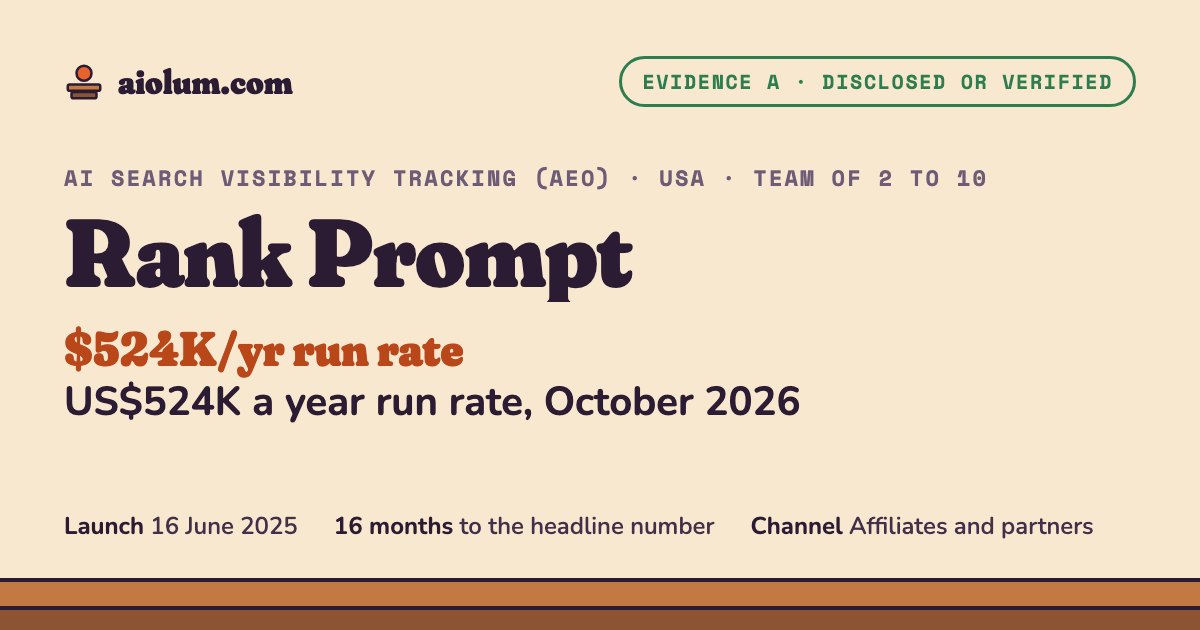
Four people who ran digital marketing agencies, Nazareno Castro Bay, Ethan Kramer, Cole Feigl and Trevor Anderson, first built it as an internal tool for clients who asked "Does AI recommend our brand?". They launched it by press release from Miami on 16 June 2025, at US$29 a month, with a 30% lifetime revenue share for agencies. The company is Rank Prompt LLC in Florida. TrustMRR, a site that publishes revenue read directly from a company's payment processor, lists it under the X account of Tomas Marengo, whom the About page calls Founding Engineer. On 14 October 2026, Stripe data on TrustMRR showed MRR, monthly recurring revenue (the subscription revenue that comes in each month, with yearly plans counted as one twelfth of their price), of US$43,672 from 212 active subscriptions. That is about US$524,000 a year. Monthly revenue grew 5.5 times from November 2025 to September 2026.
The revenue numbers on this page are grade A: they come from the payment processor. The team, the product description and the customer claims are company statements, grade C. The average subscription pays about US$206 a month, between the prices of the two agency plans, so most of the revenue comes from agencies and businesses, not individuals. The page also shows the large funded competitors, a study that found AI answers change from one run to the next, and three earlier companies that sold brands a measure of their visibility on platforms that they did not own.
The numbers, graded
Each row shows the evidence grade and the source numbers from the list at the end of this page. The grades are explained in How Aiolum verifies.
| Fact | Value | Grade | How we know | Sources |
|---|---|---|---|---|
| Monthly recurring revenue, 14 October 2026 | US$43,672 | A | Stripe, connected to TrustMRR by API key. Revenue last synced 14 October 2026. | [1] |
| Run rate from that MRR | about US$524,000 a year | calc | Calculated: US$43,672 times 12 is US$524,064, the headline figure on this page. | [1] |
| Active subscriptions, 14 October 2026 | 212 | A | Stripe through TrustMRR. | [1] |
| Average MRR per active subscription | about US$206 a month | calc | Calculated: US$43,672 divided by 212. Between the Agency plan (US$119 to US$149) and the Agency Plus plan (US$239 to US$299), far above Starter (US$39 to US$49). The customers are mostly agencies and businesses. | [1, 2] |
| Revenue in the last 12 months | US$280,608 | A | Stripe through TrustMRR, to 14 October 2026. All-time revenue is US$289,312. | [1] |
| Revenue in the last 30 days | US$50,384 | A | Higher than MRR because yearly plans count in full on the day that they are paid. TrustMRR shows +38.6% against the 30 days before. | [1] |
| Revenue per month, November 2025 and September 2026 | US$8,279 and US$45,493 | A | Stripe through TrustMRR. The public monthly table starts in November 2025. | [1] |
| Growth from November 2025 to September 2026 | 5.49 times | calc | Calculated: US$45,493 divided by US$8,279. | [1] |
| Largest one-month rise | March 2026: from US$10,577 to US$21,245 | A | 2.01 times February, calculated. No source read explains the rise. | [1] |
| Largest one-month fall | July 2026: from US$35,487 to US$29,612 | A | Minus 16.6%, calculated. August was flat at US$29,834, then September rose to US$45,493. | [1] |
| Revenue from launch to mid-October 2025 | US$8,704 | calc | Calculated: all-time revenue US$289,312 minus the last 12 months, US$280,608. | [1] |
| Website visitors in the last 30 days | 16,645, or US$3.03 of revenue per visitor | A | Google Analytics connected to TrustMRR. Google Search Console is connected too. | [1] |
| Team, October 2026 | 5 named people; LinkedIn lists 6 employees | C | The About page names four people as Partner / Co-Founder and one as Founding Engineer. LinkedIn gives the company size as 2 to 10 employees, shows 6, and a job post for an AI Search Operations Analyst. | [3, 4] |
| Outside funding | none found | C | The launch press release names no investors, and LinkedIn lists the company type as Partnership. Not verified beyond these pages. | [4, 5] |
| Legal entity | Rank Prompt LLC, Miami, Florida | C | Terms of service, last updated 4 October 2026, governed by Florida law. LinkedIn gives the same address in Coral Gables. | [9, 4] |
| Customer claims on the site | 10,000+ customers; 5.0/5 on G2 | C | Not verified. The site does not say how it counts customers. The verified number of active paying subscriptions is 212. The TrustMRR profile text says 4.9/5 on G2. | [12, 1] |
| Partner commission | 30% of every payment, for as long as the client stays | C | Paid monthly through PartnerStack, 60-day cookie window. On Agency Plus at US$299 a month that is US$89.70 a month. TrustMRR revenue is counted before these payouts. | [7, 5] |
| Time from launch to the October 2026 figure | 16 months | calc | Calculated: June 2025 to October 2026. TrustMRR gives a founded date of 15 May 2025. | [5, 1] |
How to read this table: grade A values come from Stripe through TrustMRR. Grade C values are the company's own statements on its website, on LinkedIn or in its press release. A "calc" value was computed on this page from the rows above it.
| Plan | Per month, billed yearly (US$) | Per month, billed monthly (US$) | Limit |
|---|---|---|---|
| Free | 0 | 0 | 10 credits, one full report, 3 brands |
| Starter | 39 | 49 | 150 credits a month, 10 brands, owner only |
| Pro | 71 | 89 | 500 credits a month, 100 brands, 2 team seats |
| Agency | 119 | 149 | 1,000 credits a month, 500 brands, 10 seats, reports with your logo |
| Agency Plus | 239 | 299 | 2,000 credits a month, 1,000 brands, 25 seats, app on your own domain |
| Enterprise | custom | credits priced by volume |
The pricing page shows the price per month billed yearly and the yearly saving. The monthly prices (US$49, US$89, US$149 and US$299) are shown on the partner page. One credit runs one prompt on up to three engines; four to six engines cost two credits. The first report, 10 credits, is free without a card, and every paid plan has a 7-day free trial. At launch in June 2025 plans started at US$29 a month.
The timeline
From an agency's internal tool to US$43,672 a month in verified recurring revenue, in 16 months. Each entry carries its grade.
- Before June 2025CThe four partners run digital marketing agencies. Their agencies get visitors from AI tools without knowing why, and clients ask whether AI recommends them. They build an internal tool to answer. [5, 3]
- 15 May 2025CFounded date given on the TrustMRR profile. [1]
- 16 June 2025CLaunch by PR Newswire press release from Miami. It works with ChatGPT, Gemini, Perplexity and Grok. Plans from US$29 a month, and a partner program with a 30% lifetime revenue share for agencies. [5]
- June to mid-October 2025calcUS$8,704 of revenue in total, calculated from the Stripe figures. [1]
- November 2025AUS$8,279 of revenue in the month, the first month of the public monthly table. [1]
- January 2026CBacklink outreach and an email hub: the product finds contacts at the sites that AI cites and sends email campaigns to them. [8]
- March 2026AMonthly revenue doubles, from US$10,577 in February to US$21,245. [1]
- April 2026CGoogle Business Profile management with AI, a task board and new exports. [8]
- June 2026CAgency Suite and the Agency Plus plan: dashboard, client reporting, client portal and approvals, called the biggest release yet. Revenue that month: US$35,487. [8, 1]
- July 2026AMonthly revenue falls 16.6% to US$29,612, and stays flat in August. [1]
- September 2026CA public REST API and an MCP server for AI agents; a lead widget and white-label domains for agencies. Revenue that month: US$45,493. A LinkedIn post advertises a job for an AI Search Operations Analyst. [8, 1, 4]
- 14 October 2026AMRR of US$43,672 from 212 active subscriptions, US$280,608 of revenue in the last 12 months, verified from Stripe. [1]
Why it worked
Four causes, in the order they mattered. Each one is a reusable lesson.
Built inside agencies, sold through agencies
The four partners ran marketing agencies and built the tool for their own clients. The launch came with a 30% lifetime commission for agencies that bring clients, paid through PartnerStack. The Agency and Agency Plus plans add reports with the agency's logo, a client portal and the whole app on the agency's own domain. The average subscription, about US$206 a month, sits between the two agency prices.
Credits instead of features
In the words of the pricing page: "The platform is the same on all four. What you are choosing is how much you can run and whose name is on the report." One credit runs one prompt on up to three engines, two credits on four to six. A customer who tracks more brands or more engines needs a bigger plan.
A free first report
Every account gets one full report on ChatGPT, Claude and Google AI Mode free, without a card, and the site offers free checkers and a free 20-lesson course. Paid plans start with a 7-day free trial.
A score that says it is noisy
The methodology page says that AI answers are not deterministic and that one report is "an honest snapshot, not a verdict". The company says this is why the product is built around tracking the same questions on a schedule, which is a reason to keep paying every month.
Frequent visible releases
The changelog shows releases in January, April, June, September (two) and October 2026. Each one added a reason for agencies to move up a plan: outreach, task boards, client portals, an API and white-label domains.
How it was built
These details come from the company's own pages, from the source code of its public web page, and from the verification line on TrustMRR. The company pages are grade C. [6, 2, 12, 8, 1, 7]
- Each prompt in a customer's set runs on each chosen engine at the time of the report, in the market's language and location. The company says nothing is cached or simulated.
- Each answer is read for the brands that it names and the sources that it cites. A brand counts as present when the answer names it or one of its configured aliases. The score is the share of answers that named the brand.
- Six engines: ChatGPT, Perplexity, Google AI Mode with AI Overviews, Claude, Gemini and Grok, on every plan. ChatGPT, Claude and Google AI Mode run when the customer picks none.
- The pages read do not say whether the engines are reached through their paid APIs or through their consumer apps, or which models write the articles. The built-in AI agent gets a budget of US$5 to US$25 a month, depending on the plan.
- September 2026: a public REST API (version 1) and an MCP server, a standard connection through which AI tools such as Claude Code or Cursor can read and use a customer's account. The site also lists webhooks.
- Integrations with Google Analytics 4, Google Search Console, WordPress, Gmail for outreach emails and Google Business Profile.
- Payments run through Stripe, connected to TrustMRR by API key, without a merchant of record. The partner program runs on PartnerStack. The public website is built with Astro, a web framework, runs on Netlify, and loads PostHog product analytics, as its page source shows.
Tools named in the sources
Each one opens its page in the Tools tab, with every story that uses it.
The dead that came before
Three companies in the Loot Drop database sold brands a measure of their visibility, or tools to raise it, on platforms that they did not own. The values below are from that database and are not independently verified.
Klout
The promiseA score from 1 to 100 that measured how influential a person or a brand was on social networks.
Why it diedFacebook, Twitter and Instagram built their own analytics, rival scores gave more detail, and changes to the platforms' API access limited the data that Klout could collect.
Salorix
The promiseMachine learning that ranked social media conversations, so brands could see the themes and influencers in their market.
Why it diedIts investors withdrew their support, at the same time as leaner competitors with newer AI methods arrived.
LocalOn
The promiseWeb tools and local search optimization, so small shops could be found online by nearby customers.
Why it diedShopify and Wix offered the same tools. It ran out of money before it found a difference that small businesses would pay for.
What changed
All three sold a measure of visibility, or a way to raise it, on platforms owned by someone else. Klout's score lost its meaning when the social networks built their own analytics and limited access to their data. Salorix depended on investors who withdrew. LocalOn had nothing that larger platforms did not also offer. Rank Prompt faces the first and the third risk directly: six AI providers control the answers that it measures, and many other tools, some with far more money, measure the same thing.
Two things differ. First, Rank Prompt has no investors to withdraw: its revenue is paid by customers, verified from Stripe, and it was paying from the first months. Second, its score is not a secret formula like Klout's: it is a count of real answers, and the customer can open and read every answer behind it. What has not changed is the dependence on the platforms. If OpenAI or Google close automated access or sell brands their own reports, the measurement loses its value.
Can one person copy it now?
The product, with difficulty. The sales channel, yes.
AI visibility tracking is now a crowded market with companies that have raised more than US$100 million. What can still be copied is the route: build a tool for the clients of your own agency, then sell it to other agencies with their name on the reports and a commission for life.
Where it is still open: Other new places where buyers ask a machine instead of searching: AI shopping assistants, voice assistants and AI agents that book or buy for their users. In each one, businesses cannot yet see how they appear.
- 1Start from a question that your own clients already ask and that no tool answers.
- 2Sell credits tied to usage, so that heavy users pay more and light users can start cheap.
- 3Give agencies white-label reports, a client portal and a recurring commission, so that they resell it.
- 4Give the first report away without a card, and ship a visible release every month or two.
What to watch
The risks are the mirror image of the causes above.
A crowded market with large venture rounds
Profound raised a US$35 million Series B led by Sequoia on 12 August 2025, a US$96 million Series C at a US$1 billion valuation on 24 February 2026 (with fewer than 120 employees), and, as AI Weekly reported from Bloomberg, a US$180 million Series D at US$1.8 billion on 15 September 2026. Peec AI in Berlin, launched in February 2025, raised a US$21 million Series A on 18 November 2025, US$29 million in total, with more than 1,300 brands and agencies. Rank Prompt's own compare page lists Profound, Peec, Otterly.AI, Gauge and RankPill, and the SEO suites Semrush and Ahrefs.
AI answers change from one run to the next
A study by SparkToro and by Gumshoe, an AI tracking startup, reported by Search Engine Journal on 30 January 2026, ran 2,961 prompts on ChatGPT, Claude and Google's AI Overviews. ChatGPT and Google returned the same list of brands less than 1% of the time across repeated runs of the same prompt, and the same list in the same order less than 0.1% of the time. The share of answers that name a brand was more stable than its position. Rank Prompt's score is that share, but a report with a few prompts is a small sample, so a change of a few points from one week to the next can be chance.
Dependence on the AI providers
The product works only as long as six providers let it ask questions automatically and get answers like the ones their users see. OpenAI's Terms of Use for ChatGPT, effective 1 January 2026, forbid users to "Automatically or programmatically extract data or Output". The pages read do not say whether Rank Prompt uses the providers' paid APIs or their consumer apps. Klout lost data when the social networks changed their API access.
Young, and a team of five or six
The product is 16 months old, the public monthly table covers 11 full months, and revenue fell 16.6% in July 2026 before rising again. Churn is not public. At the headline figure the About page names five people, four partners and one founding engineer, and LinkedIn lists six employees and an open job. TrustMRR lists only the engineer as founder.
Revenue is not profit
TrustMRR counts revenue before the 30% commission that partners receive for each client they bring, and before the cost of running prompts on six AI engines and the agent budget. Neither cost is public, so the profit is unknown.
Customer claims are not verified
The home page says 10,000+ customers and shows logos of Mastercard, P&G and 7-Eleven; the TrustMRR profile text names Mastercard, LVMH, Lenovo, Costco, AstraZeneca and Hyatt. None of this is verified, and the site does not say how it counts customers. The verified number of active paying subscriptions is 212.
Sources
The grade next to each source is the best grade that the source can support. "Read in full" means that the text of the page was downloaded and the numbers were checked in it.
- A TrustMRR: Rank Prompt, Stripe-verified revenue, synced 14 October 2026Read the markdown profile (rank-prompt.md) in full. The revenue tables, monthly timeline, MRR and subscriptions come from Stripe through an API key; the description and customer names are founder-written, grade C.
- C Rank Prompt pricing page, read 14 October 2026Read in full. Source for the plans, credits, engines, brands, seats and the agent budget.
- C Rank Prompt About pageRead in full. Source for the agency origin, the six engines and the names and roles of the team.
- C Rank Prompt company page on LinkedInRead the public page. Source for the company size, the 6 employees, the company type, the address and the job post.
- C PR Newswire, 16 June 2025: Rank Prompt Launches as Pioneering Platform to Optimize Brand Visibility in AI Search Engines (as published by MarTech Series)Read in full. The company's own press release. The same text on aijourn.com carries the dateline MIAMI, June 16, 2025. Source for the founders, the launch price and the partner program.
- C Rank Prompt methodology page: AI Visibility MethodologyRead in full. Source for how prompts are run, how answers are scored and the note that answers are not deterministic.
- C Rank Prompt partner program pageRead in full. Source for the 30% commission, PartnerStack, the cookie window and the monthly prices.
- C Rank Prompt changelogRead in full. Entries are dated by month. Three entries are dated December 2024, before the launch; they are not used here because the date may be an error.
- C Rank Prompt terms of service, last updated 4 October 2026Read the sections on the operator, payments, governing law and contact. Source for Rank Prompt LLC and Florida law.
- C TrustMRR founder page: Marengo (@tomymarengo)Read in full. Links the profile to the X account TomyMarengo.
- C X profile of TomyMarengoRead through api.fxtwitter.com: the profile, whose bio says Building @RankPrompt, and the latest 20 posts. The text of none of them mentions revenue, and two have no text.
- C Rank Prompt home pageRead in full, and the page source. Source for the customer claims, the engine list and the Astro framework.
- C Rank Prompt compare pageRead the list of tools that the company compares itself with.
- C Search Engine Journal, 30 January 2026, Matt G. Southern: AI Recommendations Change With Nearly Every Query: SparktoroRead in full. A report of the SparkToro and Gumshoe study. The study itself was not downloaded.
- C Profound newsroom, 12 August 2025: Profound Raises $35M Series B as AI Search Becomes the Next Platform ShiftRead in full. The competitor's own announcement.
- C Fortune, 24 February 2026, Lily Mae Lazarus: Exclusive: As AI threatens search, Profound raises $96 million to help brands stay visibleRead in full. Source for the Series C, the US$1 billion valuation and the headcount.
- C AI Weekly, 15 September 2026, Alexis Dufresne: Profound Hits $1.8B on $180M Series D From Sequoia, KleinerRead in full. A short summary of a Bloomberg report; the Bloomberg article was not read.
- C Tech.eu, 18 November 2025, Tamara Djurickovic: Peec AI raises $21M Series A to help brands win in AI searchRead in full. Source for the round, the total funding, the launch month and the 1,300 brands and agencies.
- C OpenAI Terms of Use, effective 1 January 2026Read the section on what users may not do. These terms cover ChatGPT and other services for individuals; the page says that separate Business Terms govern the APIs.
- C Loot Drop database export, 1,749 failed startupsLocal export. AI-written summaries, not independently verified. Source for the failed predecessors.