AI Toolbox
AI Toolbox is a browser extension, a small program that runs inside the Chrome browser and can add buttons and panels to the web pages you open. It adds folders, bookmarks, a prompt library, export to text, Markdown, JSON and PDF, and full-text search, which means search in the words of every message and not only in chat titles, to the web pages of ChatGPT, Gemini, Claude and Grok. It does not sell an AI model: users keep their own ChatGPT, Google, Anthropic or X accounts. The free plan has small limits. A paid plan for one AI app costs US$9.99 a month, US$59 a year or US$99 once, and all four apps cost US$199 once.
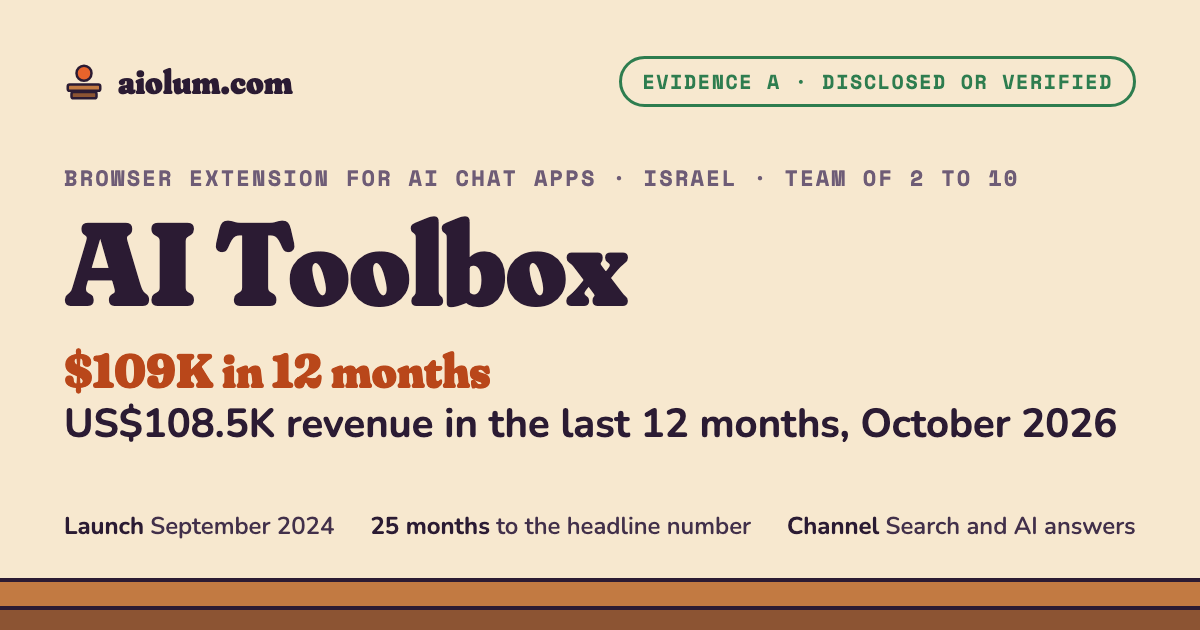
Two developers, Adi Leviim and Mohammad El-Esawi, released it as ChatGPT Toolbox on the Chrome Web Store in September 2024 through their two-person company, Infi Developments. It had more than 8,000 users in February 2025. In April 2026 it added Gemini, Claude and Grok and took the name AI Toolbox, and in October 2026 the store shows 40,000 users. TrustMRR, a site that reads a seller's sales directly from the payment provider (the service that charges the buyer's card) through an API key (a password that lets one program read another program's data), shows US$108,506 of revenue in the 12 months to 14 October 2026, from Lemon Squeezy and Polar, and US$22,302 in September 2026 alone. The pricing page calls the lifetime license, one payment for permanent use, its most popular plan, and about 94% of the last 30 days of revenue does not repeat monthly. So the MRR, monthly recurring revenue, the subscription money that repeats every month, is only US$1,334.
The revenue figures are grade A. The costs, the margin, the working hours and the claim of no advertising are the seller's own words, grade C, and this page marks them as claims. Adi Leviim has listed the business for sale on TrustMRR since January 2026, asking US$800,000. The page also shows what happened to earlier companies that added order and search to a platform that they did not own.
The numbers, graded
Each row shows the evidence grade and the source numbers from the list at the end of this page. The grades are explained in How Aiolum verifies.
| Fact | Value | Grade | How we know | Sources |
|---|---|---|---|---|
| Verified revenue, 12 months to 14 October 2026 | US$108,506 | A | TrustMRR, read from the Lemon Squeezy and Polar accounts through API keys, synced 14 October 2026. All-time revenue: US$110,833. | [1] |
| Verified revenue, last 30 days | US$21,509 | A | TrustMRR, same sync. Last 3 months: US$55,888. Last 6 months: US$84,122. | [1] |
| Run rate from the last 30 days | about US$258,108 a year | calc | Calculated: US$21,509 times 12. Most of this money is one-time payments, so the next 12 months can differ. | [1] |
| Revenue by month | US$2,869 in November 2025, US$6,942 in May 2026, US$22,302 in September 2026 | A | TrustMRR monthly table. Calculated: September 2026 is 7.8 times November 2025 and 3.2 times May 2026. July to September 2026 brought US$53,010, 2.05 times April to June. | [1] |
| Verified revenue before mid-October 2025 | US$2,327 | calc | Calculated: all-time US$110,833 minus the 12-month US$108,506. This covers the first 13 months. The sources do not say whether some early sales went through an account that is not connected to TrustMRR. | [1] |
| Monthly recurring revenue (MRR) | US$1,334 from 151 active subscriptions | A | TrustMRR snapshot. Calculated: US$8.83 per subscription per month, between the US$4.92 of the yearly plan and the US$9.99 of the monthly plan. | [1, 3] |
| Share of last-30-day revenue that does not repeat monthly | about 93.8%, or US$20,175 | calc | Calculated: US$21,509 minus US$1,334, divided by US$21,509. This money comes from lifetime licenses and from yearly plans paid in advance. | [1, 3] |
| Prices, October 2026 | US$99 once per AI app, US$199 once for all four, or US$9.99 a month | C | Pricing page. Yearly plan: US$59 per AI app. Teams: US$12 per seat per month billed yearly. 14-day money-back guarantee. | [3] |
| Chrome Web Store users, 14 October 2026 | 40,000, rated 4.8 from 996 ratings | C | Google's store listing. Version 5.0.54, updated the same day. | [4] |
| Chrome Web Store users, 9 August 2026 | 30,000, rated 4.6 from 559 ratings | C | A third-party comparison of 25 ChatGPT extensions that read the store listings that day. | [9] |
| Users, February 2025 | more than 8,000 | C | The company's home page as saved by the Wayback Machine on 27 February 2025, when the product was still called ChatGPT Toolbox. | [10] |
| Website visitors, last 30 days | 21,193, with US$1.03 of revenue per visitor | A | TrustMRR, read from Google Analytics through its API. Google Search Console is also connected. | [1] |
| Team | 2 co-founders | C | The About page calls Infi Developments a two-person company and names Adi Leviim (product and front end) and Mohammad El-Esawi (back end and AI systems). TrustMRR's team-size field shows the range 2 to 5 people. | [2, 1] |
| Outside funding | none | C | TrustMRR profile: Bootstrapped. No source mentions an investor. | [1] |
| Costs, margin and working time | under US$100 a month, about 93% margin, about 5 hours a week | C | Seller's claims in the TrustMRR description. TrustMRR shows a 92.0% profit margin for the last 30 days, but costs are not in its list of verified sources. Not verified. | [1] |
| Advertising | none, by the seller's account | C | Seller's claims: growth is 100% organic from a site built for Google and AI answer engines, and 37% of users come from organic Google search. Not verified. | [1] |
| Asking price | US$800,000 | C | Set by the seller on TrustMRR, listed since 14 January 2026, 6 offers received. TrustMRR shows a revenue multiple of 3.1. Calculated: the price is 3.10 times the run rate above and 7.37 times the last 12 months. | [1] |
| Time from launch to the October 2026 figure | 25 months | calc | Calculated: September 2024 to October 2026. | [1, 2] |
How to read this table: a grade A value is a TrustMRR figure read from the Lemon Squeezy and Polar accounts, or from Google Analytics, through an API key. A grade C value is the company's or the seller's own statement, a store listing, or a third-party test. A "calc" value was computed on this page from the rows above it.
| Plan | Per month, billed yearly (US$) | Per month, billed monthly (US$) | Limit |
|---|---|---|---|
| Free | 0 | 0 | 2 folders, 2 bookmarks, 2 saved prompts, first 5 search results |
| Premium, one AI app | 4.92 | 9.99 | one AI app; US$59 a year |
| Lifetime, one AI app | 99 one-time | one AI app, all future updates | |
| All Access Lifetime | 199 one-time | all four AI apps and any added later | |
| Teams | 12 | 15 | per seat, all four AI apps, at least 2 seats |
Each paid plan covers one AI app: ChatGPT, Gemini, Claude or Grok. All Access Lifetime covers all four and any app added later. The page shows the US$99 lifetime price next to a crossed-out US$123, and All Access next to US$396, the price of four single lifetime licenses. Teams costs US$12 per seat per month billed yearly or US$15 billed monthly, with at least 2 seats. All paid plans have a 14-day money-back guarantee.
The timeline
From a ChatGPT add-on with 8,000 users to a four-app extension that took in US$22,302 in one month, in 25 months. Each entry carries its grade.
- Mid 2024CTwo heavy ChatGPT users, each with hundreds of chats, find no folders, no search filters by date or role and no bulk export in ChatGPT, by the company's account. [2]
- September 2024CChatGPT Toolbox launches on the Chrome Web Store, and Infi Developments is founded the same month to publish it. The Wayback Machine first saves the website on 12 September; the product's X account opens on 24 September. [2, 11, 14]
- 27 February 2025CThe home page says more than 8,000 users and offers a free year of the subscription, worth US$48, as a prize. Firefox and Edge versions are offered too. [10]
- 13 April 2025CAdi Leviim opens his X account, where he later calls himself co-founder of AI Toolbox. [13]
- 19 June 2025CFirst Wayback copy of OpenAI's help article on Projects in ChatGPT, a built-in way to group chats, files and instructions. [18]
- 30 June 2025CChatGPT Toolbox launches on Product Hunt, after a first launch there in 2024. [8]
- Before mid-October 2025calcVerified revenue in the first 13 months adds up to US$2,327. [1]
- December 2025BSecurity researchers report that four browser extensions with more than 8 million users had collected people's AI chats since July 2025. AI Toolbox reads the same AI pages. [16, 17]
- 14 January 2026CThe business is listed for sale on TrustMRR. The asking price in October 2026 is US$800,000. [1]
- April 2026CVersion 5.0.0: Gemini, Claude and Grok modules join ChatGPT in one install, and the product is renamed AI Toolbox. [5, 2]
- June 2026AVerified revenue: US$12,368 in the month, after US$6,942 in May. [1]
- 9 August 2026CA third-party test of 25 ChatGPT extensions reads 30,000 users and 4.6 stars from 559 ratings, and calls AI Toolbox the best folder-and-tags suite. [9]
- 6 September 2026CAI Toolbox 3.0 launches on Product Hunt. The company says it finished first for the day. [8, 2]
- September 2026AVerified revenue: US$22,302 in the month, 7.8 times November 2025. [1]
- 14 October 2026AThe store shows 40,000 users, 4.8 stars from 996 ratings and version 5.0.54 released that day. TrustMRR shows US$108,506 in 12 months and MRR of US$1,334. [4, 1]
Why it worked
Four causes, in the order they mattered. Each one is a reusable lesson.
Features the AI apps did not have
By the company's account, in mid-2024 ChatGPT had no folders, no search filters by date or role and no bulk export, and heavy users kept hundreds of chats. The extension added these inside ChatGPT's own sidebar, so users kept their habits and their AI subscription.
One set of tools for four AI apps
In April 2026 the Gemini, Claude and Grok modules joined ChatGPT in one install. Each paid plan covers one app, and All Access covers all four for US$199 once. One search box, one folder tree and one prompt library work across all four, which no single AI company offers.
One-time prices
A lifetime license costs US$99 per AI app, about ten months of the US$9.99 monthly price. TrustMRR counts a one-time payment as revenue in the month it arrives, but MRR counts only subscriptions. That is why the last 30 days brought US$21,509 while MRR is US$1,334.
Search pages instead of ads, by the seller's account
The seller says growth comes only from a website written for Google and for AI answer engines. The Wayback Machine first saved 168 pages of the site in all of 2025, and 607 new pages from July to September 2026, the quarter in which revenue was 2.05 times the quarter before (calculated). The site also publishes an llms.txt file, a plain-text summary written for AI models. Three Product Hunt launches, X accounts and a subreddit add to it.
How it was built
These details come from the company's own pages and from the tech list on its TrustMRR profile, which the founders filled in. They are grade C. [1, 7, 2, 5, 4]
- The TrustMRR tech list names Next.js, TypeScript and Sass for the front end, and Node.js, Express, MongoDB, Redis, Nginx, DigitalOcean, Cloudflare, GitHub Actions and Resend for the back end.
- The extension keeps a copy of the user's chats in IndexedDB, a database built into the browser, and runs search and automatic topic tags on the user's device.
- Folders, saved prompts, bookmarks and settings are stored on the company's servers, encrypted at rest, so that they follow the user to other devices.
- Three features, PDF export, pulling a long chat into a new one, and carrying a chat to another AI app, send the text of one chosen chat to the servers. The two summary features pass that text to the OpenAI API.
- Payments went through Lemon Squeezy and now go through Polar; some old subscriptions are still billed by Lemon Squeezy. A purchase is matched to the user's AI account by email address.
- Version 5.0.0 came out in April 2026 and version 5.0.54 on 14 October 2026. Since late August 2026 the extension can show notices to users without a store update.
Tools named in the sources
Each one opens its page in the Tools tab, with every story that uses it.
The dead that came before
Five companies in the Loot Drop database added order, search or sync on top of a platform that they did not control. The values below are from that database and are not independently verified.
Xobni
The promiseSearch and contact tools inside Microsoft Outlook.
Why it diedTied to one email program. Microsoft improved Outlook itself and users moved to phones. Yahoo bought what was left.
Xmarks
The promiseSync bookmarks and tabs across browsers and devices.
Why it diedChrome, Firefox and Safari built sync in, for free.
Readability
The promiseClean reading of any web article, without ads and clutter.
Why it diedBrowsers added a free reader mode, and few readers paid.
Sunrise
The promiseOne calendar app for calendars from Google, Microsoft and others.
Why it diedMicrosoft bought it in 2015 and closed it a year later, moving its features into Outlook.
Kippt
The promiseA bookmarking tool to save, organize and share web content.
Why it diedPocket and Evernote did the same job, and its sharing features did not bring new users.
What changed
Each of the five added order, search or sync to something that it did not own: Outlook, the browser, web articles, calendars and bookmarks. Each raised venture money and had to become large. Then the platform built the feature itself, or a bigger company bought it or did the same job, and the add-on lost its reason to exist. AI Toolbox makes the same bet on ChatGPT and three other AI apps, and OpenAI has already added Projects to ChatGPT.
Three things differ. Two people run it without outside money, so, by the seller's account, it makes a profit at a size at which the predecessors could not have survived. It covers four AI apps, so one platform change does not end it, and its search and folders across all four apps are something no single AI company sells. And it took its money early, through one-time licenses: that made it profitable quickly, but it leaves a long support promise to whoever owns it next.
Can one person copy it now?
The method, yes. This niche, only with care.
Two developers built more than US$100,000 a year of revenue by adding the missing parts of AI chat apps, with no outside money and no servers that store the chats. The method is repeatable: find what heavy users of a fast-growing web app keep asking for, build it inside that app, and sell it once at about ten months of a subscription. The niche itself is now crowded: one comparison tested 25 ChatGPT extensions in August 2026, and the AI apps keep adding folders and projects.
Where it is still open: New AI apps with heavy users and weak history tools: AI search engines, AI image and video generators, voice assistants, and the web versions of AI coding tools.
- 1Read the reviews and forum posts of a fast-growing web app, and list the features that its heavy users ask for and do not have.
- 2Build those features inside the app's own page, and keep the user's data in the browser so that server costs stay small.
- 3Offer a free plan with small limits, a monthly price, and a one-time price of about ten months of the monthly price.
- 4Write one help or comparison page for each question that users type into search engines, and publish an llms.txt summary for AI answer engines.
- 5When a second and a third app grow, add a module with the same features and sell one bundle for all of them.
What to watch
The risks are the mirror image of the causes above.
It lives inside other companies' web pages
The extension adds buttons and panels to the pages of ChatGPT, Gemini, Claude and Grok. The company's changelog says these apps change their interfaces without notice and that a change can hide a button the extension attaches to; its terms say such changes may affect features temporarily or permanently. It also depends on the Chrome Web Store, whose policies say Google may change them at any time.
The AI apps add the same features
OpenAI's help center describes Projects in ChatGPT, which group chats, files and instructions and can take old chats with a Move to project option; the Wayback Machine has a copy of that article from June 2025. Three of the five predecessors on this page lost to a platform that built the feature itself. AI Toolbox's answer is search, folders and export across four AI apps at once.
Lifetime plans are paid once and supported for years
About 94% of the last 30 days of revenue does not repeat monthly. The terms promise lifetime buyers all future updates, and All Access buyers every new AI app the extension adds, for as long as the extension works. Each lifetime buyer adds support work for years while the money arrives once. The seller names turning one-time plans into subscriptions as a task for a buyer.
Extensions that collected AI chats
In December 2025 The Register and The Hacker News reported Koi Security's finding that Urban VPN Proxy and three other extensions, with more than 8 million users, had collected people's prompts and answers on ChatGPT, Claude, Gemini, Grok and other AI apps since July 2025, and that the data was sold for marketing. One of them had a Featured badge from the Chrome Web Store. AI Toolbox reads the same pages. Its privacy policy says chats stay in the browser, except for short previews of bookmarked messages and three features that send one chosen chat to its servers, two of them on to the OpenAI API for a summary. So the listing's line that no chat content leaves the browser says more than the policy does.
For sale, with access to users' browsers
The business has been listed on TrustMRR since 14 January 2026 at US$800,000, with 6 offers, and was still listed after 273 days (calculated to 14 October 2026). A buyer would take over an extension that about 40,000 people let read their AI chat pages. The Register notes that the store's Limited Use policy allows user data to move when a business changes owner.
Seller numbers that this page could not check
The margin, the costs under US$100 a month, the 5 hours a week, the zero ad spend, the 1,700 paying customers, the 47,000 monthly users and the 23,000-member subreddit are the seller's words. The listing also says revenue grew from US$2,900 a month in May, but the verified table shows US$6,942 for May 2026; US$2,869 is the figure for November 2025.
The growth is recent
Calculated from TrustMRR: 77.5% of the 12-month revenue came in the last 6 months and 51.5% in the last 3 months. The verified history is short, and it depends on new one-time sales every month.
Sources
The grade next to each source is the best grade that the source can support. "Read in full" means that the text of the page was downloaded and the numbers were checked in it.
- A TrustMRR markdown profile: AI Toolbox, synced 14 October 2026Read the markdown profile in full. Revenue, MRR, subscriptions and visitors are read through the Lemon Squeezy, Polar and Google Analytics APIs (grade A). The description, seller message, team size, funding, tech list and costs are founder-written (grade C).
- C AI Toolbox: About Infi Developments, the team behind AI ToolboxRead in full. Source for the two co-founders, the two-person company and the dated history.
- C AI Toolbox pricing page, read 14 October 2026Read in full. Source for every price in the pricing table.
- C Chrome Web Store listing: AI Toolbox: Folders, Prompts, Advanced Search & Export for AI Chats, read 14 October 2026Read in full. Google's store data: users, rating, version, update date and the trader details, which place the publisher in Ramla, Israel.
- C AI Toolbox changelog: every release since 2024Read in full. Source for the April 2026 rename, the version numbers and the statement on interface changes by the AI apps.
- C AI Toolbox Terms of Service, last updated 1 October 2026Read the sections on lifetime licenses and on third-party dependencies. The terms name Infi Developments as publisher but give no registration number or address.
- C AI Toolbox Privacy Policy, last updated 1 October 2026Read the sections on data kept in the browser, data on the servers, OpenAI processing, payment processors and analytics.
- C Product Hunt: AI Toolbox product page and its three launchesRead the launch list and the summary. Source for the launches in 2024, on 30 June 2025 and on 6 September 2026.
- C gptprotools.com: 25 Best ChatGPT Chrome Extensions Compared (2026), updated 5 October 2026Read the comparison table and the AI Toolbox entry. A third-party test that read the store listings on 9 August 2026.
- C Wayback Machine: ai-toolbox.co home page, 27 February 2025, then ChatGPT ToolboxRead in full. Source for the 8,000 users and the US$48 yearly subscription offered as a prize.
- C Wayback Machine capture index for ai-toolbox.coDownloaded the index and counted with python3 the first capture of each HTML page per quarter. A capture date shows when the archive first saw a page, not when the page was written.
- C AI Toolbox llms.txt, read 14 October 2026Read the opening section. A summary of the site written for AI models.
- C Adi Leviim on X (@adileviim): profile and posts from 4 to 14 October 2026Read the profile and the timeline through api.fxtwitter.com: 53 of his own posts, all product tips. The timeline API returned nothing older than 4 October 2026.
- C AI Toolbox on X (@get_ai_toolbox): profileRead the profile through api.fxtwitter.com. Source for the date the account opened, 24 September 2024.
- C TrustMRR founder page: Adi LeviimRead in full. Lists one startup with verified revenue, AI Toolbox, and no other product.
- B The Register, 16 December 2025: Chrome, Edge privacy extensions quietly snarf AI chatsRead in full. Reports Koi Security's research, the Featured badge and the gap in the Limited Use policy.
- B The Hacker News, 15 December 2025: Featured Chrome Browser Extension Caught Intercepting Millions of Users' AI Chats, by Ravie LakshmananRead in full. A second report of the same research.
- C OpenAI Help Center: Projects in ChatGPTRead in full. The article gives no launch date; the first Wayback copy of it is from 19 June 2025.
- C Chrome for Developers: Chrome Web Store Program PoliciesRead the sections on user data, Limited Use and policy changes.
- C Loot Drop database export, failed startupsLocal export. AI-written summaries, not independently verified. Source for the failed predecessors.