SEObot
SEObot is an AI agent for SEO. An AI agent here is a program that plans and carries out a chain of tasks with language models, with no person directing each step. SEO, search engine optimization, is the work of making web pages appear high in Google's results so that people visit them without paid advertising. A customer enters a website address. SEObot studies the site, chooses search phrases, writes articles and publishes them to the customer's blog every week. Plans in the company's help center start at US$49 a month for 9 articles.
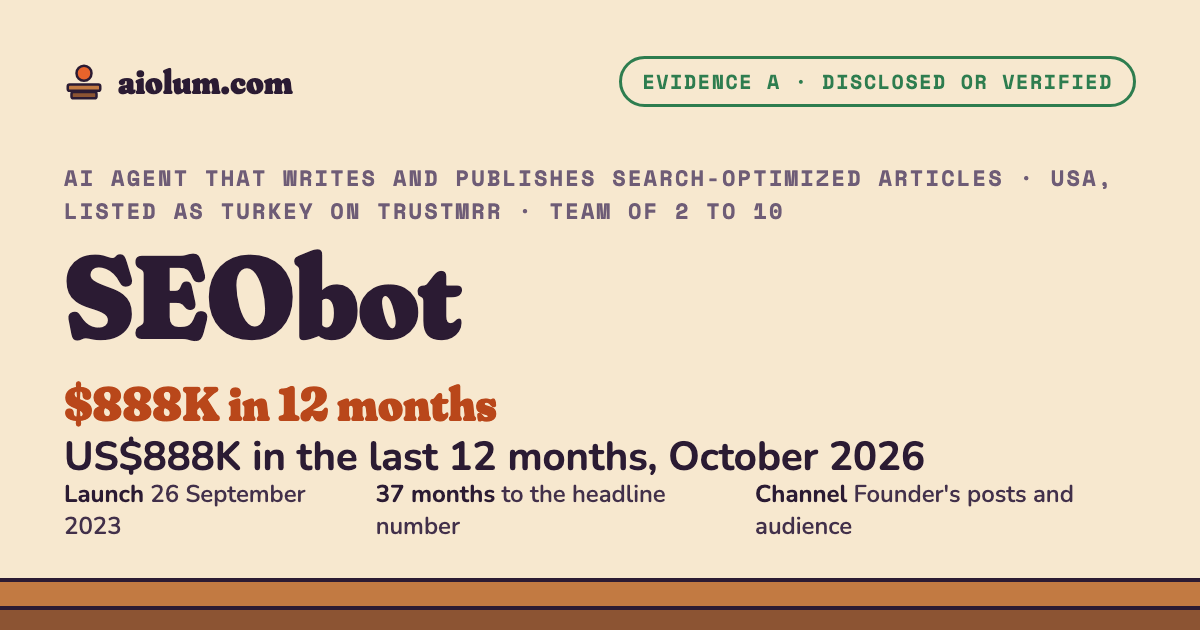
John Rush announced it on X on 26 September 2023. He runs it with one partner, Vitalik May, who writes the code, and they split ownership 50/50. Rush also runs a studio of more than 20 small products under the name MarsX; this page counts SEObot only. TrustMRR, a site that reads revenue from a company's Stripe account through an API key, shows US$888,125 for the 12 months to 13 October 2026 and US$1,899,549 since the first payment. An API key is a password that lets one program read data from another program.
Two points need care. First, the founder said "almost 120K MRR" in an interview in May 2025. MRR, monthly recurring revenue, is the subscription revenue of one month. The public payment records start in November 2025, and no month in them is above US$103,105. This page shows both numbers and does not decide why they differ. Second, revenue has fallen in every month since January 2026: the last 30 days brought US$37,817, about half of the 12-month average of US$74,010. The page also explains Google's spam policy of March 2024 against pages produced in bulk to gain rankings, which is the main risk for a customer who buys articles from a machine.
The numbers, graded
Each row shows the evidence grade and the source numbers from the list at the end of this page. The grades are explained in How Aiolum verifies.
| Fact | Value | Grade | How we know | Sources |
|---|---|---|---|---|
| Revenue in the 12 months to 13 October 2026 | US$888,125 | A | TrustMRR, read from the Stripe account by API key, synced 13 October 2026 at 14:14 UTC. The copy cached one day earlier showed US$889,399 for its own 12 months. | [1] |
| Revenue in the last 30 days, at 13 October 2026 | US$37,817 | A | Same profile. A second line on the profile, called a snapshot, shows US$38,082. Change against the 30 days before: minus 10.3%. | [1] |
| Revenue in the last 3 months and the last 6 months | US$127,902 and US$307,606 | A | Same profile. | [1] |
| Revenue since the first payment | US$1,899,549 | A | The all-time line of the profile. The profile gives 23 September 2023 as the founding date. | [1] |
| Revenue by month, November 2025 to September 2026 | Nov US$99,433; Dec US$98,888; Jan US$103,105; Feb US$93,999; Mar US$85,954; Apr US$75,669; May US$63,803; Jun US$57,391; Jul US$50,806; Aug US$48,380; Sep US$40,732 | A | TrustMRR monthly table. October 2026 to the 13th: US$13,967. Months before November 2025 are not public. | [1] |
| MRR and active subscriptions | US$37,197 a month; 515 subscriptions | A | TrustMRR snapshot. MRR change over 30 days: minus 10.5%. The payment provider is Stripe; the profile says that SEObot is not sold through a merchant of record. | [1] |
| Average month of the last twelve | US$74,010 | calc | Calculated: 888,125 divided by 12 equals 74,010. | [1] |
| Latest 30 days against that average | 51.1% of it, so 48.9% lower | calc | Calculated: 37,817 divided by 74,010 equals 0.511. The first half of the 12 months brought US$580,519 (888,125 minus 307,606) and the second half US$307,606, a fall of 47.0%. | [1] |
| Highest month to latest full month | US$103,105 in January 2026 to US$40,732 in September 2026, minus 60.5% | calc | Calculated: 40,732 divided by 103,105 equals 0.395. Each month from February to September 2026 is lower than the month before. | [1] |
| Average revenue per subscription | about US$72 a month | calc | Calculated: 37,197 divided by 515 equals 72.23, between the US$49 plan and the US$99 plan. | [1, 6] |
| Revenue received before the 12-month window | US$1,011,424 in about 24.7 months | calc | Calculated: 1,899,549 minus 888,125. From 23 September 2023 to 13 October 2025 is about 24.7 months, so the average is about US$41,000 a month. This total can contain some months near US$100,000 in 2025. It cannot confirm or exclude US$120,000 in May 2025. | [1] |
| Founder's statement, mid-May 2025 | "almost 120K MRR" | C | Interview with Nathan Latka, published on 12 June 2025. While he shows his Stripe screen he says that revenue has two channels, Stripe and enterprise invoices, and that the Stripe channel is "over 100K a month". He also says that he sells credits. The public payment records do not cover May 2025. | [2, 3] |
| That statement next to the payment records | US$120,000 stated; US$103,105 in the highest verified month | calc | Calculated: 120,000 is 16.4% above January 2026, the highest month in the public records, and 20.7% above November 2025, the earliest. The two numbers belong to different months, so this is not a direct check. See the first item under what to watch. | [1, 2] |
| Founder's statement, November 2025 | "100K MRR" and "we make 100K a month" | C | Starter Story podcast, published 11 November 2025; the recording date is not given. The payment records show US$99,433 for November 2025, a difference of 0.6%. This statement agrees with the records. | [4, 1] |
| Cost of the language models | about US$30,000 a month on US$100,000, a 70% margin | C | Founder on Starter Story, November 2025. Not verified: TrustMRR sees money received, not costs. | [4] |
| People who build and run SEObot | 2 | C | John Rush, chief executive, has the idea, builds the first version and promotes the product. Vitalik May, technology chief, writes the code and the help-center articles. They split ownership 50/50. Product Hunt lists the same two people as makers. | [2, 6, 12, 14] |
| Revenue per person | about US$444,000 a year | calc | Calculated: 888,125 divided by 2 equals 444,062.50. | [1, 2] |
| Share of the founders' time spent on customer support, May 2025 | almost 80% | C | Rush in the Latka interview: customers cannot connect their content systems, and the two of them were building nothing new. | [2] |
| Outside funding | none reported | C | Rush says that he builds with no venture money, after ten years in venture-funded companies. No source read for this story names an investor in SEObot. | [2, 19] |
| Yearly revenue of the whole studio, not counted in the headline | US$2M (March 2024), US$3.5M (May 2025), US$3M (November 2025) | C | Founder statements for 20 to 26 products together. None of the three totals is verified. If both of his May 2025 numbers are right, SEObot was 41.1% of the total (calculated: 120,000 times 12 equals 1,440,000, divided by 3,500,000). | [13, 2, 4] |
| Another product of the same founder, for comparison | TinyAdz: US$58,356 in 12 months | A | TrustMRR, Stripe by API key. John Rush is listed as co-founder. He offered it for sale at US$75,000 on 30 August 2026 and at US$49,000 on 4 September 2026. It is 6.6% of SEObot's 12-month revenue (calculated: 58,356 divided by 888,125). | [15, 14] |
| Entry price | US$19 a month in May 2025; US$49 a month from September 2025 | C | Archived home page of 18 May 2025; help-center article of 15 September 2025; home page of 13 October 2026. Calculated: 49 divided by 19 equals 2.58 times. | [8, 6, 5] |
| Price per article | US$5.44 on the smallest plan; US$3.50 on the largest | calc | Calculated: 49 divided by 9 equals 5.44; 1,050 divided by 300 equals 3.50. | [6] |
| Work behind one article | 727 prompts, 126 jobs, 2 hours, US$6 | C | Founder's post of 5 December 2024. The post does not say whether US$6 is the cost to produce the article or its price. | [10] |
| Articles written | more than 100,000 by May 2025; more than 200,000 by October 2026 | C | Home page claims, together with 0.6 billion and then 1.2 billion search impressions for customers' sites. Not verified. | [8, 5] |
| Followers of the founder on X | 117,867 | C | Read on 13 October 2026. The TrustMRR profile shows 116,621. | [14, 1] |
| Country | USA by its terms of service; Turkey on TrustMRR | C | The terms are under the law of Delaware and name only "SEObot AI". The TrustMRR profile lists the country code TR. Rush grew up in the Caucasus and studied in Norway, by a 2025 newsletter. No source read for this story says where Vitalik May lives; Ukraine is not verified. | [7, 1, 18] |
| Time from the announcement to the headline date | 37 months | calc | Calculated: September 2023 to October 2026. | [9, 1] |
How to read this table: a grade A value was read by TrustMRR from the company's Stripe account through an API key, last synced on 13 October 2026 at 14:14 UTC. A grade C value is a statement by a founder or by the company's own pages. A "calc" value was computed on this page from the rows above it. Grade A covers money received in that Stripe account. It does not cover invoices paid outside Stripe, costs, margin or profit.
| Plan | Per month, billed yearly (US$) | Per month, billed monthly (US$) | Limit |
|---|---|---|---|
| US$49 plan | 49 | 9 articles a month | |
| Pro | 99 | 20 articles a month | |
| US$199 plan | 199 | 50 articles a month | |
| Enterprise | 499 | 100 articles and 20 directory listings a month | |
| US$570 plan | 570 | 150 articles a month | |
| US$1,050 plan | 1050 | 300 articles a month |
One credit is one article. Credits do not expire, and unused credits are refunded only within 7 days of purchase. The company publishes no yearly price, so the yearly column is empty. The help center says that the complete list of plans is shown only after a customer has set up a website, so the plans today may differ from this list. Only the US$99 and US$499 plans are named in the help center (Pro and Enterprise). The FAQ on the home page also offers a full refund on the US$49 plan after the first article. Agencies that order 300 or more articles pay US$3.50 per article. On 18 May 2025 the home page said that subscriptions started at US$19 a month.
The timeline
From a waiting list to about US$100,000 a month in 26 months, then eight monthly falls in a row. Each entry carries its grade.
- Late 2022CRush starts work on SEObot for his own products. On 27 December 2024 he writes: "Two years ago, I started SEObot!" [11]
- 7 September 2023CThe address seobotai.com shows a waiting list for "SeoBOT", "starting with MarsVerse projects", which are Rush's own products. [8]
- 26 September 2023CRush announces "an AI SeoBot" on X and asks readers to request access. TrustMRR gives 23 September 2023 as the founding date. [9, 1]
- November 2023 to June 2024CThe home page still offers a waiting list and says "We're onboarding new users every day". Rush later says that about six months of closed use by people he knew came first, and that the public opening was 12 to 14 months before mid-May 2025, which is March to May 2024. [8, 2]
- 5 March 2024CGoogle announces a spam policy against "scaled content abuse": many pages generated mainly to manipulate search rankings, by automation, by people or by both. [16]
- 9 March 2024CRush describes his studio as a profitable holding company with US$2 million of yearly revenue and 20 products. This is the whole studio, not SEObot. [13]
- 5 December 2024CRush describes how the agent works: one article takes about 2 hours and runs 727 prompts and 126 jobs. [10]
- 27 December 2024CSEObot launches on Product Hunt, with Vitalik May and John Rush as makers. Rush writes that users' sites had 0.6 billion search impressions and 15 million clicks. [12, 11]
- Mid-May 2025CIn an interview with Nathan Latka, Rush says "almost 120K MRR", two people, and almost 80% of their time on customer support. The home page offers plans from US$19 a month. [2, 3, 8]
- 15 September 2025CThe help center lists six plans, from US$49 a month for 9 articles to US$1,050 a month for 300 articles. [6]
- November 2025AThe first month in the public payment records: US$99,433. On the Starter Story podcast, published on 11 November, Rush says "100K MRR". [1, 4]
- January 2026AThe highest month in the public payment records: US$103,105. [1]
- February to September 2026ARevenue falls in each of eight months, to US$40,732 in September. On 27 February Rush writes that he is building a second version of the agent interface for SEObot and five other bots. [1, 14]
- 13 October 2026ATrustMRR shows US$37,817 for the last 30 days, 515 active subscriptions and US$1,899,549 since the first payment. The product is on sale from US$49 a month. [1, 5]
Why it worked
Four causes, in the order they mattered. Each one is a reusable lesson.
Buyers before the launch
Rush had a large following on X (117,867 followers in October 2026) and more than 20 products and directories for the same customer, a founder without a marketing team. He says that growth came about 30% from search, 30% from cross-promotion between his own products and 30% from social media. SEObot itself has a button that sends the customer to ListingBott, another product of his.
A finished result, not a writing tool
The customer enters a website address and receives published articles. There is no editor to learn and no prompt to write. The price is per article, through credits, so a customer who wants more articles pays more, and the model cost of each article is covered by its price.
Built for his own sites first
Rush says that he built SEObot because he needed it for his own 11 software products and 20 directories. His own sites are the public examples on the home page, and he posts their traffic results. That gave the product test data and marketing material at the same time.
Two people on an equal split
Rush tests the idea and sells; a technical partner builds. On SEObot the partner is Vitalik May, with 50% of the ownership. The same contract is used across the studio, which is how one person can be a founder of more than 20 products.
How it was built
These details come from the founders' posts and interviews and from the product's own pages. They are grade C. [10, 4, 5, 6, 2, 8, 18]
- The agent splits one article into a tree of small tasks: research in Google results, an outline, the text, fact checks, internal links and images. The founder counted 727 prompts and 126 jobs for one article, over about 2 hours.
- The language models are rented through the APIs of OpenAI, Anthropic and Google. Rush says that he uses all three and changes between them as each one improves, and that the model cost is about 30% of revenue.
- Finished articles go straight to the customer's content system: WordPress, Webflow, Shopify, Ghost, Framer, Wix, Notion, HubSpot or Unicorn Platform, or any other site through a REST API and webhooks.
- Billing is by credits through Stripe: one credit is one article and credits do not expire. By the founder's account, large customers pay by invoice outside Stripe.
- The marketing site is built on Unicorn Platform, a website builder that Rush bought for about US$800,000, and the help center runs on Intercom.
- Demand was tested with a waiting list in September 2023 and with a closed group for about six months, before the public opening in 2024 and the Product Hunt launch on 27 December 2024.
Tools named in the sources
Each one opens its page in the Tools tab, with every story that uses it.
The dead that came before
Four companies in the Loot Drop database sold marketing results or cheap content before language models could write an article. The values below are from that database and are not independently verified.
Metigy
The promiseMachine learning that does the work of a marketing team for a small business.
Why it diedIts software gave general advice, such as post more video, and the owner still had to do the work. Small businesses wanted the work done for them, and many left within two or three months.
Pressly
The promiseA platform that helps a brand collect and publish content with less effort.
Why it diedIt only collected content that other people had written. Larger marketing suites added the same feature next to analytics and search tools, and Pressly did not expand quickly enough.
Hyperink
The promiseE-books on narrow subjects, produced quickly by experts.
Why it diedEvery book needed paid people to write it and to market it. Amazon's self-publishing tools and free articles on the web reduced what readers would pay.
Waterproof Digital Camera
The promiseA review website for one product type, built to earn sales commissions from search visitors.
Why it diedIt used aggressive search tactics that Google's rules forbid. Google's updates removed its rankings, and its single product category left it nothing else to sell.
What changed
Before 2023, software could advise on marketing but could not do the work. Metigy's models produced general advice, and the business owner still had to write every post. Pressly could only collect what other people had written. Hyperink needed paid writers for every book. The promise "we do your content for you" needed people, and people cost more than small customers would pay.
Language models removed the writer. SEObot's founder counts 727 model calls for one article, and the article sells for US$3.50 to US$5.44. Two people serve 515 subscriptions. The problem of the fourth predecessor did not change: Waterproof Digital Camera lived on Google's rankings and ended when Google changed its rules. An article agent sells pages that are worth their price only while Google ranks them, and in March 2024 Google wrote a policy about pages made in bulk for that purpose.
Can one person copy it now?
The method, yes. This exact product, with care.
An agent that delivers a finished result for a small monthly price is still open to two people, and the build is ordinary: rented models, a queue of tasks and connections to content systems. But the verified revenue of this product has fallen in every month since January 2026, and its starting advantage was the founder's audience of about 117,000 followers and more than 20 other products that send customers. A copy without that distribution starts from zero.
Where it is still open: Agents that deliver one finished marketing result for one kind of business are still open: content in the local language of one country, product pages for online shops, or pages written to be quoted by AI answer engines. Each needs proof that the pages help readers, because Google's policy judges the value of a page to users and not the method that produced it.
- 1Build the tool for your own sites first, and publish the results with real traffic numbers.
- 2Sell the finished result, a published article, and price it per unit so that heavy users pay their own model cost.
- 3Test demand with a waiting list and a closed group for some months before a public launch.
- 4Work with one technical partner on an equal split: one person sells and supports, the other builds.
- 5Connect the product to the systems that customers already use, so that delivery needs no manual step.
What to watch
The risks are the mirror image of the causes above.
A founder figure above the payment records
In mid-May 2025 the founder said that SEObot was doing "almost 120K MRR". The public payment records start in November 2025, and their highest month is US$103,105, in January 2026. The sources allow four explanations and do not allow a choice between them. One: May 2025 was a higher month than any month since November 2025; that month is not public. Two: part of the revenue is paid by invoice outside Stripe, as the founder said in the same interview, and TrustMRR reads the Stripe account only. Three: he sells credits, so "MRR" in his sentence may mean all money received in a month and not only subscriptions. Four: the number was rounded up. His later statement, "100K MRR" in November 2025, agrees with the records to within 1%.
Revenue is falling
The last 30 days brought US$37,817 against a 12-month average of US$74,010. From January to September 2026 each month was lower than the one before, minus 60.5% in total. The sources give no reason. Three dated facts from the same period may or may not be connected: the entry price rose from US$19 to US$49 between May and September 2025, the founder said in May 2025 that many more people now compete for search traffic with AI, and in February 2026 he announced a rebuilt version. The headline is a figure for the past 12 months and not a forecast: at the rate of the last 30 days, a year brings about US$454,000 (calculated: 37,817 times 12 equals 453,804).
Google's policy on pages made in bulk
On 5 March 2024 Google added a spam policy against "scaled content abuse". The policy page, as read in October 2026, defines it as the case where "many pages are generated for the primary purpose of manipulating search rankings and not helping users", with "little to no value to users, no matter how it's created". The first example in Google's list is "Using generative AI tools or other similar tools to generate many pages without adding value for users". Sites that break the policy "may rank lower in results or not appear in results at all". The policy does not forbid AI writing; Google's announcement says that automation is spam "if the primary purpose is manipulating ranking in Search results". For a customer this means two things. The risk is on the customer's own website, because the penalty applies to the site that publishes the pages and not to the tool. And a customer who lets the agent publish without review, on subjects where the site adds nothing new, is close to the example in the policy. SEObot's own FAQ says that its article quality sometimes matches an average human writer, sometimes falls short and occasionally exceeds it, and the product lets the customer approve, edit or decline every article.
No public figure on customers who stay
A customer whose pages stop ranking has no reason to buy more articles. SEObot publishes impressions and clicks for all customers together, 1.2 billion and 30 million, and no figure for how many customers stay. TrustMRR keeps the churn history behind a login. The fall in revenue is consistent with customers leaving, but the public records do not show the cause.
One founder, more than 20 products
Rush says that he brings a product to about US$50,000 a month, pauses, brings it to US$100,000, pauses again and moves to other tools. In May 2025 almost 80% of the two founders' time on SEObot went to customer support. In the same interview he said that he never sells a product; in August 2026 he offered another one, TinyAdz, for sale. The totals he gives for the studio, US$3.5 million and later US$3 million a year, are not verified and are not SEObot's figures.
Margin not verified
TrustMRR verifies money received. The 70% margin and the US$30,000 a month of model costs are founder statements from November 2025, when revenue was about US$100,000 a month. No source shows the margin at the revenue of October 2026.
Sources
The grade next to each source is the best grade that the source can support. "Read in full" means that the text of the page was downloaded and the numbers were checked in it.
- A TrustMRR profile of SEOBOT, revenue read from Stripe by API keyRead the markdown profile on 13 October 2026 (revenue last synced 13 October 2026 at 14:14 UTC) and compared it with a copy cached one day earlier. The revenue, MRR and subscription figures come from the Stripe account. The profile text is written by the founder and is grade C.
- C Founderpath, 12 June 2025: How John Rush Built $3.5M ARR With AI Agents and Two-Person Teams (interview by Nathan Latka)Read the full transcript, 170 passages, on the /watch page of this resource. Founder interview. Source for "almost 120K MRR", the two revenue channels, the team of two, the 50/50 split, the support load and the statement about venture money. The founder shows his Stripe screen to the interviewer; this page did not see it, so the figures stay grade C.
- C GetLatka interview page, interview date 15 May 2025: How MarsX.dev Reached $3.5M ARR Across 20 AI-Powered Tools in 2025Read the summary and the metrics table. The same interview as the Founderpath resource; used for the interview date.
- C Starter Story podcast, 11 November 2025: I Make $250K/Month From 20 Apps, transcript on StationLMRead the full transcript on this third-party page; did not watch the video. Source for "100K MRR", the 70% margin, the model costs, the studio total of US$3 million and the partner arrangement. The recording date is not given.
- C SEObot home page, read 13 October 2026Read in full. Source for the starting price, the features, the content systems, the FAQ on article quality, the count of 200,000 articles and the two founders' contact accounts. The address /pricing returns an error page; the price is on the home page.
- C SEObot Help Center, 15 September 2025, by Vitalik May: What's SEObot pricing?Read in full, together with the article on plan upgrades dated 27 February 2025. Source for the pricing table, the plan names Pro and Enterprise, and the rule that credits do not expire.
- C SEObot terms of service, read 13 October 2026Read the sections on credits, refunds and governing law. Source for the Delaware clause and the 7-day refund rule.
- C Internet Archive copies of seobotai.com, 7 September 2023 to 18 May 2025Read four copies: 7 September 2023 (waiting list), 18 November 2023 and 23 June 2024 (waiting list, onboarding new users every day), 18 May 2025 (subscriptions from US$19 a month, 100,000 articles).
- C John Rush on X, 26 September 2023: first announcement of SeoBotRead through api.fxtwitter.com, as the post quoted inside his post of 27 February 2026.
- C John Rush on X, 5 December 2024: We've built a real AI AGENTRead through api.fxtwitter.com, as a repost in Vitalik May's timeline. Source for 727 prompts, 126 jobs, 2 hours and US$6.
- C John Rush on X, 27 December 2024: Two years ago, I started SEObot!Read through api.fxtwitter.com. Source for the start of the work and the Product Hunt launch.
- C Product Hunt: SEObot, launched 27 December 2024Read the data inside the page. Source for the launch date and the two makers.
- C John Rush on X, 9 March 2024: How I Startup!Read through api.fxtwitter.com. Source for the studio total of US$2 million and 20 products.
- C John Rush and Vitalik May on X: profiles and timelines, read 13 October 2026Read page by page through api.fxtwitter.com/2/profile/johnrush/statuses. The interface returned 98 posts back to 14 February 2026 only, so older revenue posts could not be searched. The handle changed from johnrushx to johnrush, by his post of 11 August 2026. Source for the follower count, the posts of 27 February, 30 August and 4 September 2026, and Vitalik May's profile text.
- A TrustMRR profile of TinyAdz, revenue read from Stripe by API keyRead the markdown profile on 13 October 2026. Another product with John Rush as co-founder. Used only to keep SEObot's figures apart from the rest of the studio.
- C Google Search Central blog, 5 March 2024: What web creators should know about our March 2024 core update and new spam policiesRead the section on the new spam policies and on scaled content abuse. Google's own statement of its rules.
- C Google Search Central: Spam policies for Google web search, read 13 October 2026Read the section on scaled content abuse and the sentence on the consequences. Google's own statement of its rules.
- C No-Code Exits newsletter, 29 August 2025: How John Rush is Building an AI Empire Without VC or EmployeesRead in full. Source for the founder's background. It gives no revenue figure for SEObot.
- C John Rush's personal siteRead in full. Source for the product list and for his own description: seven venture-funded startups, then bootstrapping.
- C Loot Drop database export, 1,749 failed startupsLocal export. AI-written summaries, not independently verified. Source for the failed predecessors.