RankAI
RankAI sells search engine optimization (SEO), the work of making a website appear high in Google results for the searches that its buyers type, as a service that runs mostly by itself. It reads the customer's site and market, chooses which pages should exist, writes them with language models, programs trained on large amounts of text that write text, publishes them to the customer's own website and rewrites the ones that do not perform. It now also sells answer engine optimization, the same work aimed at being named in the answers of AI assistants such as ChatGPT, Claude and Perplexity. Businesses buy it for their own sites. Marketing agencies buy a white-label version, which means that the agency resells the service under its own brand.
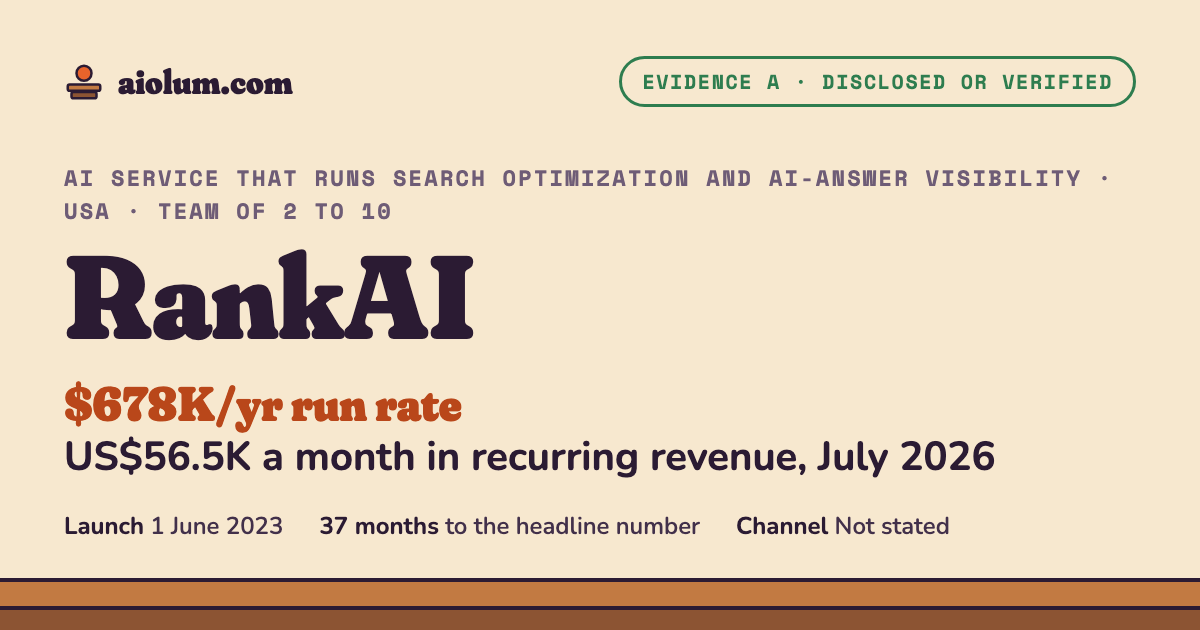
Y Combinator's directory lists two co-founders: Dyllan Liu, the chief executive, and Hugo (Kanghong) Zhan, the technology chief. Both worked in engineering at Amazon and studied at UC Berkeley. The company was founded in 2023 and went through Y Combinator's Summer 2023 batch in San Francisco. In September 2024 its plans cost US$69 and US$129 a month. In July 2026 its monthly recurring revenue (MRR), the total of all active subscriptions for one month, was US$56,533 from 155 subscriptions. That is a run rate, one month multiplied by twelve, of about US$678,000 a year. Revenue had been about US$21,000 a month from November 2025 to March 2026 and reached US$54,841 in July 2026.
The revenue figures are grade A: TrustMRR reads them from the company's account at Stripe, its payment processor, through an API key, a password that lets one program read data from another. That key expired on 30 July 2026, so no figure on this page is later than that day. RankAI took venture money from Y Combinator and, by its own account, from others. Y Combinator lists a team of three, and the same directory now lists Dyllan Liu under former founders. The page also shows four failed companies that sold traffic from platforms that they did not control.
The numbers, graded
Each row shows the evidence grade and the source numbers from the list at the end of this page. The grades are explained in How Aiolum verifies.
| Fact | Value | Grade | How we know | Sources |
|---|---|---|---|---|
| Monthly recurring revenue, 30 July 2026 | US$56,533 | A | TrustMRR snapshot from the Stripe API at the last sync. The profile gives MRR growth of 26.9% in the last 30 days of synced data. | [1] |
| Revenue in the 30 days to 30 July 2026 | US$54,910 | A | Stored snapshot from the last sync. The profile gives growth of 38.0% against the 30 days before. | [1] |
| Run rate from that MRR | about US$678,000 a year | calc | Calculated: 56,533 times 12 equals 678,396. This is the headline figure on this page. | [1] |
| Active subscriptions, 30 July 2026 | 155 | A | TrustMRR snapshot from Stripe. | [1] |
| Average MRR per active subscription | about US$365 a month | calc | Calculated: 56,533 divided by 155 equals 364.7. The profile does not show how the amounts are spread. | [1] |
| Revenue in the profile's last 12 months | US$290,278 | A | The ten monthly rows, October 2025 to July 2026, add up to US$290,277 (calculated), the same figure within rounding. So the window holds no payments after 30 July 2026: at most ten months of data, October 2025 to July 2026. | [1] |
| Monthly average over those 12 months | about US$24,190 | calc | Calculated: 290,278 divided by 12. It is below the mid-2026 level, because the window ends with more than two months without data. | [1] |
| Revenue since the start | US$376,985 | A | All-time figure from Stripe, as of 30 July 2026. | [1] |
| Share of all revenue earned in the last 12 months | 77% | calc | Calculated: 290,278 divided by 376,985 equals 0.770. The remaining US$86,707 came before October 2025. | [1] |
| Monthly revenue, November 2025 to March 2026 | US$18,016 to US$22,640 | A | Average US$20,833 a month (calculated). | [1] |
| Monthly revenue, April to July 2026 | US$37,029, US$41,775, US$39,865 and US$54,841 | A | July 2026 is 31% above May 2026, the best earlier month, and 2.4 times March 2026 (calculated). | [1] |
| Revenue synced after 30 July 2026 | none | A | The profile states that the Stripe API key expired at 21:04 UTC on 30 July 2026; the last sync was at 15:04 UTC that day. Its daily rows from 16 September to 15 October 2026 show US$0.00, and its 3-month total, US$15,967, is lower than July alone, so it covers days after the last sync. Without synced data these are not verified falls in revenue. | [1] |
| Team | 3 people | C | Team size in the Y Combinator directory, read 15 October 2026. The November 2024 launch post lists the same number: the two co-founders and a third team member who had grown FlowGPT to 4 million users through search traffic. | [2, 3] |
| Accelerator | Y Combinator, Summer 2023 batch | B | Y Combinator's own directory. Its standard deal is US$500,000 for 7% of the company plus an uncapped SAFE; no source says what RankAI received. | [2, 10] |
| Other investors | Treeo VC, and a seed stage dated December 2024 | C | Listed by the funding directory VCBacked, without an amount. No press report of a funding round was found. | [9] |
| Microsoft, OpenAI and a16z | logos under 'Backed by world-class investors' | C | Homepage. The TrustMRR description reads 'Investors from YCombinator, OpenAI, A16z, etc.', which can mean people who work there. No source says that Microsoft, OpenAI or a16z invested as companies. | [1, 4] |
| First published prices, September 2024 | US$69 and US$129 a month | C | Archived homepage: Starter with 2 blog posts a week, Advanced with 10 a week. | [7] |
| Entry price for agencies, October 2026 | from US$49 a month per client site | C | Agency page. Plans for businesses are sold through a demo call. | [5] |
| Pages on rankai.ai, October 2026 | 497 | calc | Calculated: counted in the sitemap on 15 October 2026. 368 articles, 53 blog posts, 22 comparison pages (17 with named SEO and AI-search competitors, 5 with website builders, Claude Code and content management systems), 16 free SEO tools and 15 education pages. | [8] |
| How customers arrive | not stated by any source | C | The November 2024 launch post asked readers for introductions to small businesses. In 2026 the company sells through agencies and publishes its own articles and free SEO tools. No source says which brought most customers. | [3, 5, 8] |
| Operating company | LineUpp, Corp. | C | Terms of service, governed by California law. | [6] |
| Time from founding to the July 2026 figure | 37 months | calc | Calculated: June 2023 to July 2026. The founding date is the one in the TrustMRR profile; no source gives a release date. | [1] |
How to read this table: a grade A value comes from the company's Stripe account through TrustMRR, as of the last sync on 30 July 2026. A grade B value is published by Y Combinator about its own investment. A grade C value is a company statement or a third-party directory. A "calc" value was computed on this page from the rows above it.
| Plan | Per month, billed yearly (US$) | Per month, billed monthly (US$) | Limit |
|---|---|---|---|
| Autonomous Agent, for agencies | from 49 | per client site; bulk pricing available | |
| Expert-Led Full Service, for agencies | custom | custom | dedicated strategist |
| For businesses | not published | not published | book a demo; the TrustMRR profile says a self-serve plan exists |
| Starter, September 2024 | 69 | 2 blog posts a week; shown next to US$109 | |
| Advanced, September 2024 | 129 | 10 blog posts a week; shown next to US$199 |
The current site publishes one price: the Autonomous Agent plan for agencies starts at US$49 a month for each client site, with bulk pricing, and the page does not say whether yearly billing is cheaper. The Expert-Led Full Service plan for agencies and the plan for businesses have no published price: the buyer books a call or a demo. The two 2024 rows come from the Wayback Machine, where each price was shown next to a higher crossed-out price. In July 2026 the average monthly recurring revenue per active subscription was about US$365 (calculated: 56,533 divided by 155).
The timeline
From a Y Combinator batch in 2023 to US$56,533 in monthly recurring revenue in July 2026, in 37 months. Each entry carries its grade.
- 1 June 2023CFounding date in the TrustMRR profile. Y Combinator's directory gives the founding year as 2023. [1, 2]
- Summer 2023BY Combinator's Summer 2023 batch, San Francisco. Y Combinator's standard deal is US$500,000; no source says what RankAI received. [2, 10]
- 12 September 2024CThe earliest archived homepage calls RankAI an AI SEO agency that is 20 times cheaper, with plans at US$69 and US$129 a month for 2 or 10 blog posts a week. Parts of the page still carry placeholder text from a website template. [7]
- 13 November 2024CLaunch post on Y Combinator's site: AI agents that replace marketing agencies. Five automated steps, from crawling the customer's site to publishing weekly blog posts. A team of three. [3]
- December 2024CThe funding directory VCBacked dates a seed stage to December 2024, with Y Combinator and Treeo VC as investors and no amount. [9]
- October 2025AFirst month in the profile's verified monthly table: US$12,604. [1]
- November 2025 to March 2026AVerified revenue stays between US$18,016 and US$22,640 a month. [1]
- April 2026ARevenue rises to US$37,029, 64% above March (calculated). [1]
- July 2026ABest month in the table: US$54,841. Monthly recurring revenue of US$56,533 from 155 active subscriptions. [1]
- 30 July 2026ALast revenue sync at 15:04 UTC. The Stripe API key that TrustMRR uses expires at 21:04 UTC the same day. No figures after this date. [1]
- October 2026CThe site sells search optimization, answer engine optimization and conversion work, with a white-label agency plan from US$49 a month per client. Y Combinator's directory shows the company as active with a team of 3, Hugo (Kanghong) Zhan as active founder and Dyllan Liu under former founders. [2, 4, 5]
Why it worked
Four causes, in the order they mattered. Each one is a reusable lesson.
Price
The 2024 launch post says that small business owners still pay thousands for marketing agencies, and that RankAI's first agent makes the SEO process 20 times more affordable. The archived 2024 homepage offered plans at US$69 and US$129 a month, against the US$1,000 to more than US$10,000 that the same page says businesses spend on agencies.
The full cycle, done for the customer
The launch post lists five steps: crawl the site, suggest technical fixes based on Google's guide, research keywords, write the content, and publish the fixes and weekly blog posts to the live site. The 2026 homepage adds measuring and rewriting: RankAI researches, publishes, measures, and rewrites. The terms of service describe the content as AI-generated and human-reviewed.
Agencies resell it
The agency page offers a white-label plan from US$49 a month per client site. It says that agencies resell this work at US$2,000 to US$6,000 a month in the U.S., and that RankAI aims to leave them at least 40% margin. Agencies are the first target persona in the TrustMRR profile.
From Google to AI answers
By October 2026 the product menu lists search engine optimization, answer engine optimization, conversion rate optimization and analytics, and the homepage names Google, ChatGPT, Claude and Perplexity as the places where pages should appear. Verified revenue went from US$22,640 in March 2026 to US$37,029 in April and US$54,841 in July. No source says which change caused the rise.
How it was built
These details come from the company's own pages and from the founder-written part of the TrustMRR profile. They are grade C, except the payment provider, which TrustMRR verifies. [1, 4, 5, 6, 8]
- Next.js for the website, and OpenAI and Stripe in the backend, as the tech stack in the TrustMRR profile lists them. No source names a model.
- Stripe takes the subscription payments. TrustMRR reads them through a Stripe API key, which expired on 30 July 2026.
- It publishes to the customer's content management system: the homepage names Webflow, Framer and WordPress, and a question in the FAQ also names Next.js and Sanity.
- The terms of service list website audits, technical fixes, keyword research, AI-generated and human-reviewed content, reporting, and integrations such as Google Search Console.
- Agency customers get white-label reports, one dashboard for all client accounts and a shared Slack channel for support.
- The company's own site follows the same method: its sitemap lists 497 pages in October 2026, including 368 articles, 53 blog posts, 22 comparison pages and 16 free SEO tools.
- The operating company is LineUpp, Corp. Its terms are governed by California law.
Tools named in the sources
Each one opens its page in the Tools tab, with every story that uses it.
The dead that came before
Four companies in the Loot Drop database sold small businesses and brands more traffic from a platform that they did not control, or content made mainly to rank. The values below are from that database and are not independently verified.
PostRocket
The promiseData-driven timing and tuning of Facebook posts, so that brands reach more people.
Why it diedThe product depended on Facebook's API and News Feed algorithm. Facebook changed both and moved brands toward paid ads.
Waterproof Digital Camera
The promiseCamera reviews written to rank in Google and earn affiliate commissions from Amazon.
Why it diedIt ranked through aggressive search tactics. Google's algorithm updates took away the traffic, and the commissions with it.
LocalOn
The promiseWebsites, social media and local search visibility for small shops, without coding.
Why it diedSmall businesses chose Shopify and Wix, which offered more. It ran out of money before it stood out.
Pressly
The promiseContent curation that keeps a brand's audience supplied with relevant posts with less effort.
Why it diedLarger marketing suites added curation as one feature among many, and a single-purpose tool could not stand out.
What changed
Each of the four sold traffic or content for a business, and each depended on a platform that decided how much attention the work received: Facebook's feed for PostRocket, Google's ranking for the affiliate blog, or a small-business market that larger platforms served better. The affiliate blog is the closest case: it made pages mainly to rank, and Google's updates removed the traffic.
Two things differ. First, language models make the writing and publishing cheap enough to sell the result of an agency for tens or hundreds of dollars a month, and agencies resell it at their own price. Second, the pages go on the customer's own site, about the customer's own products, and the terms say a person reviews them. The old risk remains: Google and the AI assistants decide how many visitors those pages receive.
Can one person copy it now?
The method, yes. Being early, no.
The method is public and several small teams sell it: an automated search service at a monthly price, sold to businesses directly and to agencies under their own brand. RankAI started in 2023 with Y Combinator's money and network, and its own site now carries 17 pages that compare it with named competitors.
Where it is still open: Search and AI-answer visibility for one platform or one industry, for example online stores or local services, where a narrow service can show results quickly.
- 1Sell the result that an agency sells, research, pages, publishing and rewrites, for a monthly fee that a small business can pay.
- 2Publish to the customer's own site and content management system, so that there is nothing to migrate.
- 3Give agencies a white-label version and a margin, so that they resell it to their clients.
- 4Add visibility in AI answers as assistants take a share of searches.
- 5Keep a human review step and add pages only where they help a reader, because of Google's scaled content abuse policy.
What to watch
The risks are the mirror image of the causes above.
Google's scaled content abuse policy
On 5 March 2024 Google announced its March 2024 core update and three new spam policies. One is scaled content abuse: many pages generated for the primary purpose of manipulating search rankings and not helping users, whether made by automation, by people or by both. One example in the policy is using generative AI tools to generate many pages without adding value for users. RankAI writes and publishes pages automatically, so its customers pass this test only where the pages add value for readers. Its terms say the content is human-reviewed, and in 2024 its larger plan offered 10 blog posts a week.
AI answers take clicks
Pew Research Center studied the browsing of 900 U.S. adults in March 2025 and published on 22 July 2025: users who saw a Google AI summary clicked a normal search result in 8% of visits, against 15% for users who did not see one, and clicked a link inside the summary in 1% of visits. RankAI now also sells visibility inside such answers, but a mention in an answer can bring fewer visits than a high ranking used to.
Same field, compared
This site's stories on SEObot (two co-founders, no outside money by the founder's statement, US$888,000 in the 12 months to October 2026) and ChatSEO (three co-founders, no outside money by the founders' statement, a run rate of US$385,000 a year in October 2026) describe the same automated search service; RankAI's run rate of about US$678,000 a year in July 2026 falls between them, and it is the only one of the three with venture money.
The verified figures stop on 30 July 2026
TrustMRR states that the Stripe API key expired on 30 July 2026, and nothing has been synced since. The profile does not say why. This does not show that revenue stopped or fell: the zeros after that date are missing data. It also means that nobody outside the company can see whether the growth of April to July 2026 continued.
Dependence on model providers
The only model provider that any source names is OpenAI, in the founder-written tech stack. A price rise, a policy change or an outage at that provider changes the cost and the output of every page RankAI writes. The homepage FAQ asks: why can't I just use Claude or ChatGPT? So the company itself treats the general AI assistants as a substitute for its service.
A change of founders
The Y Combinator directory describes Dyllan Liu as co-founder and chief executive, the 2024 launch post lists him in the team, and the TrustMRR profile still names its founder as Dyllan. The Y Combinator directory now lists him under former founders, with Hugo (Kanghong) Zhan as the active founder. No source says when or why this changed.
Sources
The grade next to each source is the best grade that the source can support. "Read in full" means that the text of the page was downloaded and the numbers were checked in it.
- A TrustMRR markdown profile of RankAI, revenue verified from Stripe, last synced 30 July 2026Read the markdown profile on 15 October 2026. The revenue, MRR and subscription figures in its Verification Sources section are grade A; the description, funding, investors and tech stack are founder-written, grade C.
- B Y Combinator company directory: RankaiRead in full. Source for the batch, founding year, team size, location, status and the active and former founders.
- C Launch YC, 13 November 2024: Rankai, AI Agents that Replace Marketing AgenciesRead in full (the page's data file). Founder-written launch post. Source for the thesis, the five steps and the team.
- C RankAI homepage, read 15 October 2026Read in full. Source for the product, the plans, the investor logos and the customer stories.
- C RankAI for agencies, read 15 October 2026Read in full. Source for the only published price and the reseller terms.
- C RankAI terms of serviceRead the sections on the operator, the services and governing law.
- C RankAI homepage archived by the Wayback Machine, 12 September 2024Read in full. The earliest snapshot; no snapshot of a pricing page exists. Source for the 2024 plans and prices.
- C RankAI sitemap, read 15 October 2026Downloaded and counted the 497 page addresses by section.
- C VCBacked: Rankai funding and investorsRead in full. A third-party funding directory. Source for the seed stage and Treeo VC; it gives no amount.
- C Y Combinator: the YC dealRead the deal terms. It describes the standard deal, not what RankAI received.
- B Google Search Central: spam policies for Google web searchRead the section on scaled content abuse.
- B Google Search Central Blog, 5 March 2024: What web creators should know about our March 2024 core update and new spam policiesRead the sections on the core update and the new spam policies.
- B Pew Research Center, 22 July 2025: Google users are less likely to click on links when an AI summary appears in the resultsRead in full. Source for the click rates with and without an AI summary.
- C Aiolum stories on SEObot and ChatSEORead the two story files on this site for the one-sentence comparison.
- C Loot Drop database export, 1,749 failed startupsLocal export. AI-written summaries, not independently verified. Source for the failed predecessors.