Chatbase
Chatbase builds AI agents for customer support. An AI agent here is a chat program that answers customer questions from a company's own documents and website, and that can take actions such as looking up an order or passing the conversation to an employee. The first version in February 2023 was much simpler: upload a PDF, then chat with its content.
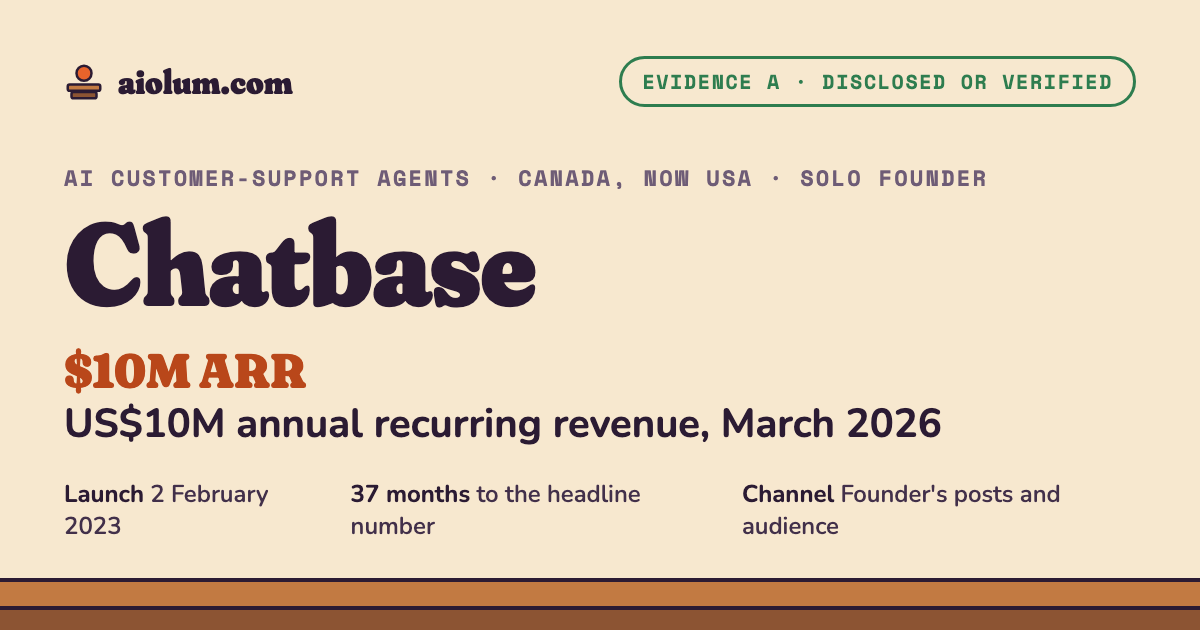
Yasser Elsaid built that first version in about two months while he was a final-year computer science student in Toronto. He posted a demo on 2 February 2023 to 16 followers, and the first customer paid about 30 minutes later. He reached US$1 million in annual recurring revenue 117 days after the demo, still alone. Annual recurring revenue (ARR) is the current monthly subscription revenue multiplied by twelve. In March 2026, Stripe, the company's payment processor, published that Chatbase had passed US$10 million in ARR with 26 employees and no outside investment.
This page grades every number by its evidence. The headline number comes from the payment processor. Most of the growth numbers are founder statements. The page also shows five failed startups that sold automated customer conversations before language models could hold one.
The numbers, graded
Each row shows the evidence grade and the source numbers from the list at the end of this page. The grades are explained in How Aiolum verifies.
| Fact | Value | Grade | How we know | Sources |
|---|---|---|---|---|
| Annual recurring revenue, March 2026 | US$10 million | A | Published by Stripe, the company's payment processor, in its customer story. One case study dates the milestone to May 2026; this page uses the Stripe date. | [1, 5] |
| Employees at US$10 million ARR | 26 | B | Stated in the Stripe story. A headcount is not a payment figure, so it is graded B. | [1] |
| Revenue per employee | about US$385,000 a year | calc | Calculated: 10,000,000 divided by 26 equals 384,615. | [1] |
| Paying customers, 2026 | more than 8,000 | B | Supabase customer story. The founder's own figure is more than 10,000 (grade C). | [2, 5] |
| Outside funding | none | B | Stripe writes fully bootstrapped. Supabase writes not a single dollar of venture funding. One AI-written directory claims a Y Combinator batch and a US$3 million raise. No other source supports that, so it is not counted. | [1, 2, 11] |
| First public demo | 2 February 2023, posted to 16 followers | C | Founder interviews. | [3, 5] |
| Time to the first paying customer | about 30 minutes | B | Stated in the Stripe story and in founder interviews. A pricing page was live at launch. | [1, 5] |
| Monthly recurring revenue, 11 February 2023 | US$400 | C | Monthly recurring revenue (MRR) is the subscription revenue of one month. | [5] |
| Monthly recurring revenue, end of February 2023 | US$3,000 | C | [5] | |
| Monthly recurring revenue, mid-March 2023 | US$10,000 | C | [5] | |
| Monthly recurring revenue, mid-May 2023 | US$64,000 | C | Founder interview with Indie Hackers. | [3, 5] |
| Time to US$1 million ARR | 117 days | C | Founder interviews. US$1 million ARR equals about US$83,000 of monthly revenue. | [4, 5] |
| Date of US$1 million ARR | 30 May 2023 | calc | Calculated: 2 February 2023 plus 117 days. | [5] |
| Employees until June 2023 | 1 | B | Stripe story: the founder was the only employee until June 2023. | [1] |
| ARR at the two-year relaunch, February 2025 | US$5 million | C | Founder post on Indie Hackers. | [4] |
| Time from US$1 million to US$3 million ARR | 7 months | C | Then 12 months from US$3 million to US$5 million. Growth slowed as the product moved from consumers to businesses. | [5] |
| ARR, December 2025 | US$8 million | C | Founder on the ProductLed podcast. Team of 18, of which 11 engineers. Retention 92%. | [5, 7] |
| Revenue recovered from failed card payments, 2023 to 2026 | US$870,000 | A | Stripe story. Money that automatic payment retries recovered. | [1] |
| Time from launch to US$10 million ARR | 37 months | calc | Calculated: February 2023 to March 2026. | [1, 3] |
How to read this table: a grade A value was published by Stripe, the payment processor that handles the revenue. A grade B value comes from a supplier's account or independent press. A grade C value is a founder claim. A "calc" value was computed on this page from the rows above it.
| Plan | Per month, billed yearly (US$) | Per month, billed monthly (US$) | Limit |
|---|---|---|---|
| Free | 0 | 0 | 50 message credits a month |
| Hobby | 32 | 40 | 700 message credits a month, 1 agent |
| Standard | 120 | 150 | 4,000 message credits a month |
| Pro | 400 | 500 | 15,000 message credits a month |
| Enterprise | custom | custom | Higher limits |
A message credit is one answer from a standard model. An answer from a larger model uses more credits, up to 5 per answer according to reviewers. Extra credits cost US$40 per 1,000. Removing the Chatbase name from the chat window costs US$99 a month. Yearly billing is 20% cheaper than monthly billing.
The timeline
From a weekend demo to US$10 million in annual recurring revenue in 37 months. Each entry carries its grade.
- November 2022CElsaid, in his last year at York University in Toronto, experiments with the GPT-3 API, weeks before ChatGPT is released. He did not get a return offer from his Meta internship. [3, 4]
- 2 February 2023BHe posts a demo of ChatGPT for your PDFs to 16 followers. The post spreads. A pricing page is live, and the first payment arrives about 30 minutes later. [1, 5]
- February 2023CHe stops attending class and fails two final courses. The first plan costs US$9.99 a month. [3, 7]
- Mid-May 2023CUS$64,000 in monthly recurring revenue. No marketing budget: subreddits, X, LinkedIn and Product Hunt. He hires his first two employees. [3]
- 30 May 2023CUS$1 million ARR, 117 days after the demo, with one person. [4, 5]
- 2023 to 2024CChatbase moves from a consumer tool with US$10 and US$30 plans to a business product: support agents that connect to a company's systems. The team moves from Toronto to New York, where 98 of its 100 target accounts are. [5, 7]
- February 2025CRelaunch as an AI agent platform, US$5 million ARR. [4]
- December 2025CUS$8 million ARR, 92% retention, 18 people. [5, 7]
- March 2026AStripe publishes that Chatbase passed US$10 million ARR with 26 employees. [1]
- 2026CThe product sells agents for chat, email and voice, with a plan for enterprise customers. [9]
Why it worked
Four causes, in the order they mattered. Each one is a reusable lesson.
Timing
The GPT-3 API became usable in late 2022, and ChatGPT created demand in January 2023. Chat with your own documents was the obvious application. Elsaid shipped it within weeks, before the category had a name. In 2023 he said himself that the viral launch was a one-time advantage and not a strategy.
The harness, not the model
Chatbase owns everything around the model: document ingestion, retrieval of the right passage, rules that keep the agent on script, a fallback to a human, and analytics. The founder's bet was that the models would keep improving. Every model upgrade since then improved Chatbase at no cost.
Paid self-serve from day one
A pricing page and Stripe checkout were live at the first demo. Customers entered a card and deployed an agent without talking to anyone. The founder was the only employee for the first four months, so the product had to sell itself.
From toy to business tool
Hundreds of chat-with-PDF tools appeared in 2023. Chatbase left that market and sold support agents to businesses. Business customers pay more and leave less: the founder reports 92% retention. Growth was slower in that phase, from US$1 million to US$5 million in 19 months, but it held.
How it was built
These details come from founder interviews and from the customer stories of two suppliers, Supabase and Stripe. They are grade B and C. [1, 2, 3, 5]
- React and Next.js for the web app. Supabase, a hosted Postgres database with built-in login and file storage, as the whole backend, so one person did not have to connect four services.
- The OpenAI API and LangChain for the model calls. Pinecone, a vector database, stored the document embeddings at first. Later the embeddings moved into Postgres itself with the pgvector extension, so the search runs next to the data.
- Stripe Checkout and Billing for subscriptions, usage credits and add-ons, and Stripe Radar with custom rules against card-testing attacks, which self-serve products attract.
- The first version took about two months to build. Growth was organic: a story posted in subreddits worked better than a tool announcement, plus X, LinkedIn and Product Hunt.
- Later: one person owns search optimization for both search engines and AI answer engines, and about 80% of outbound sales go to warm leads who already visited the site.
- Team at US$8 million ARR: 18 people, 11 of them engineers. New hires then shifted to growth and sales.
Tools named in the sources
Each one opens its page in the Tools tab, with every story that uses it.
The dead that came before
Five companies in the Loot Drop database sold automated customer conversations before language models could hold one. The values below are from that database and are not independently verified.
Answerly
The promiseFAQ chatbots that deflect support tickets so humans handle only the complex cases.
Why it diedEvery customer needed months of hand-written FAQs and decision trees. The language processing of the time could not handle real questions, and a failed answer annoyed the customer twice.
Hipmob
The promiseCustomer chat inside mobile apps.
Why it diedIntercom and Zendesk added the same feature to larger products. With almost no funding, it stayed invisible.
RightHello
The promiseLive chat for online shops that turns visitors into buyers.
Why it diedA human had to answer every chat. Intercom raised US$240 million while RightHello had US$600,000, and small shops churned faster than they could be acquired.
Niles
The promiseA bot inside Slack that answers questions from the company's knowledge.
Why it diedSlack built its own search, and the bot needed constant retraining that a small customer base could not pay for.
Vanti
The promiseShopping chatbots that guide customers to a purchase.
Why it diedIt built its own language models. When GPT-4 arrived, any startup could build the same conversation for a fraction of the cost, and the custom models became worthless overnight.
What changed
Before 2023, a support bot needed its answers written by hand. Answerly's customers spent months on FAQs and decision trees, and the bot still failed on any question that was phrased in a new way. The companies that survived in that market, Intercom and Zendesk, sold tools for human agents, not replacements.
Language models removed the hand-written part. A company uploads what it already has, and the model reads it. Chatbase's first version was built by one student in two months, and the same idea had cost Answerly three years. Vanti is the sharpest contrast: it spent US$18 million on its own models and closed in 2024, one year after Chatbase reached US$1 million ARR on a rented model.
Can one person copy it now?
The first product, no. The pattern, yes.
Chat with your documents was copied hundreds of times within months of the launch, and the founder said in 2023 that the viral start was not repeatable. The business product now competes with Intercom and Zendesk, which bundle AI agents into their support suites, and with venture-funded agent companies that target the same enterprise accounts.
Where it is still open: The vertical version is still open: a support agent built for one industry, with the integrations and the rules that industry needs. Examples: clinics, logistics companies, banks in one country. Voice support in languages other than English is also early.
- 1When a model newly does one thing reliably, ship the obvious application within weeks, with a pricing page on the first day.
- 2Build the parts around the model: data ingestion, retrieval, rules, human handoff, analytics. Rent the model itself.
- 3Grow without a marketing budget first, then spend when revenue is reliable.
- 4Leave the consumer version when copies appear, and sell to businesses that stay.
What to watch
The risks are the mirror image of the causes above.
Bundling by incumbents
Intercom and Zendesk sell AI agents inside products that their customers already pay for. Chatbase must win on product quality and price, and the founder says quality is the only moat when features are easy to copy.
Model costs
Chatbase rents every answer from a model provider and resells it as credits. Reviewers report that an answer from a large model costs 5 credits instead of 1. If model prices fall, margins improve. If customers demand the largest models, margins fall.
Slower growth upmarket
ARR went from US$1 million to US$3 million in 7 months, then took 12 months to reach US$5 million. Enterprise sales need salespeople, onboarding calls and compliance work, which the founder is now adding.
Numbers that do not agree
Customer counts are 8,000 in the Supabase story and 10,000 in founder statements. The US$10 million ARR date is March 2026 at Stripe and May 2026 in one case study. One directory claims a Y Combinator batch and a US$3 million raise that no other source mentions.
Churn in the small-business segment
RightHello and Hipmob died from churning small customers. Chatbase's self-serve plans serve the same segment. The reported 92% retention is a founder figure.
Sources
The grade next to each source is the best grade that the source can support. "Read in full" means that the text of the page was downloaded and the numbers were checked in it.
- A Stripe customer story, 2026: Bootstrapped startup Chatbase reaches $10 million in ARR with StripeRead in full. Stripe is the company's payment processor. Primary source for the ARR, the headcount, the recovered revenue and the founding month.
- B Supabase customer story, 2026: The consolidation play that took a single founder from zero to 10 million in ARRRead in full. A supplier's account with founder quotes. Source for the customer count, the team size and the database details.
- C Indie Hackers, 2023, interview by Channing Allen: How a college student reached $64,000/mo in 6 months by being an AI first moverRead in full. Founder interview. Source for the launch story, the early stack and the growth tactics.
- C Indie Hackers, February 2025, founder post: From viral side project to a $5M/yr B2B AI platformRead in part. The full post is behind a membership wall. Source for the US$5 million ARR at the relaunch.
- C Superframeworks case study, 2026: Bootstrapped to $10M ARR, $1M in 117 Days From a Tweet to 16 FollowersRead in full. Summarizes a video interview with the founder. Source for the month-by-month revenue of 2023 and the growth phases.
- C Solo Founders newsletter, 2026: $9M ARR, no VC, solo founderRead the summary only. Confirms US$9 million ARR in early 2026 and the bootstrapped status.
- C ProductLed podcast, February 2026: How Chatbase hit $8M ARR with 18 peopleRead the episode summary, not the audio. Source for the December 2025 ARR, the team size and the move to New York.
- C Chatbase documentation and blogNot used for numbers.
- C Chatbase pricing page, read 12 October 2026, with review sites costbench.com and chatarmin.com for the plan pricesThe company page gives the Hobby price, the credit amounts and the add-on prices. The Standard and Pro prices and the credit cost of large models come from review sites.
- C Loot Drop database export, 1,749 failed startupsLocal export. AI-written summaries, not independently verified. Source for the failed predecessors.
- C NeuronFeed directory entry for ChatbaseRead in full. An AI-written directory. It claims a Y Combinator batch and a US$3 million raise. Cited only for that conflict.