My AskAI
My AskAI sells an AI agent for customer support that works inside the help desk a company already uses. A help desk is the software in which support staff receive and answer customer messages; Intercom, Zendesk, Freshdesk, Gorgias and HubSpot are examples. The agent reads the company's help center, website and past tickets, answers the customer in the same chat window, and passes the conversation to a human in the same tool when it cannot answer. The company charges a monthly plan with a price per ticket.
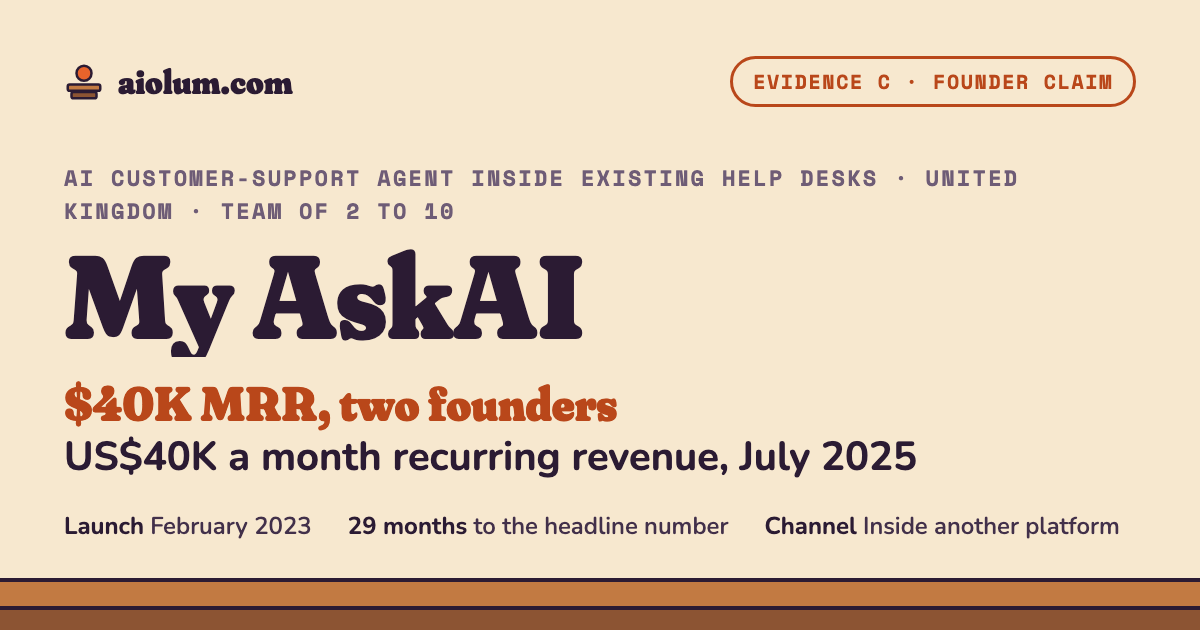
Alex Rainey, a former Accenture consultant and founder of a travel-insurance startup, and Mike Heap, a former Ernst & Young accountant and product manager, launched it in London in late February 2023. The first version was a general tool: upload any document, then ask questions about it. Rainey built it alone on Bubble, a no-code tool, which is a visual editor that produces a working web application without written program code. Revenue reached about US$14,000 a month by May 2023 and US$20,000 by November 2023, then stayed between US$20,000 and US$25,000 until the middle of 2024. About a year after launch the founders narrowed the product to customer support, which already brought 70% of the revenue, and rebuilt it in about six weeks. In July 2025 Rainey reported about US$40,000 in monthly recurring revenue (MRR), which is the subscription revenue of one month, still with two people and no investors.
Every revenue number on this page is a founder statement, grade C. The numbers were published in eight places between April 2023 and July 2025, and they agree with each other except for a few points that the page lists. No figure after July 2025 is public. Chatbase, SiteGPT and DocsBot AI, which are already on this site, started from the same 2023 idea and sell their own chat agent; My AskAI differs in the no-code build and in the choice to work inside other vendors' help desks. At the dates each one reported, it was smaller than Chatbase (US$10 million a year) and DocsBot AI (US$1 million a year) and larger than SiteGPT (US$190,000 a year).
The numbers, graded
Each row shows the evidence grade and the source numbers from the list at the end of this page. The grades are explained in How Aiolum verifies.
| Fact | Value | Grade | How we know | Sources |
|---|---|---|---|---|
| Monthly recurring revenue, July 2025 | about US$40,000 | C | Founder Alex Rainey in an Indie Hackers interview published on 10 July 2025. He also gives it as about US$500,000 a year. This is the latest dated revenue figure found. | [1] |
| Run rate from the July 2025 figure | US$480,000 a year | calc | Calculated: 40,000 times 12 equals 480,000. A run rate is the current month multiplied by twelve. The founder rounds it to about US$500,000. | [1] |
| People in the company, July 2025 | 2, both founders | C | Founder statement in the same interview. In June 2024 Starter Story listed 2 founders and 0 employees, and an agency wrote blog content for them. The company's LinkedIn page still showed 2 employees on 13 October 2026. | [1, 3, 11] |
| Run rate per person | US$240,000 a year | calc | Calculated: 480,000 divided by 2. | [1] |
| Outside funding | none | C | Founder statements in 2024 and 2025: the first version was paid with cash from earlier projects, and the founders say they want to stay without investors. Rainey's earlier company, Pluto, raised US$1.5 million. That money is not part of My AskAI. | [1, 4, 7] |
| Support conversations handled, July 2025 | more than 75,000 a month | C | Founder statement. | [1] |
| Gross margin, July 2025 | about 82% | C | Founder statement, with the cost of the AI models included. In June 2024 Heap gave 85% to 90% gross margin and 50% to 55% net margin. | [1, 3] |
| Customers who cancel per month (churn) | 12% to 13% in January 2024, 3% in July 2025 | C | Churn is the share of paying customers who cancel in one month. In the 2025 interview Rainey says it fell from 9% to 3% after better onboarding and analytics. | [7, 1] |
| Monthly revenue, 31 May 2024 | US$25,000 | C | Published by Bubble, the maker of the tool the product is built with, in its customer story. Bubble does not handle the payments, so the figure is the founders' own and is graded C. The same story gives more than 40,000 registered users. | [2] |
| Run rate from the May 2024 figure | US$300,000 a year | calc | Calculated: 25,000 times 12 equals 300,000. | [2] |
| Yearly revenue as stated in June 2024 | US$300,000 | C | In the title of a podcast episode of 11 June 2024 with Heap, and in the title of his Starter Story interview of 18 June 2024. The summary box on the Starter Story page shows US$20,000 a month, which is US$240,000 a year. | [3, 4] |
| One project outside the subscriptions, before June 2024 | about US$100,000 | C | Heap: one piece of work that came from a LinkedIn message, for about one week of work. It is not recurring revenue. | [3] |
| MRR, January 2024 | more than US$20,000 | C | Newsletter interview with Rainey, 29 January 2024. | [7] |
| MRR, November 2023 | US$20,000 | C | Title of a No Code MBA video interview with Heap, published on 3 November 2023. Only the title, the date and the description were read. | [8] |
| MRR, 18 May 2023 | about US$14,000, just over 300 paying users | C | Both founders in an Indie Hackers interview, about three months after launch. | [5] |
| Average revenue per paying user, May 2023 | about US$47 a month | calc | Calculated: 14,000 divided by 300 equals 46.67. The lowest plan in October 2026 costs US$199 a month. | [5, 10] |
| MRR, 11 April 2023 | US$6,000, more than 13,000 sign-ups | C | Rainey, about six weeks after launch. | [6] |
| Presale before the product existed, early 2023 | about US$5,000 | C | Just over 50 people paid US$99 each within two weeks, on the description alone. Check: 50 times 99 equals 4,950. | [3, 5] |
| Cost and time of the first version | under US$1,000, two to three weeks | C | Rainey says three weeks and under US$1,000 for Bubble and OpenAI. Heap says about two weeks. | [1, 3] |
| Share of revenue from customer support before the product was narrowed | 70% | C | Heap, in an interview on a supplier's blog, June 2024. | [9] |
| First archived home page that describes a support agent inside Intercom or Zendesk | 16 June 2024 | B | Wayback Machine. The snapshot of 10 October 2023 still describes a general AI assistant for any content. The wording changed between those two dates. An archive proves what the page said, not that its claims were true. | [15] |
| Growth from May 2024 to July 2025 | 60% in 14 months | calc | Calculated: from 25,000 to 40,000 is plus 60%. May 2024 to July 2025 is 14 months. | [1, 2] |
| Time from launch to US$40,000 MRR | 29 months | calc | Calculated: February 2023 to July 2025. | [1, 6] |
| Customers, October 2026 | more than 200 companies | C | Company's LinkedIn page, read on 13 October 2026. The same page says more than one million tickets resolved in total. No revenue figure after July 2025 was found. | [11] |
| Third-party estimate for October 2024 | US$212,500 a year | C | GetLatka marks this value as its own estimate. It is lower than the founders' figures for the middle of 2024. No founder statement confirms a fall in revenue. | [16] |
How to read this table: a grade C value is a founder statement in an interview or on a company page, or a third-party estimate that says so. A grade B value was recorded by an independent party. A "calc" value was computed on this page from the rows above it. No value is grade A: no payment processor has published these numbers.
| Plan | Per month, billed yearly (US$) | Per month, billed monthly (US$) | Limit |
|---|---|---|---|
| Pro | not shown | 199 | 1,000 credits a month, about 1 credit per chat ticket |
| Scale | not shown | 499 | not shown in the page data |
| Enterprise | custom | custom | on request |
The visible pricing page loads by script, so the prices were read from the structured data in the page source. It lists two plans, each after a 30-day free trial. It does not show a yearly price or the limit of the Scale plan. The company advertises a price from US$0.10 a ticket and says that a typical chat ticket uses about one credit. If a customer uses all 1,000 credits of the Pro plan, one credit costs US$0.199 (199 divided by 1,000). A company blog post of June 2026 mentions an offer of 50% off the first three months. Enterprise prices are on request.
The timeline
From a US$99 presale to about US$40,000 in monthly recurring revenue in 29 months, with about seven months without growth in between. Each entry carries its grade.
- Autumn 2022CHeap and Rainey meet through a friend. They build a tool that writes university application statements with fine-tuned AI models. It gets a few paying users, and OpenAI tells them to shut it down. [3, 4, 5]
- End of 2022CThey build No Code AI Model Builder in a few days for a hackathon. It makes about US$3,500 in sales in a few months. They sell it later to work only on My AskAI. [3, 5]
- Early 2023CA page inside the model builder offers a new product that does not exist yet. Just over 50 people pay US$99 each in two weeks, about US$5,000. At the end of January both founders decide to stop looking for other work and to build it. [3, 5]
- Late February 2023CMy AskAI launches, with a Product Hunt launch. Rainey built it on Bubble in two to three weeks for under US$1,000. The product: upload content, ask a question, get an answer. [1, 3, 6]
- 11 April 2023CUS$6,000 MRR and more than 13,000 sign-ups. Marketing so far: Twitter, Product Hunt and AI tool directories, with no paid ads. [6]
- 18 May 2023CAbout US$14,000 MRR with just over 300 paying users. [5]
- 3 November 2023CUS$20,000 MRR, in the title of a video interview. The archived home page of October 2023 still sells a general AI assistant for any content. [8, 15]
- January 2024CMore than US$20,000 MRR, with 12% to 13% of customers cancelling each month. The newsletter describes the product as a customer-support AI tool. [7]
- Early 2024CThe founders narrow the product to customer support, about 12 months after launch. Support was 70% of revenue. Rainey rebuilds the product for this use in about six weeks. [1, 2, 9]
- 31 May 2024CBubble publishes a customer story: US$25,000 in monthly revenue, more than 40,000 registered users, no staff except the two founders. [2]
- June 2024CA podcast episode and a Starter Story interview with Heap give US$300,000 a year. Heap says the company is profitable. [3, 4]
- 16 June 2024BThe archived home page reads: your AI agent for customer support, add to your existing live chat providers, like Intercom or Zendesk. [15]
- 10 July 2025CAbout US$40,000 MRR, more than 75,000 support conversations a month, churn at 3%, still two people. Rainey says the goal for 2025 is US$1 million a year and that it will be hard to reach. [1]
- October 2026CThe company is running. Its blog published customer case studies in September 2026, and its LinkedIn page shows 2 employees, more than 200 customer companies and five supported help desks. No revenue figure after July 2025 is public, so the trend since then is not known. [10, 11, 12]
Why it worked
Four causes, in the order they mattered. Each one is a reusable lesson.
A narrower customer
The first product was a tool to chat with any content, used by students, law firms and support teams. The founders say this made it hard to choose features and to describe the product. Support was 70% of revenue, so they rebuilt the product for support teams of software companies only. Reported churn fell from 12% to 13% a month in January 2024 to 3% in July 2025. In May 2023 the average paying user paid about US$47 a month; in 2026 the lowest plan costs US$199.
Inside the tool the customer already has
A support team does not replace its help desk. It installs My AskAI from the help desk's app marketplace, and the agent answers in the same inbox and hands over to human agents there. The company says a standard setup takes 10 to 15 minutes. This removes the largest cost of a new support tool, which is the move away from the old one.
A lower price than the host's own AI
My AskAI advertises a price from US$0.10 a ticket. Intercom's own agent, Fin, costs US$0.99 per outcome, which Intercom counts at most once per conversation when the issue is resolved or Fin completes a workflow. Zendesk charges US$1.50 to US$2.00 for each automated resolution above the included number. The units are not the same: My AskAI counts tickets, and the two hosts count resolved cases. The founders used the price difference as the main message on their site, and say that most new customers find them through Google or ChatGPT when they look for an alternative.
A no-code build keeps the team at two
Rainey is the only developer. He built the first version in weeks and ships changes almost daily, without pull-request reviews. Heap, who does not program, handles finance, customers, design and testing. Both say they try to automate a task before they hire for it. The cost is dependence on Bubble, which is covered below.
How it was built
These details come from founder interviews and from the blogs of two suppliers, Bubble and Pinecone. They are grade B and C. [1, 2, 3, 4, 9]
- Bubble, a no-code editor, for about 80% of the core application: the screens and the workflows. The back end outside Bubble is written in Python. The company moved to Bubble's Enterprise tier when daily traffic reached 50,000 requests, and in 2025 it was moving more of its hosting to its own AWS account.
- Retrieval-augmented generation (RAG): the program first searches the customer's content for the few passages that match a question, then gives only those passages to the language model. This keeps answers tied to the customer's own documents.
- In June 2024: Pinecone as the vector database, LangChain to split text into pieces of 400 tokens with 20 tokens of overlap, OpenAI models for embeddings and answers, Carbon to read websites and third-party sources, and Portkey as a gateway that switches to a second model when the first one fails and caches answers.
- Demand was tested with a US$99 presale before any code existed. The first version took two to three weeks and under US$1,000. The rebuild for customer support took about six weeks.
- Early growth came from AI tool directories, replies to large accounts on Twitter, AI newsletters and a Product Hunt launch about once a month. The founders say each of these stopped working within months. By 2025 most growth came from search, with site text that compares the price with Intercom Fin and Zendesk AI. The founders hold an onboarding call with every serious customer.
- Two people run the company through Slack and a simple roadmap in Notion, with one meeting in person each week. They use Cursor and ChatGPT for their own work.
Tools named in the sources
Each one opens its page in the Tools tab, with every story that uses it.
The dead that came before
Five companies in the Loot Drop database either automated customer support before language models could do it, or built their product inside a platform that another company owned. The values below are from that database and are not independently verified.
Answerly
The promiseFAQ chatbots that deflect support tickets so humans handle only the complex cases.
Why it diedThe language processing of the time could not handle real customer questions. Every customer had to write FAQs and decision trees by hand, so setup took months.
Hipmob
The promiseCustomer chat inside mobile apps.
Why it diedIntercom and Zendesk added chat features that matched it. With little funding it could not give customers a reason to switch.
Niles
The promiseA bot inside Slack that answers staff questions from the company's knowledge.
Why it diedSlack was its only platform. Slack improved its own search, and the bot lost its value to customers.
Flux
The promiseOne inbox for Slack, email, WhatsApp and other messaging apps.
Why it diedThe external platforms kept changing and breaking the integrations. The team spent its money on repairs instead of its own priorities.
PostRocket
The promiseBetter timing of posts, so that a company's Facebook page reaches more people.
Why it diedThe product relied on Facebook's API. Facebook changed the API and its rules in favor of its own advertising products, and PostRocket had no second platform.
What changed
Before 2023, a support bot needed its answers written by hand. Answerly's customers spent months on FAQs and decision trees, and the bot still failed when a question was phrased in a new way. Language models removed that work: My AskAI reads the help center and past tickets that a company already has. The build also became cheaper. One founder without an engineering team built the first version in two to three weeks for under US$1,000, with a no-code editor and a rented model.
The second cause of death in this list did not change. Niles, Flux and PostRocket depended on a platform that another company owned, and each platform owner improved its own feature or changed its rules. My AskAI is in the same position with Intercom and Zendesk, and both now sell their own AI agents. Two things differ so far. The hosts charge per resolved case at prices that leave room for a cheaper add-on, and My AskAI works with five help desks, so one host cannot end it alone.
Can one person copy it now?
The 2023 launch, no. The method, yes.
The first product, chat with your documents, was copied hundreds of times in 2023, and the founders say that the early marketing channels stopped working within months. What can be repeated is the sequence: sell before building, build with a tool that one person can change daily, find the use that pays, and attach the product to software the customer already pays for. The limit is that the host can lower its price or change its marketplace rules.
Where it is still open: The same position, a cheaper AI layer inside a tool the customer keeps, is open for help desks that the large vendors serve less well, such as regional help-desk products or a single industry with its own rules. In June 2024 Heap named online shops as the larger market; by 2026 the company's case studies include online shops.
- 1Sell a presale before you build. Here, 50 buyers at US$99 in two weeks decided which product to make.
- 2Build the first version with a no-code tool or an AI coding tool, so that one person can ship changes every day.
- 3Look at which use brings most of the revenue, and rebuild the product for that use only. Here it was 70%.
- 4Work inside the software the customer already uses, so that nobody has to switch, and price the product below the host's own feature.
- 5Talk to every serious customer during onboarding. The founders say this and better analytics cut churn from 9% to 3%.
What to watch
The risks are the mirror image of the causes above.
The hosts sell their own AI agents
Intercom's pricing page lists Fin at US$0.99 per outcome and says that Fin also works with other help desks, including Zendesk and Freshdesk. Zendesk includes AI agents in every Suite and Support plan and charges US$1.50 to US$2.00 for each extra automated resolution. My AskAI describes itself as a replacement for the host's native AI at a lower price. If the hosts lower their prices, the main reason to install it becomes weaker.
Dependence on marketplaces and APIs
The company's own description says that the product works through approved app and marketplace integrations of each help desk. A host can change its API, its approval rules or its fees. No source shows that a host has restricted My AskAI so far. Niles and PostRocket in the list above closed after their platform owner changed its product or its rules.
Dependence on Bubble and on one developer
About 80% of the core application runs on Bubble, and Rainey is the only developer. He reports a few large outages during growth, which ended with a move to Bubble's Enterprise tier, and says he should have upgraded earlier. The company is moving parts of the system to Python and its own AWS account.
No figure after July 2025
The founders published revenue openly from 2023 to the middle of 2025. In July 2025 Rainey said the goal of US$1 million a year for 2025 would be hard to reach. No later figure was found. The signs in October 2026 are indirect: 2 employees, more than 200 customer companies and an active blog. No payment processor has confirmed any number, and no TrustMRR profile was found for the company.
Numbers that do not agree
The Starter Story page of June 2024 says US$300,000 a year in its title and US$20,000 a month in its summary box. In 2025 Rainey summarized the history as US$10,000 MRR in month four, a stall, a change of direction and US$40,000 MRR six months later; the dated figures show US$14,000 in month three, US$20,000 in November 2023, US$25,000 in May 2024 and US$40,000 in July 2025. Bubble's story says the founders sold the first version of the tool at the change of direction; the founders' own interviews say they sold the earlier model builder. GetLatka estimates US$212,500 a year for October 2024, below the founders' figures.
A stall, and no proof of a fall
The sources show about seven months without growth, from US$20,000 in November 2023 to between US$20,000 and US$25,000 in June 2024. No founder statement found for this page reports a fall in revenue. The one lower value, for October 2024, is a third-party estimate.
Sources
The grade next to each source is the best grade that the source can support. "Read in full" means that the text of the page was downloaded and the numbers were checked in it.
- C Indie Hackers, 10 July 2025, interview by James Fleischmann: Bootstrapping to $40k MRR after his VC-backed startup failedRead in full in the Wayback Machine copy of 2 May 2026. The live page shows only the first section without a login; that section contains the headline figure. Founder interview. Primary source for the July 2025 revenue, the team size, the margin, the churn and the stack.
- B Bubble customer story, 31 May 2024: How My AskAI Is Leveling Up the Customer Support GameRead in full. A supplier's account with founder quotes. Bubble can observe that the application runs on its platform. It does not handle the payments, so the revenue figure in it is graded C.
- C Starter Story, 18 June 2024, interview with Mike Heap: I Built A $300K/Year AI Business For Less $50 BucksRead the sections on the start, the presale, the launch, the growth channels, churn and the current numbers. Founder interview.
- C Grow Your B2B SaaS podcast, 11 June 2024: S4E7, How MyAskAI bootstrapped with a team of 2 to $300k ARR, with Michael HeapRead the show notes and the transcript sections on the start, the presale, Bubble and the two-person team. The US$300,000 figure is in the title and the show notes.
- C Indie Hackers, 18 May 2023, interview by Darko Gjorgjievski: Making $14,000 in MRR with a custom ChatGPT toolRead in full. Interview with both founders. Source for the May 2023 revenue, the paying users, the presale and the earlier products.
- C NoCodeLife, 11 April 2023, interview by Kieran Ball: $0 to $6k MRR in 1.5 months with a no-code appRead in full. Interview with Alex Rainey. Source for the launch date and the April 2023 revenue.
- C SaaStrappers newsletter, 29 January 2024: Interview with Alex Rainey, AI bootstrapped startup generating $20K+ MRRRead the sections on revenue, funding and churn.
- C No Code MBA on YouTube, 3 November 2023: Growing an AI app on Bubble to $20k MRR within monthsRead the title, the date and the description only, not the video. The title spells the guest's name as Mike Kean; Mike Heap's own page lists this video as his interview.
- C Pinecone blog, 14 June 2024: RAG Brag with My AskAI founders, Mike Heap and Alex RaineyRead the sections on the change of direction and on the architecture. A supplier's blog, but every statement in it is a founder's answer.
- C My AskAI pricing page, read 13 October 2026, with the company blog post of 22 June 2026 on AI customer service for solo foundersThe visible page loads by script. Read the structured data in the page source for the two plan prices and the free trial, and the blog post for the credits in the Pro plan.
- C My AskAI company page on LinkedIn, read 13 October 2026Read the public page without a login. Company-written text. Source for 2 employees, more than 200 customers, more than one million tickets and the supported help desks.
- C My AskAI blog: pages about the two founders, updated February and September 2026Read both pages in full. Source for the founders' earlier jobs and products, and for the list of their interviews. The blog index showed new case studies dated 10 September 2026.
- C Intercom Fin pricing page, read 13 October 2026Read the plan section. Source for US$0.99 per outcome and for the statement that Fin works with other help desks.
- C Zendesk pricing page, read 13 October 2026Read the sections on AI agents and automated resolutions. Source for the included AI agents and the prices of US$1.50 and US$2.00 per extra automated resolution.
- B Wayback Machine snapshots of the My AskAI home page: 13 March 2023, 10 October 2023, 16 June 2024 and 28 February 2025Read the page title and the description of each snapshot. An independent archive of the company's own page. Source for the dates between which the product changed from a general assistant to a support agent.
- C GetLatka company page for My AskAI, updated 10 August 2026Read in full. A third-party database. Its value for October 2024 is marked as an estimate. Cited only for that conflict.
- C LinkedIn post by Tomasz Wesolowski, 10 July 2025, on a conference talk by Alex RaineyRead in full. A listener's summary of the talk. The date was computed from the post's ID. It confirms the two founders, the Bubble Enterprise plan and the integrations. Not used for numbers.
- C Loot Drop database export, 1,749 failed startupsLocal export. AI-written summaries, not independently verified. Source for the failed predecessors.