FounderPal
FounderPal is an AI wrapper for marketing: a product that sends what the user types to another company's AI model, together with its own long instructions, called prompts, and shows the answer in its own screens. The user describes a product, waits about five minutes and gets a marketing strategy, customer profiles and a list of tasks. It calls OpenAI's GPT-4 model through the API, the paid connection that lets a program use the model, and it was built without code in Bubble, a service that makes web apps from visual building blocks. The paid strategy is sold by one-time payment, a single charge instead of a monthly subscription.
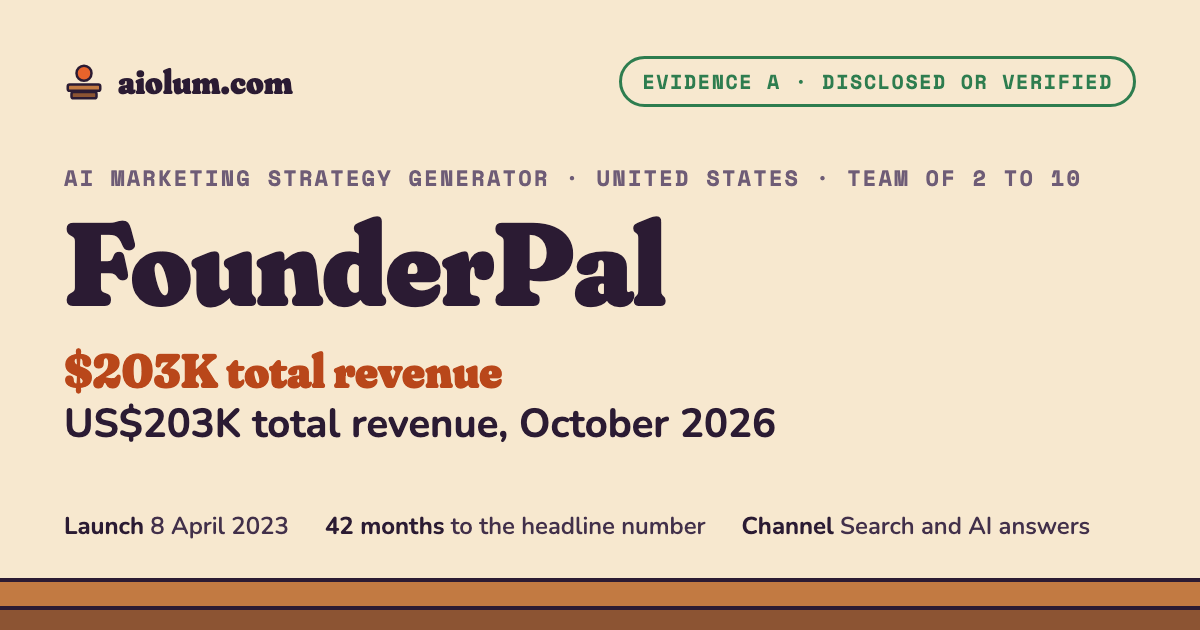
Dan Kulkov and his wife Sveta Bay sold marketing guides and prompt collections under the name MakerBox before they started FounderPal. The founders say their first version, a tweet ideas generator released in April 2023, failed. The second product, Marketing Strategy Generator, launched on 11 September 2023 and made US$1,249 on the first day and US$18,709 in the next 58 days. In March 2024 the couple reported 800 paying customers and around US$10,000 a month, with 2 founders, no employees and no outside money. Stripe data read by TrustMRR, a site that takes revenue figures directly from a company's payment account, show US$202,983 in total revenue by 14 October 2026, about 90% of it earned before November 2025.
Since then, revenue has fallen to almost nothing: US$4,074 in November 2025, US$298 in September 2026, and the MRR, the monthly recurring revenue from subscriptions, is zero. The total is grade A, from the payment processor. The monthly figures before November 2025 are the founders' own statements, grade C. No sale of the business was found, and the founders' recent posts are about other products. The page also shows earlier companies that sold marketing help to small businesses and failed.
The numbers, graded
Each row shows the evidence grade and the source numbers from the list at the end of this page. The grades are explained in How Aiolum verifies.
| Fact | Value | Grade | How we know | Sources |
|---|---|---|---|---|
| Total revenue, to 14 October 2026 | US$202,983 | A | Stripe data through TrustMRR's API connection. TrustMRR gives 23 October 2023 as the founding date and the United States as the country. | [1] |
| Revenue in the 12 months to 14 October 2026 | US$22,179 | A | Stripe data through TrustMRR. US$4,820 in the last 6 months, US$1,489 in the last 3 months and US$248 in the last 30 days. | [1] |
| Revenue earned before November 2025 | US$182,742, about 90% of the total | calc | Calculated: US$202,983 minus the monthly figures from November 2025 to 14 October 2026, which add up to US$20,241.50. The public data do not show how the earlier amount was spread over the months. | [1] |
| Average revenue per month before November 2025 | about US$7,300 | calc | Calculated: US$182,742 over the 25 calendar months from October 2023, the founding month on TrustMRR, to October 2025. | [1] |
| Best month in the public Stripe data, November 2025 | US$4,074 | A | Stripe data through TrustMRR. The public monthly data start in November 2025, so earlier months were probably higher: the founders reported around US$10,000 a month in March 2024 (grade C). | [1, 4] |
| Monthly revenue, November 2025 to September 2026 | from US$4,074 down to US$298 | A | Stripe data through TrustMRR: US$4,074, 1,965, 3,603, 2,868, 1,945, 1,413, 991, 695, 1,844, 446 and 298. October 2026 to the 14th: US$99.50. | [1] |
| Fall in monthly revenue, November 2025 to September 2026 | 92.7% | calc | Calculated: US$298 is 7.3% of US$4,074. | [1] |
| Revenue in 30 days on archived TrustMRR pages | US$3,175 (23 February 2026), US$2,668 (15 March 2026), US$1,261 (13 May 2026) | A | Archived copies of the TrustMRR page. All-time revenue on 13 May 2026 was US$199,156, so US$3,827 was added in the five months after. | [2, 3] |
| MRR and active subscriptions, 14 October 2026 | US$0 and 0 | A | Stripe data through TrustMRR. On 15 March 2026 the archived page showed US$182 of MRR, so a small recurring plan existed then. | [1, 3] |
| Run rate from the last 30 days | about US$2,976 a year | calc | Calculated: US$248 times 12. | [1] |
| Launch of Marketing Strategy Generator, September 2023 | US$1,249 on the first day, US$18,709 in the next 58 days | C | Dan Kulkov's post on X, 9 November 2023. Together US$19,958 (calculated). | [8] |
| Revenue in the first 6 months and per month, March 2024 | US$60,000; around US$10,000 a month | C | Sveta Bay in the Starter Story interview of 19 March 2024: 800 paying customers, all one-time payments. The goal for 2024 was 3,000 paying customers and US$30,000 a month. | [4] |
| Revenue of Marketing Strategy Generator, September 2024 | around US$100,000 in 10 months | C | Dan Kulkov in No Code Exits, 27 September 2024. He called it stable and growing. | [5] |
| Revenue in two years, October 2025 | about US$215,000 | C | Dan Kulkov in Indie Hackers, 9 October 2025. This is about US$32,000 more than the Stripe total before November 2025 (calculated). No source explains the difference. | [6, 1] |
| Paying customers | 800 (March 2024); more than 1,800 (February 2025) | C | The founders in Starter Story and in Dan Kulkov's Product Hunt comment. The TrustMRR profile text estimates 2,363 users. | [4, 13, 1] |
| AI cost per marketing strategy, 2024 | about US$1 | C | Starter Story, March 2024: GPT-4 through the OpenAI API with long prompts. The first month cost US$150 for Bubble and OpenAI together. | [4] |
| Team and funding | 2 founders, 0 employees, no outside funding | C | Starter Story, March 2024. Dan Kulkov calls Sveta Bay his wife and co-founder. In 2024 they worked from Ubud, Bali, Indonesia. | [4, 5] |
| Product Hunt launch of the full platform, 3 February 2025 | 13th of the day, 81 points, 21 comments | C | Product Hunt page data. | [13] |
| Dan Kulkov's other products on TrustMRR, kept apart from FounderPal | ClipsPal US$5.2K and ActivationPal US$0 in total | A | Stripe data through TrustMRR's founder page: US$208,179 across his three listed products, of which US$203K is FounderPal. | [14] |
| The founders' other revenue, kept apart from FounderPal | MakerBox about US$130,000 in 3 years | C | Dan Kulkov, October 2025, who also gave about US$10,000 a month for his three products together. In March 2024 Indie Hackers reported US$20,000 a month for all of the couple's products together. | [6, 7] |
| Time from the first version to the October 2026 figure | 42 months | calc | Calculated: April 2023 to October 2026. | [10, 1] |
How to read this table: a grade A value comes from Stripe through TrustMRR's API connection, on the live profile or on an archived copy. A grade C value is a founder's statement in posts or interviews, or a third party's page. A "calc" value was computed on this page from the rows above it.
| Plan | Per month, billed yearly (US$) | Per month, billed monthly (US$) | Limit |
|---|---|---|---|
| Free tools and demo | 0 | 0 | free AI tools and a free demo strategy |
| One strategy | 69 one-time | 1 marketing strategy; competitor's comparison page | |
| Unlimited strategies | 199 one-time | unlimited strategies; competitor's comparison page |
The title of the pricing page on 14 October 2026 reads 'Lifetime Deal with a 50% Discount'. In March 2024 the founders sold access for one strategy or for unlimited strategies, each by one-time payment. In September 2024 Dan Kulkov said the lifetime deal had become an annual pass with credits, and the code of the pricing page still counts credits for strategies and personas. TrustMRR showed US$182 of MRR in March 2026 and none in October 2026. The free tools and a free demo need no payment.
The timeline
From a tweet ideas generator that failed to US$203,000 of verified revenue, then a steep fall, in 42 months. Each entry carries its grade.
- 14 March 2023CDan Kulkov posts a first experiment built with Bubble and the ChatGPT API: describe your business, get 15 headline options for a landing page. [11]
- 8 April 2023CFirst product, Marketing Co-Pilot AI: 60 tweet ideas in 5 minutes. Dan Kulkov later calls it the first version of FounderPal; the founders say this first version failed. [10, 13, 4]
- 11 September 2023CLaunch of Marketing Strategy Generator: describe your product, wait 5 minutes, get a marketing strategy. US$1,249 on the first day. [9, 8]
- 23 October 2023CThe founding date given on the TrustMRR profile. [1]
- 9 November 2023CUS$18,709 in the 58 days after launch. [8]
- 6 February 2024CVersion 2.0 of Marketing Strategy Generator, with a new design and deeper AI answers. [12]
- 6 March 2024CIndie Hackers reports that Sveta Bay and her partner make US$20,000 a month from all their marketing products together. [7]
- 19 March 2024CStarter Story interview: US$60,000 in 6 months, 800 paying customers, around US$10,000 a month in one-time payments, 2 founders and no employees. [4]
- 27 September 2024CDan Kulkov: around US$100,000 in 10 months. The lifetime deal has become an annual pass with credits, Google search is the main channel, and the back end has moved to Xano. [5]
- 3 February 2025CProduct Hunt launch of the full platform: strategy, ideas, funnel improvement, an AI assistant, keyword research and SEO articles. More than 1,800 paying customers. 13th of the day. [13]
- 9 October 2025CDan Kulkov: FounderPal made about US$215,000 in two years. [6]
- November 2025AUS$4,074, the best month in the public Stripe data. [1]
- 15 March 2026AUS$2,668 in 30 days and US$182 of MRR. [3]
- 13 May 2026AUS$199,156 in total; US$1,261 in 30 days. [2]
- 14 October 2026AUS$202,983 in total, US$248 in the last 30 days, no active subscriptions. [1]
- October 2026CDan Kulkov's website still lists FounderPal as one of eight projects. Both founders' recent posts are about iOS apps, an analytics product called ActivationPal and browser games. [15, 16]
Why it worked
Four causes, in the order they mattered. Each one is a reusable lesson.
Buttons instead of prompts
The founders saw people do marketing with ChatGPT using short prompts and getting weak answers. They put their own marketing method into long prompts for GPT-4 behind a form: describe the product, wait 5 minutes, get a strategy. In their words, people prefer clicking buttons to typing to ChatGPT.
Pay once for a rare need
Most users do not need a new marketing strategy every week, so the founders sold one strategy or unlimited strategies for a single payment instead of a subscription. They said a US$199 one-time AI tool is easier to sell than one at US$39 a month.
Free tools as the sales channel
They built small free AI tools, launched each one on X, Product Hunt, Reddit and Hacker News, made a YouTube video and a blog post about it, and listed it in directories. They say they never asked for backlinks. Google search became the main source of customers. The Wayback index also lists hundreds of template pages, for example at least 324 pages of marketing agencies by city.
An audience and a cheap build
Both founders wrote about marketing on X and had sold digital marketing products before. The paid product was built in Bubble in 3 weeks, and its first version cost US$150 in its first month, so each test was cheap.
How it was built
These details come from the founders' interviews and posts (grade C) and from the page source of the website on 14 October 2026. [4, 5, 17, 1]
- Bubble, a no-code builder, at US$32 a month: the paid product was built in 3 weeks, with Bubble as front end and back end in the first version, which cost US$150 in its first month together with OpenAI.
- OpenAI's GPT-4 through the API with long prompts, about US$1 of AI cost per strategy in 2024. The founders chose GPT-4 over the cheaper GPT-3.5 on purpose.
- Later the back end moved to Xano, because Bubble introduced workload-based pricing and the many free tools caused high usage.
- Stripe for payments, verified by TrustMRR. ConvertKit and Resend for email, Plausible for analytics, Senja for customer testimonials and Tella for videos.
- The page source today still loads Bubble, the Xano JavaScript library and Tolt's affiliate script, and the site has an affiliate page. The code of the pricing page has credit counters for strategies and personas.
- Marketing: free tools launched on X, Product Hunt, Reddit and Hacker News, YouTube videos, blog posts and directories. Newsletter sponsorships, pay-per-click ads on the Uneed directory and TikTok were also tried.
Tools named in the sources
Each one opens its page in the Tools tab, with every story that uses it.
The dead that came before
Four companies in the Loot Drop database sold marketing software or advice to small businesses and failed. The values below are from that database and are not independently verified.
Metigy
The promiseAn AI marketing advisor that would replace a marketing team for small businesses.
Why it diedSmall businesses wanted someone to do the marketing for them, not recommendations. The generic advice was not used.
ContestMachine
The promiseOnline contests that brands could set up themselves at a low price.
Why it diedMarketing suites added contests as one feature among many, and a tool that did only one thing could not compete.
Marketfox
The promiseMarketing automation for online shops.
Why it diedMailchimp and other large tools offered the same and had far more money.
Argyle Social
The promiseA social media marketing tool to save time and raise engagement.
Why it diedLarger competitors with bigger marketing budgets won, and the product changed only in small steps.
What changed
The four sold marketing help to small businesses and failed for two reasons: the buyers wanted the work done for them, and larger suites added the same feature. FounderPal sold to the same kind of buyer, founders with little money for marketing, and met both problems in a new form: general AI chatbots that anyone can ask for a marketing plan, and competitors that sell similar reports.
What differed was the cost. The predecessors raised between US$20,000 and US$14 million. FounderPal raised nothing, was built without code, paid about US$1 in AI cost per strategy and found its customers through free tools instead of a sales team. That is how two people made about US$200,000 in three years without investors. It did not avoid the fall in demand: verified monthly revenue fell by 92.7% between November 2025 and September 2026.
Can one person copy it now?
The launch method, yes. A lasting business, not shown.
Two people without code and without investors reached around US$10,000 a month within six months, with long prompts behind a simple form, a one-time price and free tools that brought search traffic. The same method did not keep the revenue: with no subscriptions, revenue fell as soon as new sales fell, and verified revenue is now about US$250 a month.
Where it is still open: Rare, high-value documents that small businesses need and that a general chatbot does not produce well without guidance: plans for one specific industry, grant applications, pricing studies.
- 1Write down a method that you already sell as a service, and turn it into long prompts behind a form.
- 2Charge once for a result that people need rarely, such as a strategy, instead of a monthly fee.
- 3Build small free tools around the paid product and launch each one on X, Product Hunt, Reddit and Hacker News.
- 4Add a recurring product early, because one-time sales must be won again every month.
What to watch
The risks are the mirror image of the causes above.
Revenue has almost stopped
Stripe-verified revenue fell from US$4,074 in November 2025 to US$298 in September 2026, and was US$248 in the 30 days to 14 October 2026. No source gives the reason. The founders' recent posts are about iOS apps and other products, and Dan Kulkov's website lists FounderPal as one of eight projects.
One-time payments do not recur
Every sale must be won again each month. The founder said in 2024 that the revenue 'can fluctuate' and stays stable only while traffic and conversion stay stable. MRR was US$182 in March 2026 and is zero now, with no active subscriptions, so nothing carries revenue forward when new sales slow down.
Free general chatbots
The product is GPT-4 behind long prompts, and the founders built it because people were already doing marketing with ChatGPT. OpenAI offers ChatGPT with a free plan, so what a buyer pays for is the prompt design and the form around a model that is also available in ChatGPT.
Competitors at similar or lower prices
Comparison pages from competitors in 2026 list FounderPal next to Foundra at US$39 a month, Preuve AI at US$59 per report and ValidatorAI, which is free. These pages are written by the competitors themselves.
Founder totals are higher than Stripe
Dan Kulkov's figure of about US$215,000 in two years (October 2025) is about US$32,000 more than the Stripe total for the same period. The founders' early figures, such as US$10,000 a month in March 2024, have no payment-processor check.
Who owns it now
The 2024 sources name Sveta Bay and Dan Kulkov as co-founders. The TrustMRR profile names only Dan Kulkov. No sale or transfer was found, and the legal entity could not be read from the website, whose pages load their text by script.
Sources
The grade next to each source is the best grade that the source can support. "Read in full" means that the text of the page was downloaded and the numbers were checked in it.
- A TrustMRR profile of FounderPal, data as of 14 October 2026Read the markdown profile (https://trustmrr.com/startup/founderpal.md) in full. The revenue, MRR and subscription figures are from its Verification Sources (Stripe API key), grade A. The description, founding date, country and user estimate are founder-written, grade C.
- A TrustMRR page of FounderPal, Wayback copy of 13 May 2026Read in full. Source for the all-time revenue and the 30-day revenue on 13 May 2026.
- A TrustMRR page data of FounderPal, Wayback copies of 23 February 2026 and 15 March 2026Read in full after decompressing both archived data files; the other copy is https://web.archive.org/web/20260223114855/https://trustmrr.com/startup/founderpal?_rsc=2hng6. Source for the 30-day revenue on both dates and the MRR on 15 March.
- C Starter Story, 19 March 2024: We Made $60,000 From A Product We Built In 3 WeeksRead in full. Sveta Bay's own account. Source for the revenue, customers, team, costs, AI model, pricing logic and Product Hunt method.
- C No Code Exits, 27 September 2024: How Dan Kulkov grew FounderPal to $100,000 revenue with free toolsRead in full. Interview with Dan Kulkov. Source for the co-founders, the tools, the move from lifetime deal to annual pass and the marketing channels.
- C Indie Hackers, 9 October 2025, by James Fleischmann: After losing his job, this founder grew a portfolio of indie hacking tools to $10k/moRead the free part; the rest is for subscribers. Source for Dan Kulkov's revenue per product.
- C Indie Hackers, 6 March 2024, by James Fleischmann: Winning SEO by building free AI toolsRead the free introduction only. Source for the combined US$20,000 a month of all the couple's products.
- C Dan Kulkov on X, 9 November 2023: Marketing Strategy Generator earned $1249 on the launch dayRead in full through api.fxtwitter.com.
- C Dan Kulkov on X, 11 September 2023: launch of Marketing Strategy GeneratorRead in full through api.fxtwitter.com.
- C Dan Kulkov on X, 8 April 2023: Meet our first no-code product, Marketing Co-Pilot AIRead in full through api.fxtwitter.com.
- C Dan Kulkov on X, 14 March 2023: Built something fun with Bubble and ChatGPT APIRead in full through api.fxtwitter.com.
- C Dan Kulkov on X, 6 February 2024: Marketing Strategy Generator 2.0Read in full through api.fxtwitter.com.
- C Product Hunt: FounderPal, AI marketing platform for Founders, launched 3 February 2025Read the page data: launch date, daily rank, points, comments and the maker's comment by Dan Kulkov.
- A TrustMRR founder page of Dan Kulkov, October 2026Read in full. Stripe-verified totals of his three listed products.
- C Dan Kulkov's website, read 14 October 2026Read in full. Lists FounderPal among his eight projects.
- C Recent X posts of Dan Kulkov and Sveta Bay, read 14 October 2026Read the latest 20 posts of each account (@DanKulkov and @sveta_bay) through api.fxtwitter.com. Used only for what they work on now.
- C FounderPal website: home page, pricing page and their page source, read 14 October 2026The pages are built with Bubble and draw their text by script, so only page titles, descriptions, loaded scripts and the page code could be read. The prices are not in the code.
- C Wayback Machine index of founderpal.aiRead the first 5,000 rows of the capture index. Source for the first capture on 5 June 2023 and the counts of template pages.
- C Starter Story: How FounderPal Makes MoneyRead in full. Founder quotes on one-time payments.
- C Starter Story list: AI-based businesses and how much they makeRead the FounderPal entry. It says Sveta Bay co-launched the business and gives US$10,000 a month.
- C Foundra: Foundra vs FounderPal, 2026Read in full. Written by a competitor. Source for FounderPal's prices and Foundra's price.
- C Preuve AI: FounderPal alternatives and competitors, updated 24 September 2026Read in full. Written by a competitor. Source for rival tools and their prices.
- C OpenAI: ChatGPT pricingRead the plan names. Shows that ChatGPT has a free plan.
- C Loot Drop database export, 1,749 failed startupsLocal export. AI-written summaries, not independently verified. Source for the failed predecessors.