Pingo AI
Pingo AI is a phone app for practicing a foreign language by speaking. The learner talks out loud with an AI tutor in everyday scenes, such as ordering food or booking a hotel, and the app corrects pronunciation and grammar during the conversation and remembers the mistakes for later sessions. It teaches more than 25 languages. The replies come from AI models run by other companies: its privacy policy names OpenAI and Groq, a company that runs AI models for other businesses, as the providers that receive the learners' messages and voice recordings. Learners get a 7-day free trial, by the co-founder's account, and then pay by in-app purchase, a subscription sold through Apple's App Store or Google Play: US$14.99 a month or US$99.99 a year.
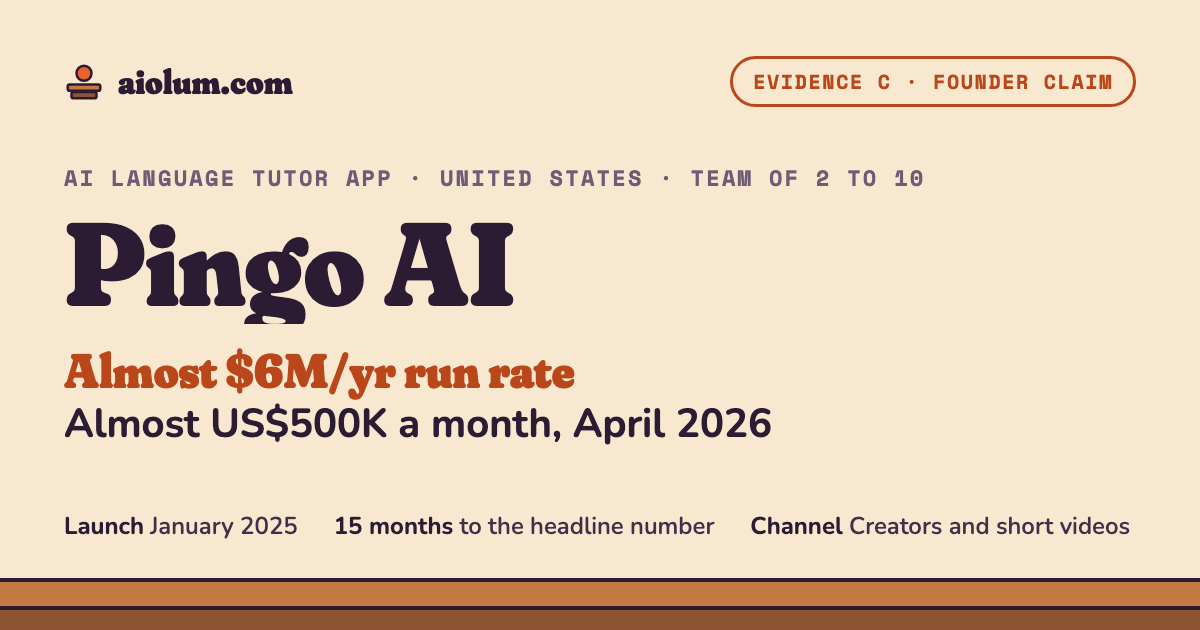
Michael Xing (CEO) and Morrie Schonfeld (COO) were roommates in their first year of college and practiced Chinese together every week, and they launched Pingo in January 2025 from Schonfeld's dorm room at Northwestern University. Two dated revenue figures from two different sources describe its growth. In their Y Combinator launch post, published on 3 August 2025, the founders wrote that as of July the app had more than 300,000 users and US$200,000 of monthly recurring revenue (MRR), the subscription revenue that repeats every month. On 20 April 2026 The Superwall Podcast, a show made by a company that sells payment screens for phone apps, published an episode with Schonfeld whose description says that Pingo "is approaching $500K/month with 3 million users and zero paid ads". That is a run rate, the monthly figure times 12, of almost US$6 million a year, 15 months after launch. Between the two figures revenue grew at most about 11% a month, down from the 100% a month that the founders reported for the first half of 2025.
The team stayed small: the Y Combinator page listed 2 people in July 2025, 3 in December 2025 and 4 from June 2026, and the only outside money in the sources is Y Combinator's standard investment of US$500,000. Users came through short creator videos, mostly on TikTok, in which a creator says a phrase in a foreign language and the AI points out the pronunciation errors; the podcast description says the app got 400 million views in a single month and that the company runs about 100 creators. The episode's 3 million users fit the company site's own "3,000,000+ Users" of 15 March 2026, and Google named Pingo the Best Hidden Gem among Google Play's best apps of 2025. Every revenue number on this page is a founder statement, grade C. A case-study site's US$500,000 a month, which cites the founders' LinkedIn profiles, agrees with the podcast but stays marked as not verified.
The numbers, graded
Each row shows the evidence grade and the source numbers from the list at the end of this page. The grades are explained in How Aiolum verifies.
| Fact | Value | Grade | How we know | Sources |
|---|---|---|---|---|
| Monthly revenue, April 2026 | almost US$500,000 | C | The Superwall Podcast, episode with co-founder Morrie Schonfeld published 20 April 2026. Its description: "Fourteen months after launching from his Northwestern dorm room, Pingo AI is approaching $500K/month with 3 million users and zero paid ads." No transcript is published. | [19] |
| Run rate from the April 2026 figure | almost US$6 million a year | calc | Calculated: just under US$500,000 times 12. This is the headline figure on this page; US$6 million is its upper bound. | [19] |
| Monthly recurring revenue, July 2025 | US$200,000 | C | Founders' Y Combinator launch post, published 3 August 2025: "As of July, we’ve grown to 300K+ users and $200K MRR since launching in January." A different source from the April 2026 figure. | [1] |
| Run rate from the July 2025 figure | US$2.4 million a year | calc | Calculated: US$200,000 times 12. | [1] |
| Growth implied between the two founder figures | at most about 11% a month | calc | Calculated: from US$200,000 in July 2025 to just under US$500,000 in April 2026 is at most 2.5 times in nine months, at most 10.7% a month. Counted to March 2026, fourteen months after launch as the episode says, it is at most 12.1% a month, the same as for the aidevcases figure below. Either way growth had slowed from the 100% a month of the first half of 2025. | [1, 19, 4] |
| Growth before the launch post | 100% a month on average, 200% in the past month | C | Founders' launch post. At 100% a month for six months, revenue doubles six times, so the January 2025 figure would have been about US$3,100 a month (calculated: US$200,000 divided by 64). | [1] |
| Users, July 2025 | more than 300,000 | C | Founders' launch post. Calculated: US$200,000 divided by 300,000 users is about US$0.67 per user a month, far below the US$14.99 monthly price, so most users did not pay. | [1] |
| Users, March and April 2026 | 3,000,000+ on the company site; 3 million in the podcast | C | Wayback Machine copy of the home page, 15 March 2026: "Join 3,000,000+ Users Getting Fluent with Pingo AI". The podcast figure of 20 April 2026 fits it. Calculated: almost US$500,000 divided by 3 million users is at most about US$0.17 per user a month, against US$0.67 in July 2025, so users grew faster than revenue. | [9, 19] |
| Users claimed in October 2026 | 6,000,000+ learners; 8,000,000+ users | C | Live home page and App Store description. The two company figures differ from each other. | [8, 5] |
| Monthly recurring revenue, about March 2026, from a case-study site | US$500,000 (not verified) | C | aidevcases.com, 24 June 2026: "$500K MRR (~$6M ARR)" 14 months after launch, labelled "Monthly (est.)". Its sources for it are the founders' LinkedIn profiles, which this page may not open, so it stays not verified, although it agrees with the podcast. The same site writes "peak ~70% month-over-month", against the founders' average of 100%, and "750K+ users", far below the company's 3,000,000. | [4] |
| Later mention by the podcast host | "hit $500K/month" | C | The host's solo episode of 25 September 2026 lists "how Pingo used one to hit $500K/month". It may repeat the April episode and gives no new date for the figure. | [20] |
| Android downloads, October 2026 | more than 5 million | B | Google Play's own count on the store page, with 4.7 stars from about 205,000 reviews. Downloads are not paying users. | [6] |
| Google Play award | Best Hidden Gem, best apps of 2025 | B | Google's blog, 18 November 2025: "Best Hidden Gem: Pingo AI Language Learning". | [7] |
| Team size on the Y Combinator page | 2 in July 2025, 3 in December 2025, 4 from June 2026 | C | Wayback Machine copies of 28 July 2025, 17 December 2025 and 21 June 2026, and the live page on 16 October 2026. The launch post is signed by the two founders. At the April 2026 figure the team was 3 or 4. A profile site, yespress.io, says other data sources list about 24 employees; not verified. | [3, 2, 1, 14] |
| Outside funding | Y Combinator's standard US$500,000 | C | Summer 2025 batch. YC invests US$500,000 in every company it accepts: US$125,000 for 7% of the company and US$375,000 on an uncapped SAFE, a contract that turns into shares at a later funding round. aidevcases.com writes "Raised a $500K seed in Sept 2025" and yespress.io lists seed funding in August 2025; the amount equals YC's standard deal, and no downloaded source names another investor. | [2, 13, 4, 14] |
| Prices | US$14.99 a month or US$99.99 a year, after a 7-day free trial | C | App Store in-app purchases and the company's llms.txt file; the trial length is from the April 2026 podcast description. The yearly plan is about 44% cheaper than 12 monthly payments (calculated). | [5, 12, 19] |
| AI providers | OpenAI and Groq | C | Privacy policy, last updated 11 August 2026: "Our third-party AI service providers currently include OpenAI and Groq." Chat messages and voice recordings are shared with them. The policy does not name the models. | [10] |
| Creator videos | 400 million views in one month; about 100 creators | C | Podcast description, 20 April 2026: "Running 100 creators like a VC portfolio, cutting the bottom 30%, coaching the middle", and a roast format that "creators invented inside a custom scenario feature hit 52 million views". aidevcases.com counted more than 200 million TikTok views across 624 videos in June 2026, as Pingo's own public figures; not verified. | [19, 4] |
| Paid ads | "zero paid ads" in April 2026 | C | Podcast description. The privacy policy of 11 August 2026 describes AppsFlyer measuring "our paid advertising campaigns", so ads may have started later, or the policy text is general. | [19, 10] |
| Users who paid nothing | 200,000 in Russia | C | Podcast description: "Why 200K Russian users generated zero dollars, and how geo-targeting became a core distribution strategy". | [19] |
| Age rating | 4+ on the App Store, Everyone on Google Play | C | Store listings. The app is sold as a language tutor; the App Store text calls Pingo "your AI speaking companion". | [5, 6] |
| Languages | 25+ to learn, 15+ languages of instruction | C | Company home page and App Store description. | [8, 5] |
| Time from launch to the April 2026 figure | 15 months | calc | Calculated: January 2025 to April 2026, by calendar month. The episode description says fourteen months. | [1, 19] |
How to read this table: a grade C value is a statement by the founders or the company, or a third party's report that says where it came from. The two grade B values come from Google, which is independent of the company: its award list and the download count on its store. A "calc" value was computed on this page from the rows above it. No revenue value is grade A or B.
| Plan | Per month, billed yearly (US$) | Per month, billed monthly (US$) | Limit |
|---|---|---|---|
| Free trial | 0 | 0 | 7 days, by the co-founder's account; not stated on the store page |
| Pingo Pro, yearly | 8.33 | US$99.99 a year; unlimited conversations and lessons | |
| Pingo Pro, monthly | 14.99 | unlimited conversations and lessons | |
| Other Pingo Pro prices listed | US$83.99, US$89.99 and US$17.99, period not stated |
Pingo Pro is an auto-renewing subscription bought inside the app. The company's llms.txt file says there is a free trial and that Pingo Pro gives unlimited conversations and lessons; the co-founder says on a podcast that the trial lasts 7 days and that outside the US a 7-day trial did 2% better than a 3-day trial. A case-study site gives the same two main prices in June 2026. The yearly plan costs about 44% less than twelve monthly payments. The App Store also lists Pingo Pro at US$83.99, US$89.99 and US$17.99 without saying the period; these may be offers, other durations or prices for other countries.
The timeline
From two roommates practicing Chinese to an app with more than 5 million Android downloads, in 21 months. Each entry carries its grade.
- First year of collegeCMichael Xing and Morrie Schonfeld are roommates and practice Chinese together every week. Xing is fluent; by 2025 Schonfeld has been learning it for eight years. [1]
- January 2025CLaunch on the App Store and Google Play from Schonfeld's dorm room at Northwestern, with the website mypingoai.com. [1, 14, 19]
- July 2025CMore than 300,000 users and US$200,000 a month in subscriptions, after average growth of 100% a month. The Y Combinator page lists a team of 2. [1, 3]
- 3 August 2025CLaunch post on Y Combinator's site, as part of the Summer 2025 batch. YC's standard investment is US$500,000. [1, 13]
- 18 November 2025BGoogle names Pingo AI Language Learning the Best Hidden Gem among Google Play's best apps of 2025. [7]
- 17 December 2025CThe Y Combinator page lists a team of 3. [3]
- March 2026CThe company's site, now at pingo.ai, says 3,000,000+ users. [9]
- 20 April 2026CThe Superwall Podcast publishes an episode with Schonfeld: Pingo is approaching US$500,000 a month with 3 million users and zero paid ads, after 400 million views in one month and with about 100 creators. [19]
- June 2026CA case-study site reports US$500,000 a month at 14 months, citing LinkedIn (not verified), and more than 200 million TikTok views across 624 videos. The Y Combinator page lists a team of 4. [4, 3]
- 11 August 2026CThe privacy policy names OpenAI and Groq as the AI providers that process the conversations. [10]
- 25 September 2026CThe podcast's host says in a solo episode that Pingo used one creative strategy to hit US$500,000 a month. [20]
- October 2026C6,000,000+ learners on the home page, 8,000,000+ users in the App Store text, more than 5 million Android downloads, and app version 5.4.4 released on 7 October. No open jobs. [8, 5, 6, 11]
Why it worked
Four causes, in the order they mattered. Each one is a reusable lesson.
Distribution through creator videos
The growth came from one repeatable video: a creator says a phrase in a foreign language, the AI says how far off the pronunciation is, and the creator reacts. People who do not learn the language also find it funny, and native speakers comment to correct and translate, so one video reaches several language communities. By the co-founder's account in April 2026, the company runs about 100 creators like a portfolio of investments, drops the weakest 30% and coaches the middle, and the app got 400 million views in a single month with no paid ads.
Speaking only
Most language apps teach words and grammar with taps and drills. Pingo does one thing, spoken conversation with correction, which the founders call the part most apps overlook. The learner picks a scene, talks, gets corrected during the conversation, and the app remembers the mistakes for the next session.
Aim at countries that pay
The co-founder says 200,000 users in Russia produced no revenue, and that geo-targeting, choosing which countries the videos reach, became a core part of distribution. A view counts only if the viewer can and will pay through the app store.
A simple app-store subscription
A 7-day free trial, reminders before the trial ends and messages after an abandoned purchase lift conversion, by the co-founder's account; then Pingo Pro costs US$14.99 a month or US$99.99 a year, paid through Apple or Google. Revenue per user was about US$0.67 a month in July 2025 and at most about US$0.17 in April 2026, so a small share of a very large free audience pays for the whole business.
Bought AI, small team
The conversations run on models from outside providers, OpenAI and Groq according to the privacy policy, so a team of two to four people could offer more than 25 languages with models that other companies run.
How it was built
These details come from the company's own pages, its launch post, the co-founder's podcast episode and the two app-store listings. They are grade C. [10, 5, 6, 1, 9, 12, 19]
- A phone app for iPhone, iPad and Android. The seller on both stores is Pingo AI, Inc. Category: Education. It needs iOS 15.1 or later.
- AI: the privacy policy of 11 August 2026 names OpenAI and Groq as the AI service providers and also mentions speech-processing providers without naming them. Chat messages and voice recordings go to these providers to generate the replies.
- Measurement: Firebase for analytics, and AppsFlyer to attribute installs to marketing sources and to measure paid advertising campaigns.
- Payments: auto-renewing subscriptions sold as in-app purchases on the App Store and Google Play. The payment screen uses a 7-day free trial, trial reminder messages and flows for abandoned purchases, by the co-founder's account.
- Features named in the store text and on the company's pages: a learning plan built from the learner's goals, role plays and debates, instant feedback on pronunciation and grammar, transcripts, and a feedback setting of strict, balanced or light.
- Website: mypingoai.com in the August 2025 launch post, pingo.ai by March 2026. In August 2025 the domain pingo.ai showed an unrelated Vietnamese app for finding places to eat.
Tools named in the sources
Each one opens its page in the Tools tab, with every story that uses it.
The dead that came before
Five companies in the Loot Drop database sold the same promise, practice with a fluent speaker over the internet, using paid human teachers. The values below are from that database and are not independently verified.
VIPKid
The promiseOne-on-one English lessons by video between Chinese children and North American teachers.
Why it diedChina's 2021 education rules banned foreign tutors and foreign curriculum, which ended its business model at once.
TutorGroup (iTutor)
The promiseOnline English tutoring that connected 30,000 Western teachers with Chinese students, at about US$50 an hour.
Why it diedChina's 2021 ban on foreign tutors removed about 70% of its revenue, while the cost of winning each customer, over US$800, and tutor turnover were already too high.
Qkids
The promiseLive small-group English classes by video, with North American teachers for Chinese children.
Why it diedChina's 2021 ban on for-profit tutoring for school-age children ended the business model at once.
Hujiang
The promiseOnline language courses with a free tier, for 190 million users in China.
Why it diedA failed stock-market listing showed that winning each customer cost too much and margins were negative, against better-funded rivals.
Teacher Finder
The promiseMatch language learners directly with tutors, without an expensive language school in between.
Why it diedBetter-funded tutor marketplaces won the market, and its simple product, built on Zapier automations, could not change fast enough.
What changed
All five sold speaking practice with a fluent person over the internet, and the demand was real: VIPKid alone served 700,000 students at its peak, by the database's account. But each lesson needed a paid human teacher, so every hour of practice stayed expensive, and three of the five ended when China changed its tutoring rules in 2021.
Pingo replaces the teacher with AI models bought from providers, so an extra hour of practice costs the model and voice processing, not a teacher's wage, and one app serves more than 25 languages in many countries through the app stores. The risk moved instead of going away: Pingo does not depend on teachers or on one government, but on the AI providers' prices, on the rules of the app stores and TikTok, and on whether Duolingo and ChatGPT give the same practice to their much larger audiences.
Can one person copy it now?
The method, yes. The empty market, no.
Pingo was early with a speaking-only AI tutor and found a video format that spread on TikTok. By 2026 Duolingo sells AI video calls and ChatGPT talks back, so a new copy would compete with both. What can still be copied is the method: a narrow product, a short video that shows the product's main moment, and a managed group of creators who post that format to the countries where users pay.
Where it is still open: Speaking practice for one exam, job or situation (medical English, job interviews, a language test for a visa), and target or native languages that the large apps serve badly.
- 1Pick the one skill that the large apps teach worst, and build only that.
- 2Find the moment in the product that is funny or surprising to watch, and make it the whole video.
- 3Give the format to many creators, about 100 at Pingo; drop the weakest and coach the middle.
- 4Aim the videos at countries where users pay; Pingo's 200,000 Russian users paid nothing.
- 5Sell one subscription through the app stores, with a free trial, a cheaper yearly plan and reminders before the trial ends.
What to watch
The risks are the mirror image of the causes above.
The revenue figures are the founders' own
Both dated figures come from the founders: US$200,000 a month in their launch post (July 2025) and almost US$500,000 a month in the description of a podcast episode with Schonfeld (April 2026). No payment processor or buyer has confirmed either, and the podcast publishes no transcript. The two figures come from different sources and fit a growth rate of at most about 11% a month, and the episode's 3 million users match the company site's figure of March 2026. A case-study site's US$500,000, which cites LinkedIn profiles that this page may not open, stays not verified; that site differs from the founders on growth ("peak ~70%" against an average of 100%) and from the company on users (750,000 against 3,000,000).
Duolingo sells the same practice
Duolingo introduced Duolingo Max, built with OpenAI's GPT-4, on 14 March 2023, and announced Video Call, spoken conversations with its character Lily, on 24 September 2024. Video Call is available to Max subscribers learning English, Spanish, French, German, Italian and Portuguese.
ChatGPT talks back
OpenAI began rolling out voice conversations in ChatGPT on 25 September 2023, for Plus and Enterprise users on iOS and Android. One Pingo reviewer on the App Store wrote that ChatGPT's spoken role play suggests things and pushes back when instructed, in a way that Pingo's conversations did not.
Dependence on model and voice providers
Every conversation goes to outside AI providers, OpenAI and Groq according to the privacy policy. Their prices, quality and terms set Pingo's costs and quality, and the same providers sell to every competitor, including OpenAI's own ChatGPT.
Team size outside the YC page
Y Combinator's page shows 2, then 3, then 4 people. A profile site, yespress.io, says other data sources list about 24 employees, which may count contractors or the roughly 100 video creators; this page could not check it. At the April 2026 figure the YC page listed 3 people (December 2025) or 4 (June 2026).
Managed creators and paid ads
The co-founder says the company runs about 100 creators and cuts the weakest 30%, so the videos are a managed program, not chance posts by fans. No source says how the creators are paid or whether the videos are marked as advertising. The episode says "zero paid ads" in April 2026, while the privacy policy of August 2026 describes AppsFlyer measuring "our paid advertising campaigns".
Users are not payers
User counts grew much faster than revenue: about US$0.67 of revenue per user a month in July 2025, at most about US$0.17 in April 2026 (calculated). The co-founder says 200,000 users in Russia paid nothing. The 6 to 8 million users claimed in October 2026 say little about revenue.
Many similar tutors
The App Store page lists similar apps such as LingoTok and Bunpo, and this site's Verbi story is another AI speaking tutor sold through the app stores and grown with creator videos. Store reviews of Pingo complain about speech recognition in Arabic and about how to cancel the subscription; the developer replied that it had added cancellation inside the app.
A wider direction
The careers page says "Pingo starts with language learning" and that the team wants to "Define what human–AI relationships look like". Today the app is a language tutor rated 4+ on the App Store and Everyone on Google Play; a move toward a general AI companion would change both the market and the risks.
Sources
The grade next to each source is the best grade that the source can support. "Read in full" means that the text of the page was downloaded and the numbers were checked in it.
- C Launch YC, 3 August 2025: Pingo AI: AI companion that helps you learn languagesRead in full, from the page's JSON. The founders' launch post, created 3 August 2025. Source for the July 2025 revenue and users, the growth rate and the founders' story.
- C Y Combinator company page: Pingo, read 16 October 2026Read in full. Source for the batch, the team size of 4, the location and the founders' roles. The address now redirects to /companies/pingo.
- C Wayback Machine copies of the Y Combinator company page, 28 July 2025, 17 December 2025 and 21 June 2026Read the team-size field in each of the three copies: 2, 3 and 4.
- C AI Dev Cases, 24 June 2026: "Getting Roasted by an AI" Went Viral, How Pingo AI Hit $500K MRR in 14 Months on 200M TikTok ViewsRead in full. A third-party case write-up, figures checked 21 August 2026. For the US$500,000 it cites the founders' LinkedIn profiles, which this site may not open, so that figure is not verified. Source for the TikTok format and video counts.
- C App Store: Language Learning: Pingo AI, read 16 October 2026Read in full. Source for the prices, the age rating, the user claim, the seller, the version notes and the reviews.
- B Google Play: Language Learning: Pingo AI, read 16 October 2026Read in full. Google's own download count and rating, and the content rating.
- B Google blog, 18 November 2025: Google Play's best apps, books and games of 2025Read the list of app awards. Source for the Best Hidden Gem award.
- C Pingo AI home page, read 16 October 2026Read in full. Source for the learner count, the languages and the note on voice data.
- C Wayback Machine copy of the Pingo AI home page, 15 March 2026Read in full. Source for the 3,000,000 users. An earlier copy, of 6 August 2025, shows an unrelated Vietnamese app on the same domain.
- C Pingo AI privacy policy, last updated 11 August 2026Read the sections on service providers, analytics and advertising measurement.
- C Pingo AI careers page, read 16 October 2026Read in full. Source for the company's stated direction and for the absence of open roles.
- C Pingo AI llms.txt file, read 16 October 2026Read in full. The company's description for AI assistants. Source for the free trial and what Pingo Pro includes.
- C Y Combinator: The Y Combinator Standard DealRead the description of the deal. These are YC's general terms; the page does not name Pingo.
- C yespress.io profile: Pingo AIRead in full. A profile site that compiles other sources. Source for the launch month, the seed-funding entry and the note that other data sources list about 24 employees; the last two were not checked.
- C Duolingo blog, 14 March 2023: Introducing Duolingo Max, a learning experience powered by GPT-4Read in full. Duolingo's own announcement; the page has since been updated to list Video Call and Roleplay as the Max features.
- C Duolingo blog, 24 September 2024: Video Call lets you have real life conversations with LilyRead in full. Duolingo's own announcement and the list of languages.
- C OpenAI, 25 September 2023: ChatGPT can now see, hear, and speakRead in full. OpenAI's own announcement of voice conversations in ChatGPT.
- C Loot Drop database export, 1,749 failed startupsLocal export. AI-written summaries, not independently verified. Source for the failed predecessors.
- C The Superwall Podcast, 20 April 2026: Morrie Schonfeld - How I built a $500k/mo ai app (so you can just copy me)Read the episode's title, date and description in the show's RSS feed (https://rss.buzzsprout.com/2522779.rss) and on the episode page. Did not listen to the 58-minute audio; no transcript is published. The co-founder's statements as the show summarizes them. Source for the April 2026 revenue, users, views, creators, paid ads, Russian users and trial.
- C The Superwall Podcast, 25 September 2026: Joseph Choi - 1,000 Hours of Studying The Most Profitable Apps in 17 MinutesRead the episode's title, date and description in the same feed and on the episode page. The host's solo episode. Source for the later mention that Pingo hit US$500,000 a month.