TrackAI
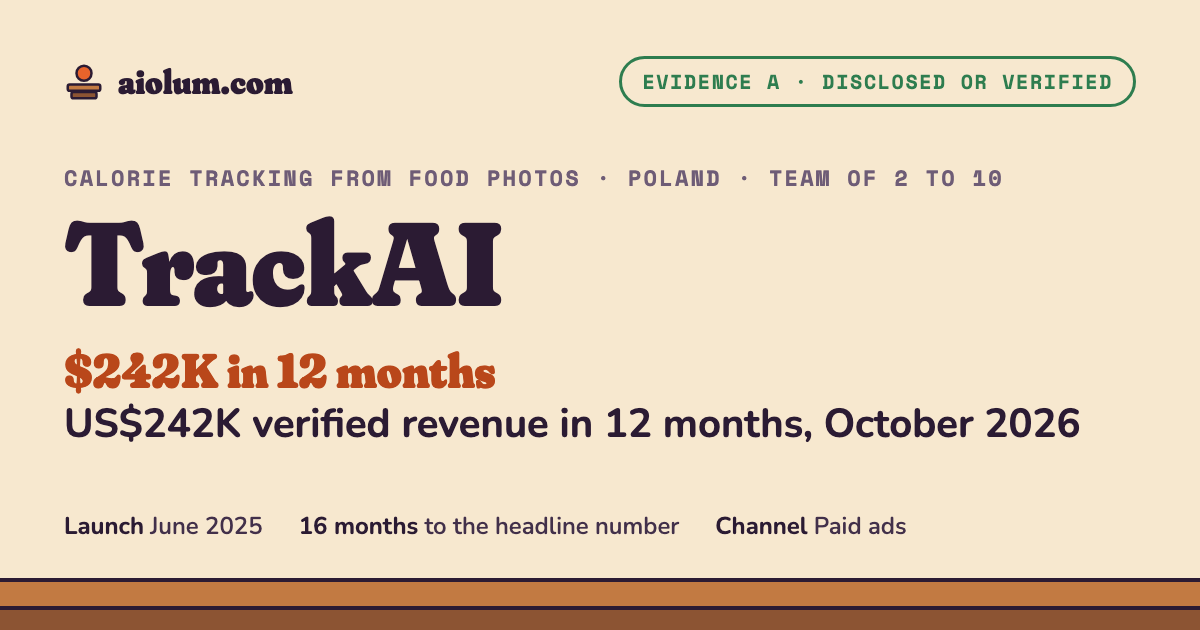
TrackAI is a phone app that estimates the calories in a meal from a photo. The user photographs a plate, and a vision model returns the dishes it sees, their weight, the calories and the macros. A vision model is an AI model that takes an image as input and answers in text. Macros is the short name for the three macronutrients: protein, fat and carbohydrates. The app is in 15 languages, and its website names borscht and varenyky among the dishes it recognises. In the three App Store countries this page checked, Ukraine has 3,918 ratings, Poland 630 and the United States 54.
Oleksandr Yashchuk, who is based in Kraków in Poland, released the app at the end of May 2025. He is the only person the sources name: the company blog calls him founder and product owner, and until spring 2026 both app stores listed him personally as the developer. The money figure on this page is not his claim. TrustMRR, a public directory of startup revenue, reads the sales from RevenueCat with an access key. RevenueCat is a service that phone apps use to sell subscriptions through Apple's and Google's stores and to count the revenue from both. On 13 October 2026 it showed US$242,116 of revenue in the last 12 months, US$21,699 in the last 30 days and 5,158 active paid subscriptions. RevenueCat's documentation describes its revenue figure as gross: before the stores take their commission and before sales tax. The business keeps less than the headline figure.
One question is not answered. On 7 July 2026 Yashchuk offered TrackAI for sale on TrustMRR for US$600,000, and he lowered the price seven times, to US$180,000 on 18 August. By 13 October the offer was closed, and both app stores named a Swiss company, Stellar Marketing AG, as the developer. No source says that a sale happened or at what price. This page therefore counts the business as running and grades every number by its evidence. It also shows four failed companies that promised easier tracking of health habits before a phone could read a photo of a plate.
The numbers, graded
Each row shows the evidence grade and the source numbers from the list at the end of this page. The grades are explained in How Aiolum verifies.
| Fact | Value | Grade | How we know | Sources |
|---|---|---|---|---|
| Revenue in the 12 months to 13 October 2026 | US$242,116 | A | TrustMRR reads it from RevenueCat through an API key. Last synced 13 October 2026, 17:17 UTC. Gross revenue: before store commission and sales tax, after refunds, as RevenueCat defines revenue. | [1, 8, 9] |
| Revenue in the last 30 days | US$21,699 | A | 7.7% lower than in the 30 days before, as the profile states. | [1] |
| All-time revenue, June 2025 to 13 October 2026 | US$278,257 | A | [1] | |
| Revenue before 13 October 2025 | US$36,141 | calc | Calculated: 278,257 minus 242,116 equals 36,141. This is the first four and a half months. | [1] |
| Monthly recurring revenue, 13 October 2026 | US$19,716 | A | Monthly recurring revenue (MRR) is the value of all active subscriptions expressed per month. 3.7% lower than 30 days earlier. It was US$21,306 on 4 August 2026. | [1, 2] |
| Active paid subscriptions | 5,158 | A | 5,122 on 4 August 2026 and 5,158 on 20 August 2026 in the archived pages. | [1, 2] |
| MRR per active subscription | about US$3.82 a month | calc | Calculated: 19,716 divided by 5,158 equals 3.82. The Ukraine store price is US$6.90 a month or US$33.90 a year. | [1, 3] |
| Highest month | US$27,412 in July 2026 | A | Monthly history: November 2025 US$12,210, December US$10,663, January 2026 US$17,337, February US$16,880, March US$25,956, April US$21,732, May US$24,031, June US$23,942, July US$27,412, August US$25,383, September US$21,949. | [1] |
| September 2026 against the July 2026 peak | 19.9% lower | calc | Calculated: 21,949 divided by 27,412 equals 0.801. | [1] |
| Last 6 months against the 6 months before | 43.0% higher | calc | Calculated: 142,475 against 99,641, which is 242,116 minus 142,475. | [1] |
| Last 3 months against the 3 months before | 0.3% higher | calc | Calculated: 71,360 against 71,115, which is 142,475 minus 71,360. Growth stopped in the summer of 2026. | [1] |
| Twelve-month revenue after a 15% store commission | about US$205,800 | calc | Calculated: 242,116 multiplied by 0.85 equals 205,799. An illustration only. It assumes the 15% rate of Apple's Small Business Program and of Google Play subscriptions, and it does not remove sales tax or advertising cost. | [1, 14, 15] |
| Payment data provider | RevenueCat, connected with an API key | A | The payments themselves go through Apple's App Store and Google Play. | [1, 9] |
| Founder's figures after 12 months, June 2026 | US$20,000 MRR, more than 4,700 paying subscribers, more than 327,000 installs | C | Founder-written description on TrustMRR. It also says the app was profitable from the second month. | [1] |
| Paying subscribers per install | about 1.4% | calc | Calculated: 4,700 divided by 327,000 equals 0.014. Both inputs are founder figures. | [1] |
| Profit margin | 10%, then 90%, then 94% | C | Not verified. TrustMRR's post of 7 July 2026 shows 10%. The archived page shows 90% on 4 August and 94% on 20 August, with the Meta Ads account not connected. The live profile shows 94%. | [1, 2, 6] |
| Asking price on TrustMRR | US$600,000 on 7 July 2026, US$180,000 on 18 August 2026 | B | Recorded in the page data of the archived listing. Seven cuts in 42 days, 70% in total. | [2] |
| Last asking price against 12-month revenue | 0.74 times | calc | Calculated: 180,000 divided by 242,116 equals 0.74. TrustMRR's own multiple on 20 August was 0.61, which is 180,000 divided by twelve times the 30-day revenue of US$24,712. | [1, 2] |
| Offers counted by TrustMRR | 10 on 4 August 2026, 21 on 20 August 2026 | B | A counter in the archived page data. The content of the offers is not public. | [2] |
| Sale listing on 13 October 2026 | closed | B | The profile says the startup is not currently listed for sale. No source reports a sale or a price. | [1] |
| Developer named by the app stores | Oleksandr Yashchuk until spring 2026, Stellar Marketing AG in October 2026 | B | App Store: his name on 6 March 2026 in a price tracker. Google Play: his name on 15 April 2026 in an archived page. Both stores on 13 October 2026: Stellar Marketing AG, Zug, Switzerland. The App Store copyright line still names Yashchuk. | [3, 4, 7, 16] |
| Team size | not published | C | One named founder. TrustMRR's record lists no co-founders. His sale notice says the founding team. | [1, 2, 5] |
| Outside funding | none, according to the founder | C | The profile says fully self-funded. No investor is named anywhere. | [1, 2] |
| App Store ratings, 13 October 2026 | Ukraine 3,918, Poland 630, United States 54 | B | Average 4.7 of 5 in Ukraine and Poland, 4.8 in the United States. From Apple's public lookup service. | [3] |
| Google Play, 13 October 2026 | 4.9 stars, about 4,680 reviews, more than 100,000 downloads | B | On 15 April 2026 the archived page showed more than 1,000 downloads. | [4] |
| Website visitors in the last 30 days | 78,056 | B | TrustMRR reads it from Google Analytics. The profile computes US$0.28 of revenue per visitor. | [1] |
| Time from launch to the headline date | 16 months | calc | Calculated: June 2025 to October 2026. Apple gives 31 May 2025 as the release date in Ukraine and Poland. | [1, 3] |
How to read this table: a grade A value was read by TrustMRR from RevenueCat, the service that records the app's subscription payments. A grade B value comes from Apple, Google, a public register, a marketplace record or an archived page. A grade C value is a founder statement. A "calc" value was computed on this page from the rows above it.
| Plan | Per month, billed yearly (US$) | Per month, billed monthly (US$) | Limit |
|---|---|---|---|
| Premium, US App Store | 4.17 | 11.99 | Year US$49.99, or US$39.99 with a discount. A week costs US$2.99 |
| Premium, Ukraine App Store | 2.83 | 6.90 | Year US$33.90, or US$23.90 with a discount. A week costs US$2.99 |
| Premium, as the founder states it on TrustMRR | 3.58 | 9.99 | Year US$42.99. A week costs US$5.99. Store and country not stated |
| Free trial | 0 | 0 | 3 days, then a subscription, according to the website |
Apple lists the in-app purchases by name: week, month, year, and a year with a discount. The yearly column is the yearly price divided by 12: 49.99 divided by 12 equals 4.17, 33.90 divided by 12 equals 2.83, 42.99 divided by 12 equals 3.58. The Poland store charges 34.99 zł a month and 149.90 zł a year. The website says there is no free version, only a 3-day trial. The founder's TrustMRR text says freemium. The two statements do not agree.
The timeline
From the App Store release to US$242,116 of verified revenue in 12 months, then a sale listing and a new company name on the store pages. Each entry carries its grade.
- 16 March 2025BThe Internet Archive records the address trackai.app for the first time. [5]
- 31 May 2025BRelease on the App Store in Ukraine and Poland, and on 2 June in the United States. The app's identifier, com.yashchuk.trackai, contains the founder's surname. [3]
- Mid-2025CThe founder writes later that the app was profitable from its second month and used no outside money. [1]
- November 2025AFirst month in the public revenue history: US$12,210. The website already loads Google Analytics, a Meta Pixel and a TikTok pixel. [1, 5]
- December 2025CBlog articles dated 7 and 8 December 2025 are signed by Yashchuk as founder and product owner. Topics: counting calories in home-cooked meals, calculating a daily intake. The archived site of 19 November 2025 had no blog. [5]
- March 2026ARevenue rises from US$16,880 in February to US$25,956, an increase of 53.8%. [1]
- 15 April 2026BThe Android version is on Google Play under the founder's own name, with more than 1,000 downloads. [4]
- June 2026CAfter 12 months the founder reports US$20,000 MRR, more than 4,700 paying subscribers and more than 327,000 installs. [1]
- 7 July 2026BTrackAI joins TrustMRR and is listed for sale on the same day at US$600,000. The sale notice says the founding team is committing to a new venture and that the new Android app brings more than half of new installs. [2, 6]
- July 2026ABest month in the history: US$27,412. [1]
- 20 July to 18 August 2026BSeven price cuts: US$450,000, US$400,000, US$350,000, US$300,000, US$250,000, US$200,000 and US$180,000. TrustMRR counts 21 offers by 20 August. [2]
- 28 August 2026BApple's records show a second calorie app from Stellar Marketing AG with this release date: ModernBody - Food Scanner. [3]
- 28 September 2026CYashchuk announces another app on X: AlertyPL, which warns of air alerts in Poland. [6]
- 13 October 2026ARevenueCat data on TrustMRR: US$242,116 in 12 months, US$21,699 in 30 days, MRR US$19,716. The sale listing is closed. Both stores name Stellar Marketing AG as developer, and Google Play shows the name Modernbody above the app. [1, 3, 4]
Why it worked
Four causes, in the order they mattered. Each one is a reusable lesson.
A known product for a language market
Cal AI, which is on this site, had more than 15 million downloads and more than US$30 million in annual revenue when MyFitnessPal announced that it had bought it, so TrackAI's verified 12-month revenue is about 124 times smaller. What the small entrant does differently, by its own description, is the market: an app in Ukrainian and 14 other languages, local dishes such as borscht, varenyky and deruny, and buyers aged 25 to 45 in Ukraine and Central and Eastern Europe.
Rented parts
Nothing in the sources suggests that the company trained a model. The founder's profile lists React Native for the app and RevenueCat for the billing, and the website is made with a visual site builder. The team's own work is the food logic, the 15 languages and the screens around the photo.
Paid advertising as the stated channel
The profile names one marketing channel: Meta Ads, which means paid advertisements on Facebook and Instagram. The website has carried tracking scripts for Meta and TikTok advertising since at least November 2025. The founder did not build an audience first: he has 89 followers on X, and the posts this page read say nothing about how he found users.
Local prices and short plans
The Ukraine store charges US$6.90 a month and US$33.90 a year, against US$11.99 and US$49.99 in the US store. A weekly plan costs US$2.99 in both. The result is many subscribers who each pay little: US$3.82 of MRR per active subscription.
How it was built
These details come from the founder-written part of the TrustMRR profile, from the source code of the website and from the store listings. They are grade B and C. The company does not publish which AI model reads the photos. [1, 3, 4, 5, 17]
- React Native for the phone app, according to the founder's profile. React Native is a framework that produces an iPhone app and an Android app from one code base written in JavaScript.
- RevenueCat for the subscriptions. It sits between the app and the two stores, records every purchase and renewal, and gives one revenue figure for both stores. TrustMRR reads that figure.
- The website is built with Framer, a visual website builder. Its source code names Framer in the archived copy of November 2025 and in October 2026.
- The same source code loads a Google Analytics tag, a Meta Pixel and a TikTok pixel. A pixel is a small script that reports visits to an advertising system, so that the system can count which advertisement brought a visitor.
- Distribution through Apple's App Store from 31 May 2025, and through Google Play by 15 April 2026 at the latest.
- The vision model is not named on the website, in the privacy policy or in the store text. The website says only that the app uses advanced AI and that its accuracy is good according to the company's own experiments.
- Marketing: Meta Ads is the only channel in the profile. The company also has a TikTok account with 46 videos and 1,948 followers, an Instagram account, a Facebook page and, since December 2025, a blog signed by the founder.
Tools named in the sources
Each one opens its page in the Tools tab, with every story that uses it.
The dead that came before
Four companies in the Loot Drop database promised easier tracking of health habits before a phone could read a photo of a meal. None of them is an exact earlier version of TrackAI: the database holds no failed calorie counter with founders that can be checked. The values below are from that database and are not independently verified.
Airo Health
The promiseA wearable device that tracks stress, exercise and nutrition intake and gives advice in real time.
Why it diedApple and Fitbit improved faster. The device did not justify its price, producing and shipping hardware overwhelmed the company, and no further funding came.
Jawbone
The promiseBluetooth headsets and fitness wristbands that turn a person's daily data into health advice.
Why it diedFitbit and Apple took the market. Product recalls, weak customer service and long court cases used up the money and the attention.
Habit Labs
The promiseHealth Month, a web application in which people set health goals and keep them through game rewards and pressure from friends.
Why it diedUsers did not want to pay a subscription for it. MyFitnessPal and Fitbit added social and game features to products that were free or better known.
Habitual
The promiseA habit-tracking app with personal feedback that keeps daily routines going.
Why it diedThe product worked, but it had no marketing plan: no partners, no presence on social media, no campaigns. Competitors with data-driven marketing got the users.
What changed
Before vision models, an app could not look at a plate. A calorie counter needed the user to search a food database and enter each portion by hand. The founder's profile calls this manual logging the reason why people quit calorie tracking within days. The hardware route failed too: Airo Health promised a wearable that tracks nutrition intake and closed in 2019, and Jawbone spent US$930 million on wearables and their apps.
A rented vision model changed the input. A photo replaces the search and the typing, and the model is paid per request, so a small team can offer the same function as a large company. The cost is accuracy: in a 2025 study, two leading general models were wrong by about 36% on average for the energy of a meal. Habitual's cause of death also still applies. When everyone can rent the same model, the difference is who reaches the users, and TrackAI's stated answer is paid advertising in one language region.
Can one person copy it now?
The method, yes. The profit is the open question.
Every part can be rented: a vision model, React Native, RevenueCat and the two app stores. What TrackAI added is a market choice, with Ukrainian language, local dishes and local prices, and paid advertising to reach that market. The sources do not show what the advertising costs. The founder's profit margin figures range from 10% to 94%, and he offered the business for sale 13 months after launch at a price that he cut by 70% in six weeks.
Where it is still open: Other language regions where no local photo calorie counter leads the store charts. A 2024 study of nutrition apps in Australia's stores concluded that AI food recognition needs more training on mixed dishes and on culturally diverse foods, which is the gap a local app can fill.
- 1Take a consumer AI app that already sells well in English, and check whether your language region has a version with local content and local prices.
- 2Rent the model and the billing. Put your own work into the local food data, the first screens and a price test for each country.
- 3Release on both stores. The founder's sale notice says the Android version brought more than half of new installs soon after its release.
- 4Connect your payment data to a public verifier early, so that readers and buyers can check the revenue.
- 5Measure what one paying subscriber costs in advertising before you increase the spending, and keep that record: a buyer will ask for it.
What to watch
The risks are the mirror image of the causes above.
Who owns it now
The founder listed TrackAI for sale on 7 July 2026 and wrote that the founding team was committing to a new venture. On 13 October 2026 the listing was closed, and both stores named Stellar Marketing AG as developer, a company entered in the Zug commercial register in November 2024 with marketing consulting as its purpose. The register notice names one board member, who is not Yashchuk. The App Store copyright line, the blog and the TrustMRR profile still carry his name. No source states a sale, a price or the present team size.
Accuracy of a photo estimate
TrackAI's website gives no error figure. It says the accuracy is good according to the company's own experiments. Independent tests show large errors. A 2025 study gave 52 standard food photos to three general models: ChatGPT-4o and Claude 3.5 Sonnet had a mean absolute percentage error of 35.8% for energy, Gemini 1.5 Pro had errors between 64.2% and 109.9% across nutrients, and all three underestimated more as portions grew. A 2024 study of nutrition apps concluded that automatic energy estimates from food image recognition were inaccurate. Neither study tested TrackAI.
Cal AI and MyFitnessPal
MyFitnessPal has owned Cal AI since December 2025 and has a meal scan of its own. Cal AI now uses MyFitnessPal's database of 20 million foods. TrackAI's protection is language and local food, and a larger company can add both.
Subscription churn
TrackAI sells weekly, monthly and yearly plans after a 3-day trial. RevenueCat's 2025 report on subscription apps, across all categories, found that nearly 30% of yearly subscriptions are cancelled in the first month, and that after one year 44.1% of yearly subscribers, 17.0% of monthly subscribers and 3.4% of weekly subscribers remain. TrackAI's own churn is not public: TrustMRR shows it only to logged-in users. The public figures point down: MRR fell 3.7% in the last 30 days, and September 2026 revenue was 19.9% below the July peak.
Store commission and store rules
The headline figure is gross. Apple's Small Business Program lowers the commission to 15% for developers with up to US$1 million of proceeds a year, and Google Play charges 15% on automatically renewing subscriptions. At 15%, US$242,116 becomes about US$205,800 before sales tax and advertising cost. Apple's program page also says that when an app is transferred, its proceeds for the calendar year count for all accounts in the transfer. Every payment goes through the two stores, so their rules decide the price of each sale.
The rented vision model
The company does not say which model reads the photos. The provider of that model sets the price per image and can change the model. The 2025 study shows how much the choice matters: the error for energy was 35.8% with two of the models and much higher with the third. A buyer of the business also takes over this dependency.
Numbers that do not agree
Profit margin: 10% in TrustMRR's post of 7 July 2026, 90% on 4 August, 94% on 20 August and in October, about 95% in the sale notice. No advertising cost is verified. Prices: the founder's profile says US$5.99 a week, US$9.99 a month and US$42.99 a year, and Apple's US page says US$2.99, US$11.99 and US$49.99. The profile says freemium, and the website says there is no free version. Users: about 400,000 in the profile, and more than 327,000 installs in the description.
Sources
The grade next to each source is the best grade that the source can support. "Read in full" means that the text of the page was downloaded and the numbers were checked in it.
- A TrustMRR profile of TrackAI, revenue synced 13 October 2026Read the markdown profile (https://trustmrr.com/startup/trackai.md) and the HTML page on 13 October 2026. Revenue, MRR and subscriptions come from RevenueCat through an API key. The description, the prices, the user count, the profit margin and the marketing channel are founder-written, grade C.
- B TrustMRR page of TrackAI as archived on 4 August and 20 August 2026Read both archived copies in full, including the page data. Source for the sale listing, the eight asking prices with their dates, the offer counts and the founder's sale notice. The notice itself is a founder statement, grade C.
- B Apple App Store listing of Calorie Counter: TrackAI, and Apple's lookup service for the United States, Poland and Ukraine, read 13 October 2026Read the listing pages of the three countries and the lookup records. Source for the seller name, the copyright line, the release dates, the ratings, the languages, the in-app prices and the seller's second app.
- B Google Play listing of Calorie Counter: TrackAI, read 13 October 2026, with the archived copy of 15 April 2026Read both copies. Source for the developer name on each date, the downloads, the rating and the developer's company address.
- C TrackAI website: home page, questions and answers, blog, terms and privacy policy, read 13 October 2026, with the archived copy of 19 November 2025Read in full. Source for the product description, the trial, the founder's title, the blog dates and, from the page source code, the site builder and the tracking scripts.
- C X: TrustMRR's post of 7 July 2026 about TrackAI, and the founder's timelineRead two pages of the timeline of @AlexYashchuk, December 2024 to October 2026, through api.fxtwitter.com. He reposted TrustMRR's post. The two pages contain no post of his own about TrackAI's marketing or revenue.
- B Swiss commercial register, entry of Stellar Marketing AG in Zug, and the company's websiteRead the register record and the founding notice of 21 November 2024, and the company's home and legal pages. Source for the seat, the date and the purpose. The website describes a digital marketing agency and does not mention TrackAI.
- B RevenueCat documentation: Overview metrics and Revenue chartRead the definitions of revenue, revenue net of taxes and proceeds on both pages (the second is https://www.revenuecat.com/docs/dashboard-and-metrics/overview). Source for the statement that revenue is before store fees and taxes.
- B TrustMRR notes for AI agents: how payment providers are connectedRead the section on RevenueCat connections. It says that TrustMRR imports daily revenue, MRR and active subscriptions from RevenueCat's charts. It does not say that commission is deducted.
- B TechCrunch, 2 March 2026, Julie Bort: MyFitnessPal has acquired Cal AI, the viral calorie app built by teensRead in full. Source for Cal AI's downloads and revenue, the date the deal closed and the food database.
- B Fridolfsson and others, 2025, Current Developments in Nutrition: Performance Evaluation of 3 Large Language Models for Nutritional Content Estimation from Food ImagesRead the abstract through the Europe PMC service, not the full paper. Source for the error figures of the three models.
- B Li and others, 2024, Nutrients: Evaluating the Quality and Comparative Validity of Manual Food Logging and Artificial Intelligence-Enabled Food Image Recognition in Apps for Nutrition CareRead the abstract through the Europe PMC service, not the full paper. Source for the conclusion on automatic energy estimates and on culturally diverse foods.
- B RevenueCat, State of Subscription Apps 2025Read the sections on cancellations and on retention after one year. A benchmark across the apps that use RevenueCat, not a figure about TrackAI.
- B Apple Developer: App Store Small Business ProgramRead the program rules. Source for the 15% rate, the US$1 million limit and the rule on transferred apps.
- B Google Play Console Help: Service feesRead the fee table. Source for the 15% rate on automatically renewing subscriptions.
- C App Pricing Lab, listing of Calorie Counter: TrackAI, last updated 6 March 2026Read in full. A third-party tracker of public App Store data. Cited only for the developer name on that date.
- C TikTok account of TrackAI, read 13 October 2026Read the public counters in the page data: followers, videos and likes. The videos themselves were not watched.
- C Loot Drop database export, 1,749 failed startupsLocal export. AI-written summaries, not independently verified. Source for the failed predecessors.