The Influencer AI
The Influencer AI makes an AI influencer, a person who does not exist, or an AI copy of a real person, who appears in social media posts as if real. The user designs the face by choosing traits such as age, hair and body, or uploads 1 to 4 photos to make an AI clone, a saved copy of the user's own face. The app then generates new photos, talking videos with lip sync, where the mouth moves to match the spoken words, virtual try-ons, where an uploaded garment is shown on the person, and product shots, all with the same face. The buyers are creators, brands and online shops that want UGC-style content, short videos that look as if an ordinary user filmed them, without hiring anyone to film. Plans cost US$19 to US$199 a month and include credits, units that each generation uses up: 1 credit for a photo, 1 or 2 credits for each second of video.
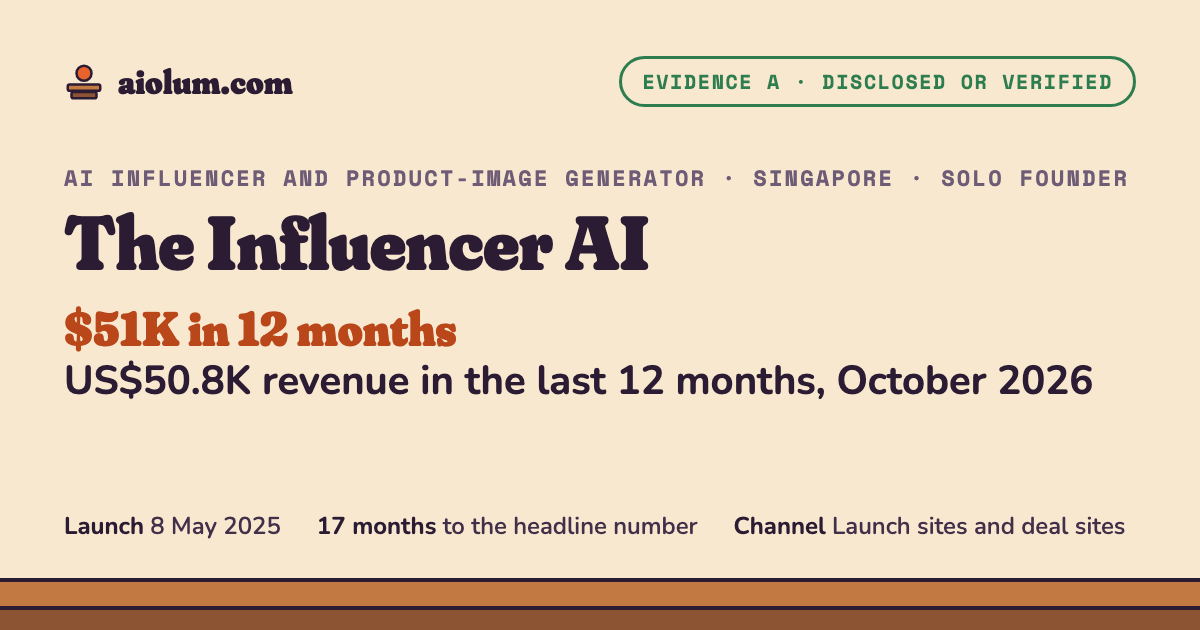
Zeeshaan Lakdawala, a software developer who lives in Barcelona, launched it on 8 May 2025, two months before he sold his earlier AI headshot app, The Multiverse AI, for US$115,000. The company behind it, Thunderbus Pte. Ltd., is registered in Singapore. He found users through launch directories in the first weeks, free single-feature tools, and later guides and comparisons written for search engines. In the twelve months to 14 October 2026 it took in US$50,824, and its MRR, monthly recurring revenue, the total of all active subscriptions for one month, was US$4,962 from 138 subscriptions. Revenue has been uneven: US$5,692 in January 2026, US$2,685 in May, US$4,909 in September. In February 2026 he wrote that the revenue was about equal to his family's living costs and that he was not yet taking any of it out.
The revenue figures are grade A. They are published by TrustMRR, a site that reads a startup's payment records directly from its payment processor, here Stripe, through an API key, a password that lets one program read another program's data. Everything else, from the team size to the user counts and the way the business found customers, comes from the founder's posts on X and the company's own pages, grade C. The page also shows the 2026 rules on labeling AI-generated people, and four earlier companies that sold images or creator content to brands and shoppers.
The numbers, graded
Each row shows the evidence grade and the source numbers from the list at the end of this page. The grades are explained in How Aiolum verifies.
| Fact | Value | Grade | How we know | Sources |
|---|---|---|---|---|
| Verified revenue in the last 12 months, to 14 October 2026 | US$50,824 | A | Stripe records read by TrustMRR through an API key, last synced 14 October 2026. The headline figure on this page. | [1] |
| Verified revenue since the start | US$65,383 | A | TrustMRR, same sync. | [1] |
| Verified revenue in the last 30 days | US$5,548 | A | TrustMRR. The 30 daily values in the profile add up to the same amount (checked on this page). | [1] |
| Monthly recurring revenue (MRR), October 2026 | US$4,962, from 138 active subscriptions | A | TrustMRR metric snapshot. The profile shows MRR growth of 13.0% in the last 30 days. | [1] |
| Run rate from the MRR | US$59,544 a year | calc | Calculated: US$4,962 times 12. | [1] |
| Average MRR per active subscription | about US$36 a month | calc | Calculated: US$4,962 divided by 138. This lies between the US$19 and US$39 plans. | [1, 3] |
| Revenue before mid-October 2025 | US$14,559 | calc | Calculated: all-time revenue minus the last 12 months. This covers about the first five months after the May 2025 launch. | [1] |
| Highest and lowest full month in the public table | January 2026: US$5,692. May 2026: US$2,685 | A | Monthly table from November 2025. May was 52.8% below January (calculated). September 2026 was US$4,909, 82.8% above May (calculated). | [1] |
| Third quarter of 2026 against the second | US$13,844 against US$9,466, up 46.2% | calc | Calculated from the monthly table: July to September against April to June. | [1] |
| Founder's pay, February 2026 | none taken; revenue about equal to his family's living costs | C | Founder's post, 2 February 2026: "We don't take any of it out yet though, still living off savings." | [17] |
| Outside funding | none found | C | No funding round appears in the founder's posts, on the LinkedIn page or on the TrustMRR profile. The founder says he lives off savings. | [17, 23, 1] |
| Team, October 2026 | 1 founder; LinkedIn lists him as the only employee | C | LinkedIn's company-size field says 2 to 10 employees, a range that the company chooses. TrustMRR lists one founder. | [23, 22, 1] |
| Users claimed by the company | more than 10,000 creators, 1,600 AI influencers built and 65,000 photos and videos | C | Home page, October 2026. Not verified. | [2] |
| Most common subjects among paying users | fitness, fashion, travel, food, finance and business | C | Company guide, September 2026. It says the account type that pays most often is a personal influencer brand rather than an experiment. | [25] |
| The founder's previous company | The Multiverse AI, an AI headshot app, sold in July 2025 for US$115,000, about 0.5 times its annual recurring revenue | C | Founder's posts. His X biography says he built it to more than US$350,000 in revenue. A May 2025 post, which does not name the app but matches its dates, says it reached US$34,000 a month at a 70% profit margin and then fell by 80%. The posts do not fit exactly (calculated: an 80% fall from US$34,000 leaves about US$6,800 a month, while 0.5 times annual recurring revenue implies about US$19,000 a month). | [12, 5, 22] |
| Paid advertising test, September 2026 | US$310 for the top place on the outbid daily board | C | Founder's post. He needed about 4 customers from it to break even. | [20] |
| Time from launch to the October 2026 figure | 17 months | calc | Calculated: May 2025 to October 2026. | [4, 1] |
How to read this table: a grade A value comes from the payment processor's records as published by TrustMRR on 14 October 2026. A grade C value is a statement by the founder or the company. A grade X value was computed on this page from the rows that it names.
| Plan | Per month, billed yearly (US$) | Per month, billed monthly (US$) | Limit |
|---|---|---|---|
| Starter | 19 | 100 credits; 1 custom influencer a month; videos up to 5 seconds; no AI Clone | |
| Creator | 39 | 250 credits; 3 custom influencers a month; videos up to 10 seconds; AI Clone | |
| Professional | 99 | 700 credits; 8 custom influencers a month; videos up to 15 seconds; AI Clone | |
| Enterprise | 199 | 1,500 credits; 16 custom influencers a month; videos up to 15 seconds; AI Clone | |
| Extra credits | 0.24 per credit one-time | bought at any time on top of a plan |
All plans are billed month to month. The pricing page shows no yearly option, and the company's own comparison guide lists its price as "No yearly plan". 1 credit buys 1 photo; video costs 1 or 2 credits per second and lip sync 1 credit per second. New users get a 3-day free trial with 10 credits, and a card is required. The "save" labels on the page compare the price per credit with the Starter plan: 19 cents on Starter, 15.6 cents on Creator, 14.1 cents on Professional and 13.3 cents on Enterprise. Pre-made influencers are unlimited on every plan.
The timeline
From a sold headshot app to a one-person AI influencer studio, in 17 months. Each entry carries its grade.
- 2023 to 2024CLakdawala builds The Multiverse AI, an app that turns selfies into AI headshots, with two partners. He later writes that it reached US$34,000 a month at a 70% profit margin, then fell by 80% from the summer of 2024. [5, 22]
- 4 March 2025CFounding date of The Influencer AI, as entered on its TrustMRR profile. [1]
- 8 May 2025CLaunch post on X: brands use AI images and video, but it is hard to keep one consistent person across the outputs, and this product solves that. [4]
- 14 to 16 May 2025CLaunch on the Uneed directory, then a listing on There's An AI For That, which he says brought one conversion and, within a day, more visitors than all his other sources together in the previous 14 days. [7, 8]
- 27 May 2025CVirtual try-on added, built on FASHN AI's try-on model. [9]
- 15 June 2025CHe launches a free Virtual Try On tool with no sign-up, 3 uses a day, and calls such free tools his side project. The site now has five of them, each linking back to the app. [10, 29]
- 1 July 2025CLaunch on Product Hunt. [11]
- July 2025CHe sells The Multiverse AI for US$115,000 and writes that he now works on The Influencer AI, which is "picking up steam". [12]
- 6 September 2025CA user publishes a step-by-step guide to the app on X. It says the photo editor uses Google's Nano Banana model. [14]
- 17 October 2025CMost users dropped off at the pricing step of a hard paywall, so he adds a 7-day free trial and tracks it with PostHog. [15]
- 12 January 2026CHe lists the business on TrustMRR and posts a chart of a "revenue rollercoaster" in the previous three months. [16]
- 2 February 2026CRevenue is about equal to his family's living costs in Barcelona. He is still living off savings. [17]
- January to May 2026AVerified monthly revenue falls from US$5,692 to US$2,685. [1]
- 3 June 2026CThe Influencer AI 2.0: one consistent person, or a clone of the user, for UGC, social media, shop listings and ads. [18]
- 15 July 2026CHe removes the hard paywall completely, so that people see more of the app at each step from visitor to trial user, and writes that the funnel is improving. [19]
- 31 August 2026BInstagram announces that it will limit the reach of accounts that show AI-generated people without its "AI-generated profile" label. [30]
- 2 September 2026CHe pays US$310 for the top place on the outbid board for one day. [20]
- 20 September 2026CHe compares two models for NSFW detection, the automatic screening of sexual content, on the app, and writes that the one called jev is faster, more accurate and cheaper than GPT-5.6 Luna. [21]
- 14 October 2026ATrustMRR sync: US$50,824 in the last 12 months, US$65,383 in total, MRR US$4,962 from 138 subscriptions. Not listed for sale. [1]
Why it worked
Four causes, in the order they mattered. Each one is a reusable lesson.
One face that stays the same
General image generators make a new person with each prompt. Here the face is saved once, from chosen traits or from 1 to 4 photos, and every later photo, clip, edit and try-on is generated from it. The company says it tests new image and video models as they are released and switches when one is better, so the user does not have to follow model releases.
Credits tie model use to payment
Each plan includes a fixed number of credits: 1 for a photo, 1 or 2 for each second of video. The price per credit falls from 19 cents on Starter to 13.3 cents on Enterprise, and extra credits cost 24 cents. A heavy user buys more credits instead of using more model time for the same price.
Many small sources of visitors
AI directories and Product Hunt in May to July 2025, five free single-feature tools that link back to the app (the try-on tool of June 2025 needed no sign-up), nine guides and comparisons written for search, an affiliate program that pays 25% of each payment for a year, and one US$310 ad. The founder wrote that the affiliate program also brings backlinks, links from other sites that help search ranking. No traffic data is public: the TrustMRR profile has no analytics or Search Console connection, so the share of each source is not known.
Trial experiments, one at a time
Until October 2025 users had to pay before they could see the app, and most dropped off at the pricing step. He added a 7-day trial, measured it, and in July 2026 removed the paywall completely. In October 2026 the site offers a 3-day trial with 10 credits and asks for a card to prevent abuse.
How it was built
These details come from the founder's posts, a user's public guide, archived copies of the site and the company's own pages. They are grade C. [29, 14, 9, 21, 1, 15, 24, 22]
- The site is a Next.js web app: the image paths in archived copies of its pages are Next.js paths.
- The models are rented from model companies, not trained by the business. The site does not name them; it says it runs the latest frontier image and video models. A user's guide from September 2025 says the photo editor used Google's Nano Banana model, and the try-on launched in May 2025 on FASHN AI.
- In September 2026 the founder compared two models for NSFW detection, the automatic screening of sexual content, on the app.
- The clone setup changed. The founder's TrustMRR description mentions 10 input photos, and the September 2025 user guide says 5 or more photos and about 5 minutes of training. In October 2026 the site asks for 1 to 4 photos and says there is no training and no waiting.
- Payments run through Stripe, which TrustMRR reads through an API key. The trial funnel is measured with PostHog.
- The company is Thunderbus Pte. Ltd., registered in Singapore, under Singapore law. The founder works from Barcelona. No source names anyone else working on the business.
Tools named in the sources
Each one opens its page in the Tools tab, with every story that uses it.
The dead that came before
Four companies in the Loot Drop database tried to give brands or shoppers images and content without a real photo shoot or with someone else's creators. The values below are from that database and are not independently verified.
FameBit
The promiseA self-service marketplace where brands paid YouTube creators to make sponsored videos.
Why it diedGoogle bought it in 2016. The database says YouTube then turned to large brands, and TikTok took much of the creator market.
Modsy
The promiseComputer-made 3D images of furniture inside a customer's own room, so that people could buy without seeing it in person.
Why it diedEach design needed paid human designers, customers were expensive to find and rarely came back, and it never reached a profit.
Seerslab
The promiseAugmented-reality effects for selfies and short videos.
Why it diedThe large social apps did not adopt it, and Snapchat's own filters won.
Polyvore
The promiseOutfit collages made from the product images of many shops, so that fashion fans could style clothes without a photo shoot.
Why it diedYahoo bought it, and it could not compete with Pinterest and Instagram for users.
What changed
The four companies sold content or effects that someone else could make more cheaply or give away. FameBit sold access to human creators; after Google bought it, YouTube turned to large brands and TikTok took much of the creator market. Modsy made computer images of rooms, but each one needed paid designers, so every sale cost too much. Seerslab made selfie effects and lost to Snapchat's own filters. Polyvore let users style outfits from shop photos and lost its users to Pinterest and Instagram. All four raised outside money, from US$1.75 million to US$72.7 million.
The Influencer AI pays no designers and no creators. A rented model renders each image or clip, and the customer pays for it in credits, so the main cost grows with use instead of ahead of it. One person runs it, and about US$5,000 a month already roughly matches the founder's family costs, where the predecessors raised millions. The open risk is the Seerslab one: Instagram, TikTok and the model makers can add the same feature to their own apps.
Can one person copy it now?
The method, yes. The market is crowded.
Nothing here needed money or an audience: a product built on models that other companies train, sold as a subscription with credits, and found through directories, free tools and search pages. The same method fits any task where people want the same AI output again and again. But the company's own comparison names seven competitors in this category, and verified revenue has stayed between about US$2,700 and US$5,700 a month for a year.
Where it is still open: Consistent people for niches that the general tools ignore: catalog models for small clothing shops, presenters for training videos in many languages, and labeled AI personas for brands that must follow the 2026 disclosure rules.
- 1Pick one thing that general image tools do badly, here the same face in every picture, and build only that.
- 2Sell credits instead of unlimited use, so that each generation is paid for by the user who makes it.
- 3Put free, no-sign-up versions of single features on their own pages, each linking back to the paid app.
- 4List the product on AI directories in launch week and count the visitors from each one.
- 5Change the trial one step at a time and measure each change.
What to watch
The risks are the mirror image of the causes above.
Disclosure rules now decide reach
On 31 August 2026 Instagram announced that it will limit the reach of accounts that show AI-generated people without its "AI-generated profile" label (TechCrunch). Meta shows an "AI info" label on content that it detects as made by an AI tool, and the company's own guide says TikTok requires its AI-generated content label on realistic synthetic people. In the EU, Article 50 of the AI Act applies from 2 August 2026: a deployer, the person or company that uses an AI system under its own authority, must disclose that a deep fake is artificially generated. A deep fake is AI-made image, audio or video content that resembles existing persons, objects, places or events and would falsely appear authentic (AI Act text; date from the European Commission). The company tells users to label every account and post as AI.
Paid posts by AI people are still ads
In the US, the Federal Trade Commission's Endorsement Guides call for a clear disclosure of any material connection with a brand, such as payment. In its 2023 revision the FTC wrote that the new definition of an endorser covers virtual influencers and also writers of fake reviews. The FTC says that the responsibility for disclosing rests with the influencer and the brand, not the platform, so a brand that pays for posts by an AI persona carries that duty.
Audience trust
Instagram said that people do not like finding out that a profile that seemed human shows an AI-generated person, and TechCrunch reported growing frustration with AI-generated content as AI influencers become common. If audiences avoid labeled AI accounts, the creators who pay for this tool lose their reason to pay.
Misuse of a real person's likeness
The clone is made from 1 to 4 photos. The site says to use your own photos or get explicit permission, and the terms forbid infringing the rights of others, but none of the pages read for this story describes a check that the photos show the account holder. A clone of someone else without consent is the kind of deep fake that the new rules target.
Dependence on model providers
The business trains no models of its own. Its quality, its cost per credit and its features depend on image and video models from other companies, which can change prices, add watermarks or ship the same feature themselves. A user wrote in September 2025 that Google's Veo clips carry SynthID watermarks that TikTok detects and flags; that claim is not verified.
Competition and small, uneven revenue
The company's own comparison lists seven competitors, from APOB AI at US$15 a month to Influencer Studio at US$49, and general tools such as ChatGPT also make images, though with a new face each time. Verified revenue swung between US$2,685 and US$5,692 a month over the last year, with 138 subscriptions in October 2026, and the founder was not yet paying himself in February 2026.
Fan-platform demand
The home page cites a virtual model said to earn up to €10,000 in a strong month from brand deals and subscriptions, and lists fan platforms among ways to earn; one guide names Fanvue next to Patreon. The same company's comparison sends fan-platform content to two other tools, and in September 2026 the founder was testing NSFW detection. Whether the product stays a marketing tool depends on keeping that line.
Sources
The grade next to each source is the best grade that the source can support. "Read in full" means that the text of the page was downloaded and the numbers were checked in it.
- A TrustMRR profile: The Influencer AI (Stripe-verified revenue, synced 14 October 2026)Read the markdown profile (https://trustmrr.com/startup/the-influencer-ai.md) in full on 14 October 2026. Grade A for the Verification Sources metrics: revenue by period, the daily and monthly tables, MRR and subscriptions. The description, founding date and insights are founder-written, grade C.
- C The Influencer AI home page, October 2026Read in full. Source for the features, the clone and builder, the user claims, the affiliate terms, the consent advice in the FAQ and the earning section.
- C The Influencer AI pricing page, October 2026Read in full. Source for the plans, credits, cost per credit, trial and extra credits.
- C Zeeshaan Lakdawala on X, 8 May 2025: Just launched The Influencer AIRead in full through api.fxtwitter.com. Source for the launch date and the problem statement.
- C Zeeshaan Lakdawala on X, 13 May 2025: the earlier SaaS that hit US$34,000 a monthRead in full through api.fxtwitter.com. Source for the earlier company's revenue and its 80% fall.
- C Zeeshaan Lakdawala on X, 13 May 2025: 3 learningsRead in full through api.fxtwitter.com. His lessons from the earlier company, including a skipped blog feature that later ranked first on Google.
- C Zeeshaan Lakdawala on X, 14 May 2025: launched on UneedRead in full through api.fxtwitter.com.
- C Zeeshaan Lakdawala on X, 16 May 2025: listed on There's An AI For ThatRead in full through api.fxtwitter.com. Source for the directory's traffic compared with his other sources.
- C The Influencer AI on X, 27 May 2025: Try On with FASHN AIRead in full through api.fxtwitter.com. The company account names the try-on model provider.
- C Zeeshaan Lakdawala on X, 15 June 2025: a free Virtual Try On toolRead in full through api.fxtwitter.com. Source for the free no-sign-up tools.
- C Zeeshaan Lakdawala on X, 1 July 2025: launch on Product HuntRead in full through api.fxtwitter.com.
- C Zeeshaan Lakdawala on X, 15 July 2025: We sold The Multiverse AI for US$115KRead in full through api.fxtwitter.com. Source for the sale price and the multiple.
- C Zeeshaan Lakdawala on X, 29 July 2025: affiliate program and backlinksRead in full through api.fxtwitter.com.
- C A user's guide on X, 6 September 2025: how to make AI UGC with The Influencer AIRead in full through api.fxtwitter.com. The author calls the founder a close friend, so this is not an independent review. Source for the Nano Banana editor, the clone setup in 2025 and the SynthID claim.
- C Zeeshaan Lakdawala on X, 17 October 2025: a 7-day trial replaces the hard paywallRead in full through api.fxtwitter.com. Source for the paywall drop-off and PostHog.
- C Zeeshaan Lakdawala on X, 12 January 2026: listed on TrustMRRRead in full through api.fxtwitter.com, with his post from the same hour (status 2010648674477445629) about the revenue rollercoaster of the previous three months. The chart image was not read.
- C Zeeshaan Lakdawala on X, 2 February 2026: revenue equal to family costs, living off savingsRead in full through api.fxtwitter.com.
- C The Influencer AI on X, 3 June 2026: The Influencer AI 2.0Read in full through api.fxtwitter.com.
- C Zeeshaan Lakdawala on X, 15 July 2026: hard paywall removedRead in full through api.fxtwitter.com.
- C Zeeshaan Lakdawala on X, 2 September 2026: top of the outbid board for US$310Read in full through api.fxtwitter.com.
- C Zeeshaan Lakdawala on X, 20 September 2026: models compared for NSFW detectionRead in full through api.fxtwitter.com. The linked image was not read.
- C Zeeshaan Lakdawala's X profile and timeline, read October 2026Read the profile and all 173 posts that api.fxtwitter.com returned, July 2021 to October 2026. Source for his biography, location and the absence of any funding or team posts.
- C The Influencer AI company page on LinkedInRead the public page. Source for the company-size field and the single listed employee.
- C The Influencer AI terms of serviceRead in full. Source for the legal entity, the usage rules and the governing law.
- C The Influencer AI guide, updated 17 September 2026: How to Create an AI Influencer in 2026Read the sections on paying users, cloning and disclosure. Source for the paying users' subjects, the consent advice and the platform rules as the company summarizes them.
- C The Influencer AI guide, updated 2 October 2026: Best AI Influencer Generators in 2026Read the comparison table and the picks. Source for the competitors, their prices and the line that sends fan-platform content to other tools.
- C The Influencer AI guide: How to Create an AI Influencer Like Aitana LopezRead the section on monetization, which names Fanvue and Patreon.
- C The Influencer AI blog index and sitemap, October 2026Read in full, with the sitemap at https://www.theinfluencer.ai/sitemap-0.xml (23 pages, among them the blog index, eight blog posts, a UGC guide and five free tools).
- C Wayback Machine capture list for theinfluencer.aiRead the capture list. It holds captures of home-page links tagged as coming from the free try-on and photo-editor pages on 15 July 2025, the first blog capture on 29 December 2025, and Next.js image paths.
- B TechCrunch, Lauren Forristal, 31 August 2026: Instagram puts new limits on undisclosed AI profilesRead in full. Source for Instagram's new label, the reach limits and Instagram's statement on what users want.
- B Federal Trade Commission: FTC's Endorsement Guides, What People Are AskingThe FTC site refused the download; read the Wayback Machine copy of 13 October 2026, the sections on platform disclosure tools and responsibility.
- B Federal Register, 26 July 2023: Guides Concerning the Use of Endorsements and Testimonials in AdvertisingRead the section on the revised definition of an endorser, which discusses virtual influencers.
- B EU AI Act, Article 50: transparency obligations for providers and deployers of certain AI systemsRead in full. Source for the deep fake disclosure duty and the definition of a deep fake.
- B European Commission: Guidelines on the transparency obligations under the AI ActRead in full. Source for the date of application, 2 August 2026, and the Code of Practice on Transparency of AI-generated Content.
- B Meta newsroom: Our approach to labeling AI-generated content and manipulated mediaRead in full, with its later updates. Source for the AI info label.
- C Loot Drop database export, 1,749 failed startupsLocal export. AI-written summaries, not independently verified. Source for the failed predecessors.